



Every parent wants a child who will succeed.
That isn’t unique.
The question is what success will demand by the time today’s six-year-old becomes twenty-six.
Because every generation inherits a different game.
Our parents taught us to pass examinations because examinations opened doors. Their parents taught them to secure government jobs because stability meant survival. Somewhere along the way, many of us were taught that accumulating certificates automatically translated into opportunity.
For a while, that worked.
Today, it works a little less.
The world your child is entering rewards something deeper than the ability to remember information. Information has become abundant. What remains scarce is the ability to ask better questions, think independently, learn continuously, and create value from knowledge that everybody else can access.
That is why becoming an AI literate child has surprisingly little to do with artificial intelligence itself.
It has everything to do with developing the kind of mind that knows how to use intelligence—human or artificial—wisely.
We Keep Preparing Children for Yesterday’s Problems
A parent once asked me a question that has stayed with me.
“Should I enroll my child in coding classes?”
It’s a sensible question.
Just not the first one.
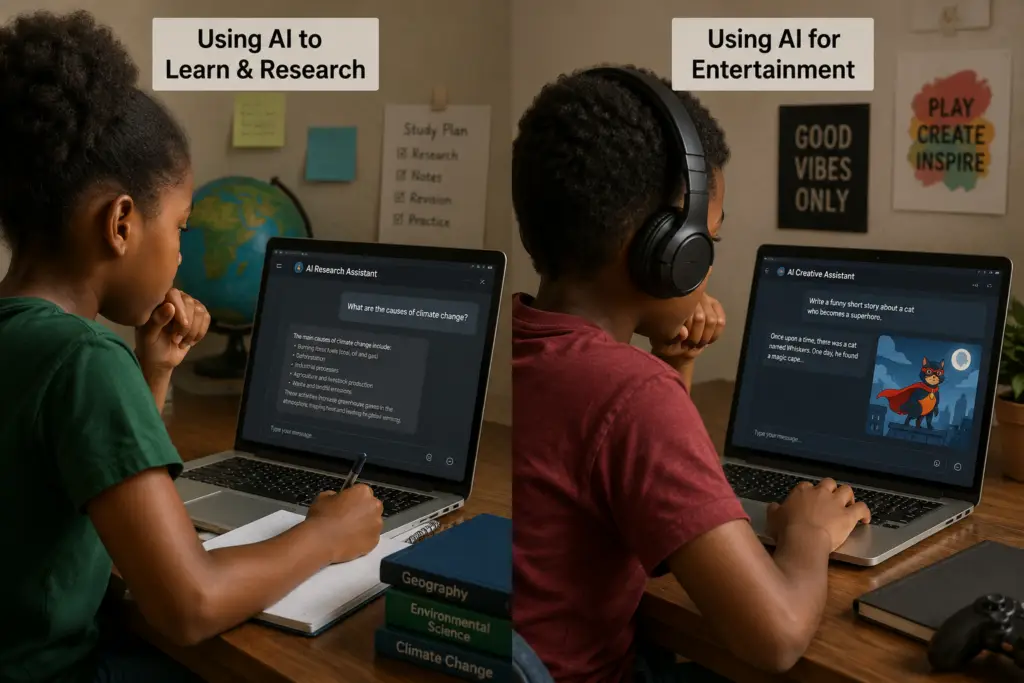
Because I’ve seen children who have never written a single line of code use AI to understand science, improve their writing, practise public speaking, explore business ideas, and satisfy a curiosity that their classrooms simply didn’t have enough time to entertain.
I’ve also watched children with the same technology spend an entire afternoon asking AI to generate cartoons, tell jokes, or settle imaginary battles between superheroes.
The device was the same.
The internet connection was the same.
The difference was the child sitting behind the screen.
That difference wasn’t talent.
It was habit.
And habits, unlike talent, can be intentionally cultivated.
Habit One: They Ask Questions That Make Thinking Unavoidable
Here’s something many adults haven’t noticed yet.
AI doesn’t simply reward knowledge.
It rewards curiosity.
Most people approach AI the same way they approached Google. They type the first thing that comes to mind, skim the answer, and move on. An AI literate child behaves differently because they understand that the quality of an answer usually rises or falls with the quality of the question that produced it.
Instead of asking,
“Tell me about climate change.”
They ask,
“Why do some countries experience drought while others experience flooding? Explain it the way you would teach a twelve-year-old, then show me how it affects Africa.”
See the difference?
The first child is collecting information.
The second child is building understanding.
Those are two very different activities, and only one of them compounds over a lifetime.
Parents should spend less time worrying about whether children know every answer and far more time celebrating thoughtful questions. Curiosity is one of the few abilities that becomes more valuable as technology becomes more powerful.
Habit Two: They Learn to Challenge Information—Respectfully
Let’s settle something before it becomes a problem.
AI is remarkably capable.
It is also remarkably capable of making mistakes.
That’s not a contradiction. It’s simply the reality of an evolving technology.
An AI literate child understands this early. They don’t become cynical, assuming every answer is wrong, neither do they become naïve enough to believe every polished response they receive. They develop the discipline of checking sources, comparing perspectives, and asking follow-up questions whenever something feels incomplete.
That habit reaches far beyond artificial intelligence.
It shapes the kind of adult they eventually become.
Because the people who thrive in the future won’t necessarily be those surrounded by the most information. They’ll be the ones who know how to separate reliable information from convincing nonsense.
That has always been a valuable skill.
AI has simply made it indispensable.
Habit Three: They Create More Than They Consume
This may be the habit that changes everything.
Walk into almost any home and you’ll find children consuming content from morning until night. Videos become hours. Hours become days. Days quietly become years, and somewhere along the way, creativity gives way to passive entertainment.
Technology didn’t cause that.
It merely made it easier.
Now imagine a different child.
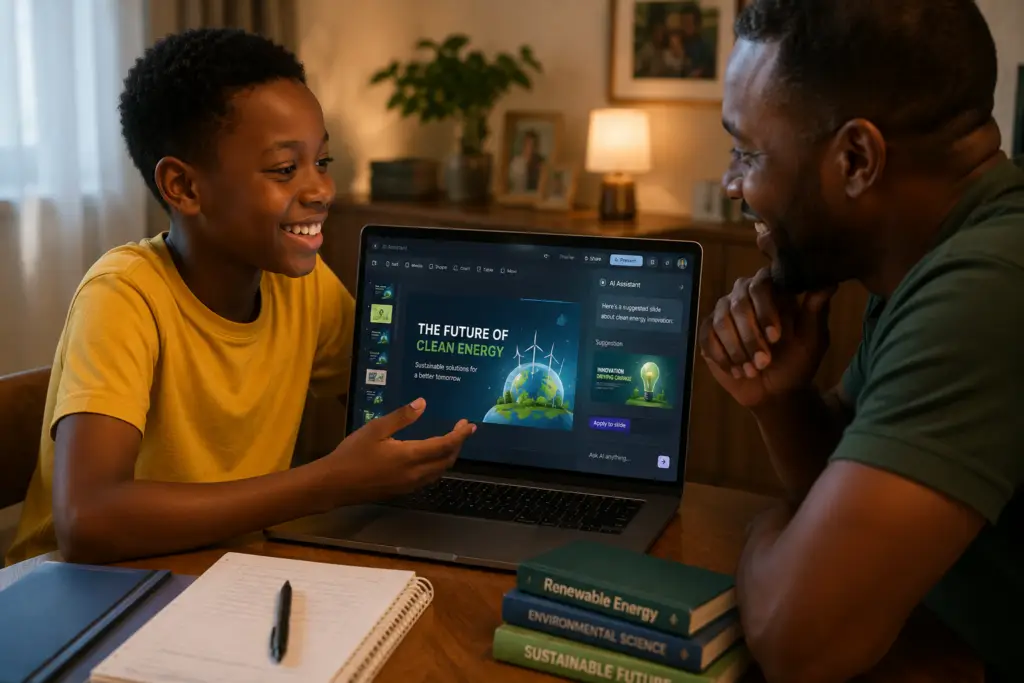
A child who uses AI to draft stories they later improve with their own imagination. A child who designs presentations, creates illustrations for school projects, practises speeches before competitions, brainstorms business ideas, or asks AI to explain concepts they didn’t fully understand in class.
That child is building something.
Even when the first attempt isn’t impressive, the habit itself is quietly shaping a creator instead of merely producing another consumer.
The internet rewarded people who could publish.
The AI era rewards people who can create consistently.
That’s a distinction worth teaching early.
Habit Four: They Fall in Love With Learning Itself
Everything we’ve discussed leads here.
Because tools change.
Software changes.
Even AI will change.
The children who flourish twenty years from now won’t succeed because they mastered today’s chatbot. They’ll succeed because they never stopped becoming better learners.
Think about it for a moment.
Schools eventually end.
Formal education eventually ends.
The habit of learning doesn’t have to.
An AI literate child sees every unfamiliar topic as an invitation rather than an inconvenience. They become comfortable saying, “I don’t understand this yet,” because they know that understanding is usually just a few thoughtful questions away.
That mindset quietly transforms everything else.
It makes careers more resilient.
Businesses more innovative.
Communities more adaptable.
And individuals far less intimidated by change.
Why This Matters So Much for African Families
For decades, many Africans have been forced to learn with fewer resources than much of the world. Libraries were limited. Educational materials were expensive. Access to experts often depended on geography rather than determination.
Artificial intelligence doesn’t erase those inequalities overnight.
But it changes the starting point.
Today, a curious child in Enugu, Kano, Port Harcourt, Kigali, Nairobi, Accra, or Lusaka can ask questions that previously required access to specialists or well-funded schools. The answers won’t always be perfect, but the opportunity to learn has become dramatically more accessible than it was even five years ago.
That opportunity should not be wasted.
Because every technological revolution rewards the people who engage with it early enough to shape their thinking before everyone else catches up. This isn’t an option. The World Economic Forum’s Future of Jobs Report 2025 projects that technological change -especially AI- is reshaping the skills employers value most, with analytical thinking, continuous learning, and AI-related capabilities becoming increasingly important across industries.
The Goal Was Never to Raise an AI Expert
Here’s the mistake many parents will make.
They’ll assume this conversation is about raising software engineers.
It isn’t.
Some AI literate children will become doctors who diagnose illnesses more effectively because they know how to work alongside intelligent tools. Others will become lawyers, architects, teachers, entrepreneurs, artists, scientists, pastors, or farmers who simply solve problems more intelligently than the generation before them.
The profession isn’t the point.
The habits are.
An AI literate child asks thoughtful questions. They verify before believing. They create instead of merely consuming, and they remain lifelong students even after classrooms become memories.
Those habits will outlive today’s technology.
They’ll remain valuable long after the apps we currently celebrate have disappeared and been replaced by something we can’t yet imagine.
That, perhaps more than anything else, is what parents should be preparing for.
Because the future rarely belongs to those who know the most.
It almost always belongs to those who never stopped learning.
If we can raise more children across Africa with those habits, we won’t simply be preparing them to use artificial intelligence.
We’ll be preparing them to shape the future that artificial intelligence is helping to create.
We’ll be preparing every child become an ai literate child.
Continue your journey with The Prepared Child to discover practical strategies for raising confident, capable learners in the AI age. Visit For Parents for actionable guidance you can begin applying at home today, and explore About House of Chrys to learn why we believe Africa’s greatest investment isn’t artificial intelligence itself—it’s the children who will one day decide what to do with it.
In all things, prepare.