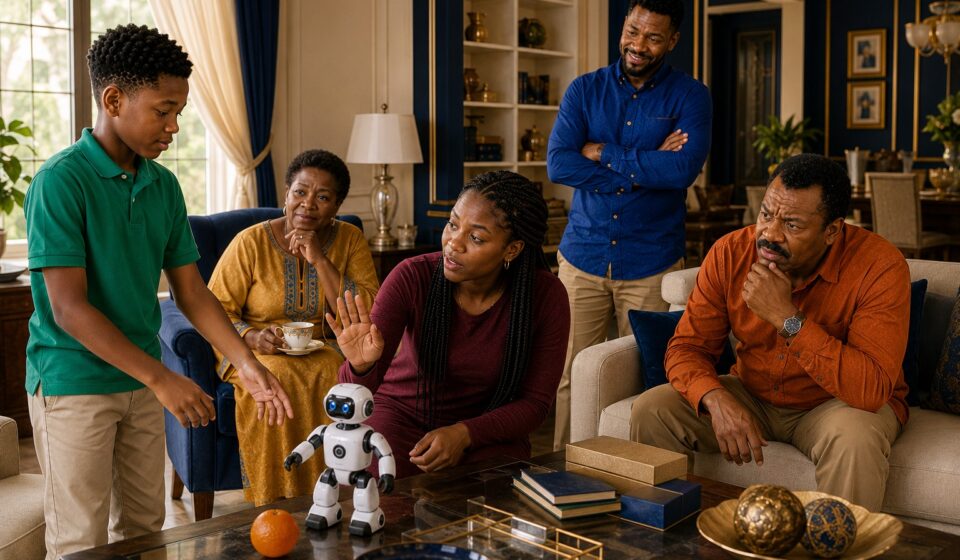

The small robot had been staring at the orange for almost thirty seconds.
Hector stared back.
“So?”
Nothing.
Hector moved the orange closer.
Still nothing.
From behind him, Ada whispered, “Don’t help it.”
“I wasn’t.”
“You were about to.”
“I was just moving the orange.”
“Exactly.”
Hector slowly put it back on the table.
Across the room, Mr. Okoro was watching the experiment with the seriousness of a football coach observing a penalty kick.
“This machine is not ready,” he announced.
Mummy Chrys, sitting by the window with a cup of tea, looked over.
“Or perhaps you haven’t taught it properly.”
Everyone turned toward her.
Mr. Okoro frowned.
“Teach a machine?”
Mummy Chrys shrugged.
“You teach children. Why should a machine be different?”
Chrys smiled.
That was the moment the experiment changed.
They weren’t going to spend the afternoon simply using AI.
They were going to figure out how to learn AI for kids—by experimenting, making mistakes and discovering what the technology could actually do.
What Does It Actually Mean to Learn AI?
If a child asks, “What is AI?” it is tempting to give them a definition.
Artificial intelligence is technology that enables computers to perform tasks that can involve things such as recognizing patterns, making predictions, understanding language or generating content.
But memorizing that sentence isn’t really learning AI.
A child who understands AI should gradually be able to ask:
How does it work?
Where does it get its information?
Why does it sometimes get things wrong?
How can I test it?
What can I create with it?
What should I never give it?
That is why learning AI should be treated more like learning science than memorizing computer vocabulary.
1. Start by Finding AI in Everyday Life
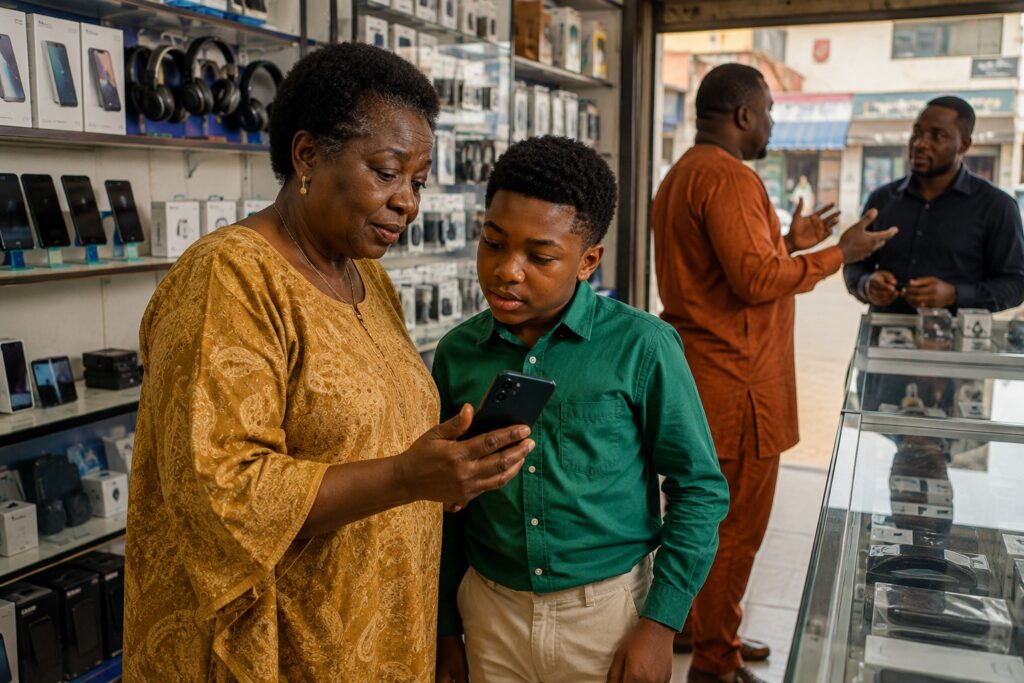
The following morning, Hector and Mummy Chrys went to a small electronics shop with Mr. Okoro.
Hector noticed something interesting.
The shopkeeper’s phone was suggesting products based on previous activity.
Outside, a delivery driver was using a navigation app.
Inside, a security camera was analyzing movement.
Hector suddenly stopped.
“Is all of that AI?”
Mummy Chrys didn’t answer immediately.
Instead, she asked:
“What do you think?”
Hector looked around.
“I think some of it is.”
“Why?”
He pointed toward the phone.
“Because it’s making a prediction about what someone might want.”
Mummy Chrys nodded.
“Good. Now you’re investigating instead of guessing.”
This is one of the easiest ways to begin learning AI.
Children can walk around their homes, schools or communities and identify places where AI might be involved.
They can investigate:
- Recommendation systems
- Voice assistants
- Smartphone cameras
- Navigation apps
- Search engines
- Translation tools
- Online shopping systems
- Facial or image recognition
The goal isn’t to label everything as “AI.”
The goal is to make children curious about how technology works.
2. Experiment With How Machines Learn
Back at the House, Ada had prepared a challenge.
She placed three bowls on the floor.
One contained bottle caps.
One contained pencils.
One contained toy cars.
“Sort them,” she told Hector.
“That isn’t AI.”
“No.”
“Then why are we doing it?”
“Because I want you to understand something before we talk about machine learning.”
Hector sorted everything.
Then Ada changed the rules.
She secretly moved several objects into different categories.
Hector immediately noticed.
“You changed the examples.”
“Exactly.”
This is a simple way to introduce a powerful AI concept.
Many machine-learning systems learn patterns from examples.
Children can demonstrate the idea without needing advanced mathematics.
Give them examples.
Let them identify a pattern.
Introduce new examples.
See whether their prediction still works.
Then change the original examples.
What happens?
The experiment becomes a conversation about training data.
This is where how to learn AI for kids becomes much more interesting than simply watching AI demonstrations.
Children begin discovering that what goes into a system can affect what comes out.
3. Learn Prompting Through Challenges
That evening, Uncle Emeka arrived with a problem.
He had asked an AI tool to write a business advertisement.
He wasn’t impressed.
“It doesn’t understand my business.”
Ada looked at the screen.
“Your prompt says, ‘Write something good about my business.’”
“And?”
“That isn’t very specific.”
Uncle Emeka folded his arms.
“What should I have said?”
Ada turned to Hector.
“You answer.”
Hector thought for a moment.
“Tell it what you’re selling.”
“Okay.”
“Tell it who you’re selling to.”
“Continue.”
“Tell it what you want the person to do.”
Uncle Emeka stared at him.
“So the child is teaching me prompting?”
“Apparently,” Ada said.
Prompting is an excellent way for children to learn that clear instructions produce better results.
Give a child a simple challenge:
Ask an AI system to explain the same subject three different ways.
For example:
- Like you’re explaining it to a five-year-old.
- Using a football analogy.
- Using a short story.
Then compare the answers.
Which explanation is clearest?
Which contains information that needs checking?
Which prompt produced the best result?
Now the child isn’t merely asking AI questions.
They’re conducting an experiment.
4. Make AI Prove Its Answer
The next challenge came from Chrys.
He placed two sheets of paper on the veranda.
“One contains facts.”
“And the other?”
“AI-generated statements.”
Hector looked suspicious.
“Which is which?”
“That’s your job.”
The experiment became a fact-checking game.
Children could ask an AI system questions about animals, history, science or geography.
Then they choose several answers and investigate them using reliable sources such as books, educational websites, museums, universities or official organizations.
Some answers may be correct.
Some may be incomplete.
Some may be completely wrong.
That discovery is important.
AI can sound confident even when an answer is inaccurate.
So one of the most important lessons in how to learn AI for kids is this:
Never confuse confidence with correctness.
A child who learns to verify information is developing a skill that goes far beyond artificial intelligence.
It is digital literacy.

5. Create Something With AI
The most exciting stage isn’t asking what AI can do.
It’s asking:
What can I make?
Ada challenged Hector to create something useful.
He chose a story generator.
Then he changed his mind.
He wanted to create a simple AI-powered system that could recognize different objects.
Then he changed his mind again.
“Why do I keep changing the project?”
Ada laughed.
“Because you’re designing.”
Children can experiment with:
- Image classification
- Story generation
- Simple chatbots
- Sound recognition
- Pattern recognition
- AI-assisted artwork
- Small coding projects
- Educational games
They don’t need to build a sophisticated commercial AI system.
A small experiment can teach enormous lessons.
What problem are you solving?
What information does the system need?
What happens when it makes a mistake?
How can you improve it?
That is where creativity and engineering meet.
6. Learn Coding Alongside AI
Not every child needs to become a programmer.
But coding can give children a deeper understanding of what happens underneath digital tools.
A child can start with basic concepts such as:
Input → Process → Output
Then move into:
If → Then
Variables
Loops
Conditions
Functions
Eventually, interested children can explore programming languages and machine-learning concepts.
The important thing is not to rush.
A child who understands logic first will have a much stronger foundation when programming becomes more complicated.
And coding introduces a valuable psychological shift.
Instead of thinking:
“Someone made this technology.”
The child begins thinking:
“Someone designed this. Maybe I can design something too.”
7. Teach AI Ethics and Privacy Early
The final lesson happened unexpectedly.
Hector was showing his younger neighbour an AI image tool when the boy asked:
“Can I upload my picture?”
Hector stopped.
He remembered something Mummy Chrys had said.
“Ask first.”
“Ask who?”
“Your parent.”
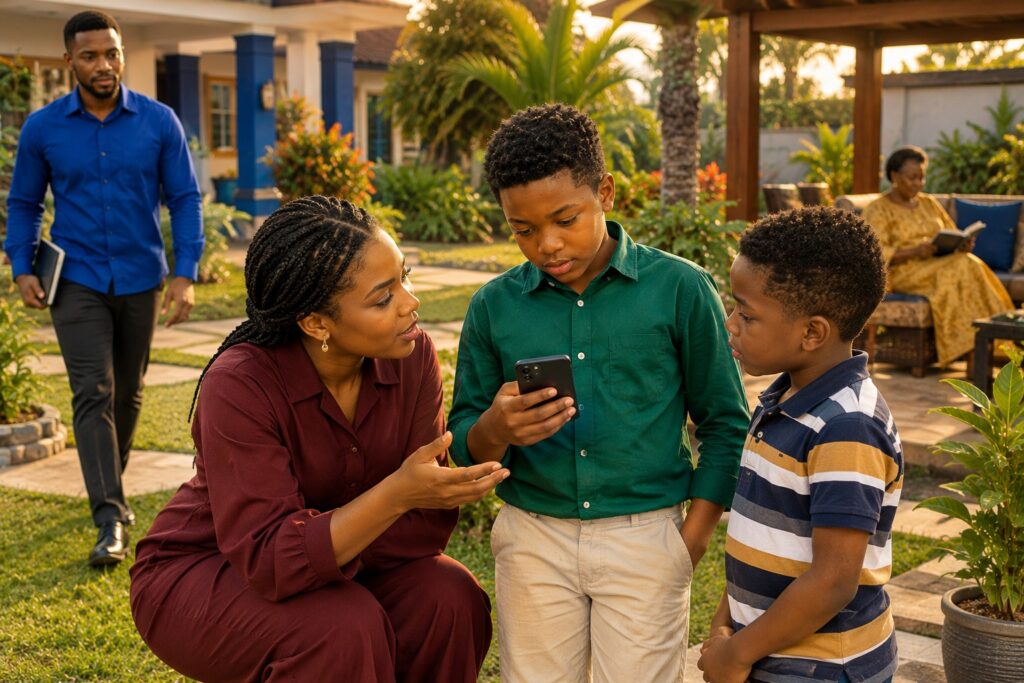
It is easy to teach children how to use AI.
It is harder—and more important—to teach them when not to use it.
Children should understand that they should be careful about entering or uploading:
- Full names
- Addresses
- School information
- Passwords
- Private photographs
- Personal conversations
- Financial information
- Information about other people
UNICEF’s guidance on AI and children emphasizes areas including safety, privacy and data protection, fairness, transparency and children’s well-being.
Children also need to understand that AI-generated images, videos and text can be misleading.
Learning AI therefore isn’t just about technology.
It is also about judgment.
A Simple 4-Week AI Learning Plan for Kids
Parents don’t need to turn the process into school.
A simple four-week challenge can work.
Week 1: Discover
Find ten examples of technology that may use AI.
For each one, ask:
What is it doing?
Week 2: Experiment
Try a simple AI activity involving images, sounds, patterns or prompts.
Record what happened.
Week 3: Question
Give AI several questions.
Check its answers against reliable sources.
Write down the mistakes.
Week 4: Create
Build something small.
A story.
A game.
A classification experiment.
A coding project.
A simple prototype.
Then explain it to someone else.
That last step matters.
If a child can explain what they built, why it works, where it failed and what they would change, they are moving beyond simply using AI.
They are beginning to understand it.
What Should Parents Avoid?
There is one trap worth avoiding.
Don’t make AI the child’s shortcut for everything.
If a child has homework, don’t immediately say:
“Ask AI.”
Instead ask:
“What have you tried?”
If they want an answer, ask:
“What do you think first?”
If AI gives them an explanation, ask:
“How could we check that?”
And if AI creates something for them, ask:
“Could you make your own version?”
The objective is not to keep children away from AI.
It is to prevent AI from replacing the mental muscles they are supposed to be developing.
UNICEF’s work on children’s AI literacy similarly emphasizes preparing children to navigate an AI-shaped world while maintaining agency, critical thinking and broader transferable skills.
The Orange Finally Moved
It was almost sunset when everyone returned to the living room.
The little robot was back on the floor.
The orange was placed in front of it.
Mr. Okoro folded his arms.
“Let’s see.”
Hector didn’t touch anything.
Ada didn’t touch anything.
Chrys didn’t touch anything.
Mummy Chrys watched from the sofa.
The robot moved.
It stopped.
Then it moved again.
Everyone leaned forward.
Finally, it reached the orange.
Mr. Okoro raised both hands.
“Victory!”
Hector laughed.
“It wasn’t victory.”
“What do you mean?”
“We changed the training examples.”
Ada nodded.
“And tested it again.”
Chrys added, “And we learned why the first attempt failed.”
Mummy Chrys smiled.
“So the machine wasn’t the lesson.”
Hector looked at the robot.
“No.”
“What was?”
Hector thought about the electronics shop, the sorting experiment, the prompts, the fact-checking exercise, the privacy discussion and the little project they had started in the workshop.
Then he answered:
“Learning how to think about technology.”
And that is perhaps the best answer to the question of how to learn AI for kids.
Children don’t need to begin with complicated mathematics or sophisticated programming.
They can begin with curiosity.
They can notice AI.
Ask questions.
Run experiments.
Make predictions.
Check answers.
Build things.
Make mistakes.
Try again.
And eventually, teach somebody else.
The technology will keep changing.
The ability to think critically about it will matter much longer.
Frequently Asked Questions
How can kids learn AI at home?
Children can learn AI at home by identifying AI in everyday technology, experimenting with beginner-friendly tools, learning basic machine-learning concepts, practicing prompting, fact-checking AI answers and creating small projects.
What is the best age to start learning AI?
There is no single perfect age. Younger children can learn through simple games, stories, patterns and everyday examples, while older children can gradually explore coding, machine learning, data and AI ethics.
Do kids need coding to learn AI?
No. Coding is useful but isn’t required to begin. Children can first learn about patterns, data, prompting, verification and responsible AI use.
Should children use AI for homework?
AI can sometimes support learning, but children should not simply copy AI-generated answers. They should understand the material, verify information and follow their school’s rules concerning AI use.
What is the most important AI skill for kids?
Critical thinking is one of the most important foundations. Children should learn to question AI outputs, verify information, understand limitations and make their own judgments.
Is AI safe for children?
AI can be useful for children when age-appropriate tools and appropriate safeguards are used. Parents should pay particular attention to privacy, personal information, online interactions, generated content and the accuracy of AI responses.
Final Thought
The future probably won’t belong to children who simply know how to ask an AI for answers.
It will belong to children who know which questions to ask, which answers to challenge, what to create and when to think for themselves.
That’s why learning AI shouldn’t begin with:
“What can AI do for me?”
It should begin with:
“What can I discover?”