7 AI Science Projects for Kids That UrgentlyTurn Curiosity Into Real Experiments

“Your machine is cheating.”
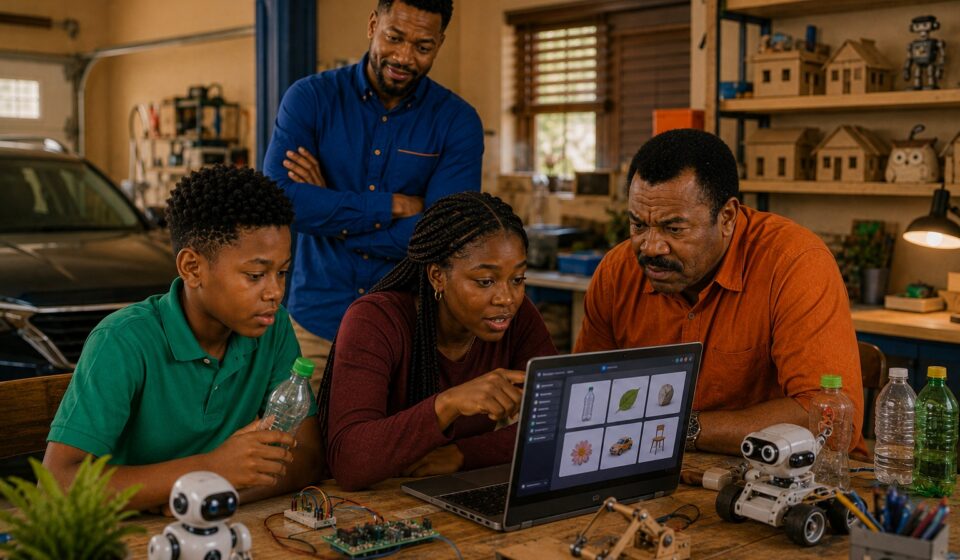
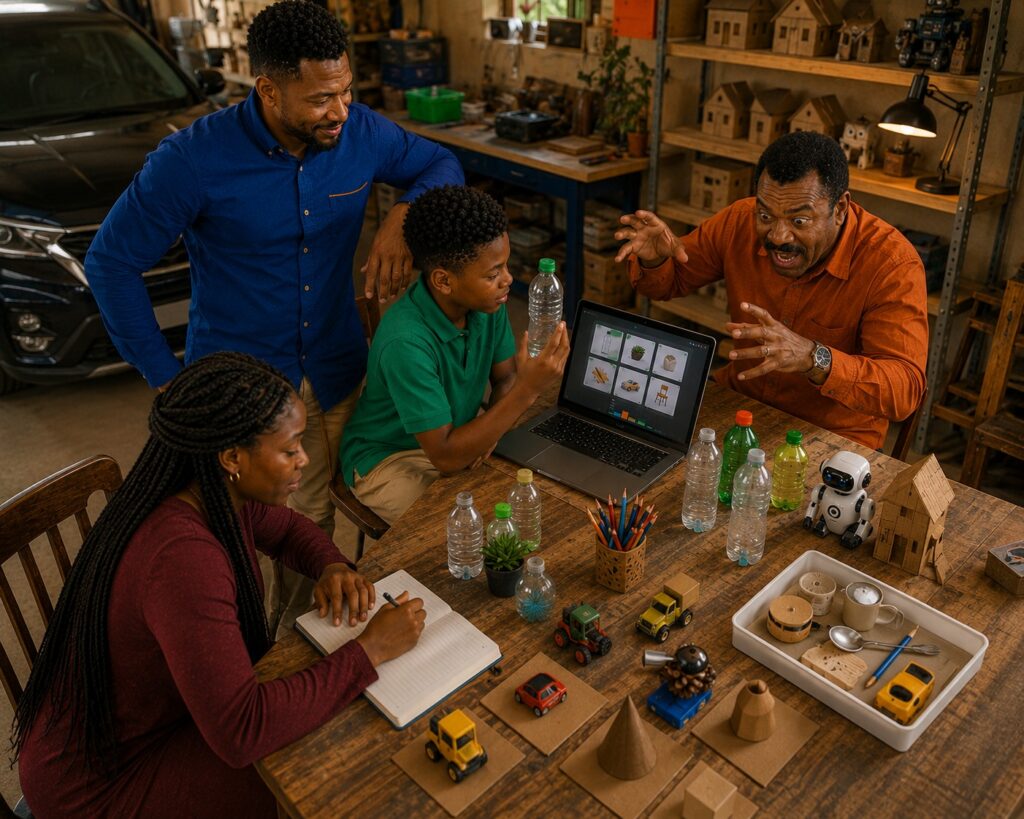
Mr. Okoro stood in the middle of the House of Chrys garage holding a cardboard box as though he had just discovered evidence in a criminal investigation.
Ada looked up from the laptop.
“It is not cheating.”
“It gave the wrong answer.”
“That doesn’t mean it cheated.”
Mr. Okoro pointed accusingly at the screen.
“It said this was a bottle.”
Ada looked at the object in his hand.
“It is a bottle.”
“No.” Mr. Okoro shook his head. “It is my malt drink bottle. That is different.”
From the doorway, Chrys folded his arms.
“I think we’ve discovered our first problem.”
“What problem?” Mr. Okoro asked.
“You are arguing with a machine without asking how you trained it.”
Hector, who had been sitting on an old wooden stool nearby, leaned forward.
“So we can teach the computer?”
Ada smiled.
“Now you’re asking the right question.”
And that was how an ordinary Saturday at the House of Chrys turned into an unexpected lesson in AI science projects for kids.
What Makes a Good AI Science Project for Kids?
A good AI science project should not simply put a child in front of an AI chatbot and ask it questions.
The interesting part is experimentation.
Children can investigate how machines recognize patterns, how training data affects results, why computers sometimes make mistakes and how humans can improve a system.
UNESCO’s AI competency framework encourages students to move from understanding AI to applying it and eventually creating with it. That makes hands-on experiments particularly useful because children are not merely hearing about AI—they are observing what happens when they change inputs, test results and make decisions.
That was exactly what Ada had in mind.
She placed three objects on the workbench: a bottle, a pencil and a toy robot.
“Let’s see if we can teach the computer to tell them apart.”
1. Build a Simple Image Classifier
This is one of the most accessible AI science projects for kids because children can actually train a machine-learning model.
A tool such as Google’s Teachable Machine allows users to gather examples, train a model and test it without needing to write code. It can work with images, sounds and poses.
Ada placed several bottles in front of the camera.
Then pencils.
Then toy robots.
Hector watched the numbers change on the screen.
“What happens if I show it something it hasn’t seen?”
Ada grinned.
“Excellent. That’s the experiment.”
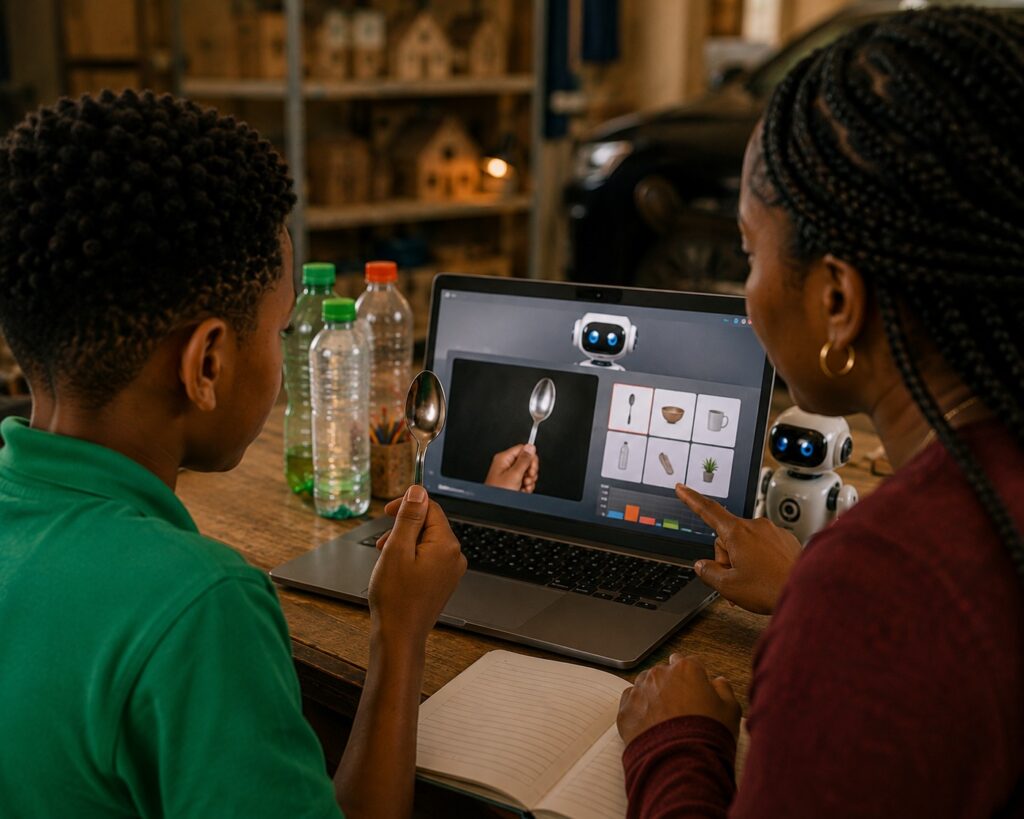
She held up a spoon.
The computer hesitated.
Everyone laughed.
But Chrys didn’t.
“That mistake is more interesting than getting it right.”
Why?
Because the child has discovered something fundamental: an AI model does not magically understand an object the way a human does. It learns patterns from examples.
2. Teach AI to Recognize Sounds
The next experiment required no bottles.
Mummy Chrys discovered that from the veranda.
She was sitting comfortably outside with a notebook beside her when she heard three strange noises from the garage.
Clap.
Clap-clap.
Whistle.
She raised an eyebrow.
“What exactly are those children doing?”
Chrys stepped onto the veranda.
“Science.”
Mummy Chrys nodded slowly.
“Science has become very noisy.”
The experiment was simple: train a model to distinguish between different sounds.
The children could collect examples of clapping, snapping fingers, knocking on a table or making another safe sound, then test whether the model could classify sounds it had not heard before.
The important lesson isn’t simply whether the computer succeeds.
Children can ask:
Which sounds did it confuse? Why? Did we give it enough examples? Were the examples too similar?
Those questions turn an entertaining activity into scientific investigation.
3. Make a Machine-Learning “Guess the Object” Experiment
By afternoon, Mr. Okoro had become competitive.
“I can beat this machine.”
Ada laughed.
“You haven’t even trained it properly.”
“I don’t need training.”
“That,” Chrys said, “is exactly what someone says before losing to a computer.”
The challenge was simple.
The children trained their model using several categories of everyday objects. Then someone presented a new object.
The model made a prediction.
The human made a prediction.
They recorded both.
After ten or twenty trials, they compared the results.
Suddenly, the garage had become a tiny laboratory.
Children can turn this into a proper science-fair project by keeping track of:
- What objects were used for training
- How many examples were collected
- Which objects were recognized correctly
- Which objects were confused
- How the model performed after adding better examples
This introduces children to an important scientific habit: measure before you conclude.
NASA’s STEM resources similarly emphasize designing, testing, evaluating and improving solutions rather than simply building something once and declaring it finished.
4. Test Whether AI Can Recognize Different Poses
Hector’s older cousin had arrived, and suddenly the garage became a miniature dance studio.
“Stand like a superhero,” Ada ordered.
Mr. Okoro refused.
“I am a businessman.”
“You can be a businessman superhero.”
“That is more reasonable.”
The experiment used pose recognition.
Children could create categories based on simple body positions—for example, standing with both arms down, raising one arm or stretching both arms sideways—and test whether an AI model could distinguish them.
The fun part comes when the child deliberately changes something.
What if the person turns sideways?
What if the lighting changes?
What if someone wears a large jacket?
What if the camera moves?
Children begin discovering that AI systems can behave differently when the conditions change.
That is science.
Not “the computer is smart.”
The conditions changed, so the result changed. Why?
5. Create an AI Recycling Sorter
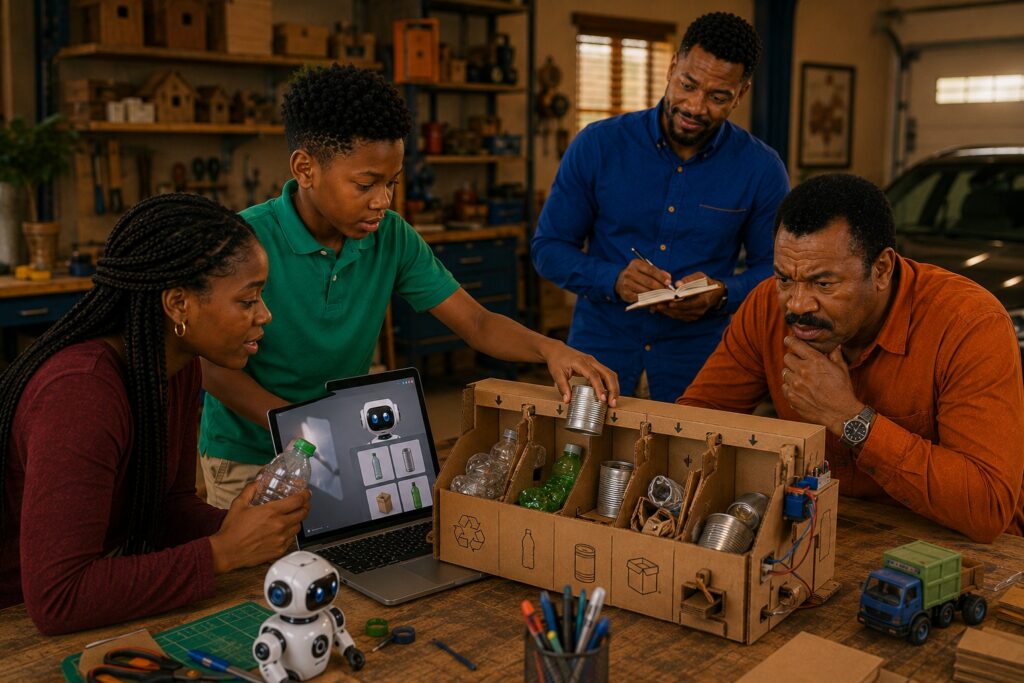
By evening, the cardboard box Mr. Okoro had brought earlier finally made sense.
Ada wanted to build a miniature recycling station.
The prototype did not need motors or complicated machinery.
They could make cardboard compartments labelled by category and train an image classifier to distinguish between different types of objects.
Plastic bottle.
Paper.
Cardboard.
Other.
Then they could deliberately introduce objects that were difficult to classify.
The experiment could become a discussion about the difference between classification and understanding.
A computer may classify something according to patterns in its training examples, but that does not mean it understands the environmental consequences of throwing that object into the wrong bin.
That distinction matters.
AI can assist people.
It does not remove the need for human judgment.
6. Investigate AI Bias With a Fairness Experiment
This was the experiment that made everyone stop joking.
Mummy Chrys came into the garage—not from the kitchen, but from the veranda—and watched Ada rearrange the training examples.
“What are you changing?”
“The examples.”
“Why?”
“Because we want to see whether changing the examples changes the results.”
That question became the heart of the experiment.
Children could create two small datasets that are deliberately different—for example, giving a model many more examples of one type of object than another—and then test whether the imbalance affects performance.
The lesson is not that the child has built a sophisticated real-world fairness system.
The lesson is simpler:
The information given to an AI system can influence what the system produces.
AI4K12’s educational framework identifies societal impact as one of the major ideas students should encounter when learning about AI.
Mummy Chrys looked at the laptop.
“So the machine isn’t necessarily the only problem.”
Ada nodded.
“Sometimes we have to examine what we gave the machine.”
Mummy Chrys smiled.
“Now that sounds like education.”
7. Build an AI Science Fair Challenge
The final project wasn’t one project.
It was a challenge.
Each child had to choose a question.
Not:
“What is AI?”
But:
- Can an AI model recognize my drawings?
- Can it distinguish between different sounds?
- Does adding more training examples improve accuracy?
- Does lighting affect image recognition?
- Can an AI model distinguish between objects it has never seen before?
- What happens when the training data is unbalanced?
Then came the most important rule.
Make a prediction before testing.
That turns an AI activity into an investigation.
Children can record their hypothesis, method, observations, results and conclusion just like they would with other science projects.
And if the AI fails?
Even better.
A failed prediction can produce a better science project than a perfect demonstration because the child now has something to investigate.
The House of Chrys Rule: Don’t Let AI Do the Thinking
Later that night, Hector found Chrys outside.
The garage was quiet.
The cardboard sorter sat unfinished beside the wall.
“So,” Hector asked, “does making AI projects mean we’re becoming programmers?”
“Not necessarily.”
“Scientists?”
“Maybe.”
“Engineers?”
“Sometimes.”
Hector thought about it.
“What are we really learning?”
Chrys looked toward the garage.
“How to ask better questions.”
That answer stayed with Hector.
Because the most valuable part of AI science projects for kids isn’t the laptop, the camera or even the AI model.
It is the habit of asking:
What happened?
Why did it happen?
What changed?
Can I test it again?
What did I get wrong?
What should I change?
That is the mindset that turns technology into science.
Parents can also connect these activities with lessons from 7 Artificial Intelligence Lessons Every Parent Can Teach Their Child at Home This Weekend, especially when discussing responsible AI use, critical thinking and experimentation.
And there is another lesson children need as their experiments become more sophisticated: privacy.
UNICEF’s current guidance on AI and children emphasizes safety, privacy and data protection, as well as preparing children to participate responsibly in an AI-shaped world.
So children should avoid experimenting with sensitive personal information, private photographs or other people’s data without permission. UNICEF also notes that children may share information such as their school, routines, friendships or feelings without realizing how sensitive that information can be.
The goal is not to frighten children away from AI.
It is to teach them how to explore it intelligently.
Back inside the garage, Mr. Okoro suddenly shouted.
“The machine has changed its answer!”
Ada rushed over.
Hector followed.
Mummy Chrys appeared at the doorway.
Chrys smiled.
Nobody had told the computer what to do.
They had changed the experiment.
And now they had another question to investigate.
That was the real project.
Frequently Asked Questions
What are AI science projects for kids?
AI science projects for kids are hands-on activities that allow children to explore concepts such as machine learning, classification, pattern recognition, computer vision, sound recognition, testing and AI ethics.
Can young children do AI science projects?
Yes. Younger children can participate through simple experiments involving sorting, patterns, sounds and images, while older children can investigate datasets, model performance, bias and more advanced machine-learning concepts.
Does a child need to know coding?
No. Some beginner-friendly tools, including Google’s Teachable Machine, allow children to experiment with machine learning without writing code. More advanced projects can introduce programming later.
What should children learn from an AI project?
The biggest lesson should not be “AI is intelligent.” Children should learn to observe, make predictions, test ideas, analyze mistakes and understand that AI systems depend on data, design and human decisions.
Are AI projects safe for children?
They can be when adults choose age-appropriate activities and establish clear rules around privacy, personal information, photographs, accounts and online tools. UNICEF recommends child-centred approaches that prioritize safety, privacy, transparency and children’s well-being.