
Artificial Intelligence for Kids Guide to Getting Started

Your child asks a smart speaker for a joke. Seconds later, their video feed fills with recommended cartoons. They don’t see the complex technology at work—they just experience a world that seems to know them.
That world is being rewritten by machine learning and data. This powerful technology shapes everything from the apps we use to the systems running our cities. Understanding it is no longer optional.
This guide is your map. We define this living technology not as a complex theory, but as the pattern-recognition and decision-making systems already shaping your child’s daily life.
Learning about it today is a fundamental right. It prepares young minds to be thoughtful creators and informed users, not just passive consumers. We cut through the hype to show you the core concepts in a way you both can grasp immediately.
You will see concrete examples in your child’s daily routine, making the abstract suddenly tangible. We lay out the powerful benefits—this is about building critical thinking, creativity, and future-ready citizenship.
Most importantly, we provide a clear, step-by-step roadmap. From block-based coding to hands-on projects, knowing is not enough. Doing is what truly prepares.
Key Takeaways
- This technology is already a part of your child’s world, from games to video recommendations.
- Early learning builds crucial skills like problem-solving and logical thinking.
- Understanding these systems helps children become informed users and creative builders.
- Core concepts like machine learning and pattern recognition can be taught in simple, engaging ways.
- Practical, hands-on projects are the best way to build real understanding and confidence.
- Parents have a vital role in guiding this learning journey with the right tools and resources.
- Starting today prepares your child for the opportunities and challenges of a tech-driven future.
Why Your Child’s Future Demands AI Literacy Today
We are no longer preparing children for a future with technology; they are living inside it now. This isn’t a distant concept. It’s the reality of their daily lives.
Smart systems shape what they watch, the games they play, and even how they communicate. The biggest impact of this explosion in technology is on this generation.
Both Gen Z and Gen Alpha are growing up alongside it. Because of their unique position, their education must include understanding these tools.
This knowledge is not a niche subject for computer scientists. It is the foundational layer of their world—from healthcare and finance to art and social interaction.
Without this literacy, your child risks becoming a passive consumer. They could be guided by systems they don’t understand, rather than shaping their own path.
This is about more than career readiness. The data is stark. The World Economic Forum projects artificial intelligence and machine learning jobs to grow by 71% in the next five years.
It is about cultivating essential skills today. We need critical thinking to question a system’s outputs. We need problem-solving to work alongside it. Ethical reasoning must guide its use.
AI literacy is the new digital citizenship. It empowers young minds to navigate a landscape of smart assistants and recommendation engines. They gain awareness and agency.
The gap between those who understand these systems and those who don’t will widen rapidly. Starting this learning journey now is the most protective action you can take.
This is not a cause for panic—it is a certainty. Your child’s future demands this knowledge. You are the catalyst. Their intelligence and creativity, guided by understanding, will define what comes next.
Demystifying Artificial Intelligence for Kids: Core Concepts Explained
The term ‘artificial intelligence’ can sound like science fiction. Its core is a simple, learnable process. We break it down into clear concepts your child can grasp.
This is about understanding the engine behind the smart world. It is not magic. It is a logical sequence of input, processing, and output.
Your child already uses these principles in daily life. Now, we give them the language to understand how machines do it too.
What is Machine Learning? Teaching Computers to Learn
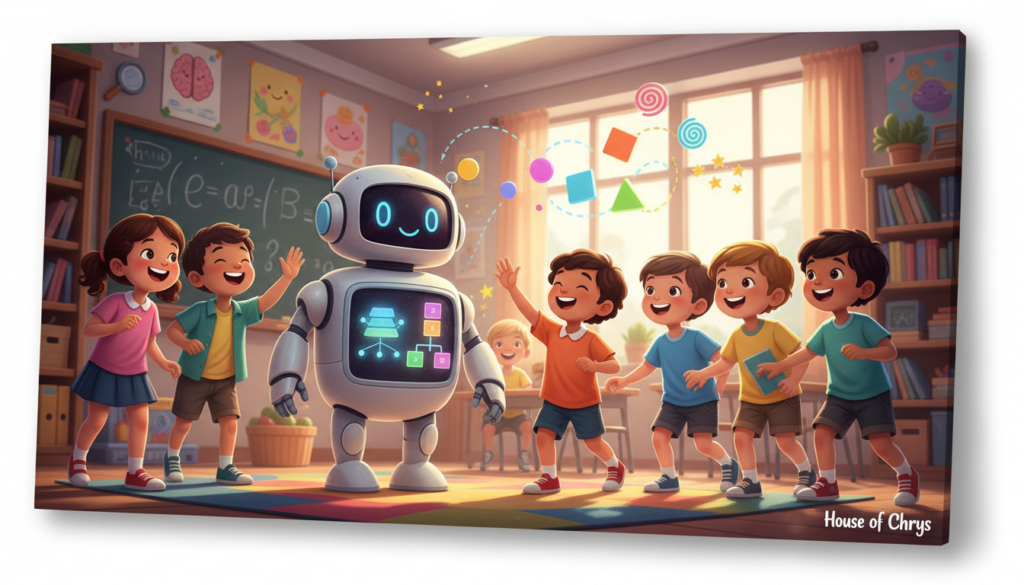
Machine learning is the powerful engine inside many smart systems. It is how we teach a computer to learn from information.
Think of showing a child thousands of cat pictures. Soon, they can spot a cat anywhere. A machine learns the same way.
You feed it vast amounts of data—like those images. The computer finds common patterns. It builds its own rules for identification.
This is learning from experiences. The machine gets better with more examples. It adjusts its internal model with each new piece of information.
Machine learning turns raw data into understanding. It is the first step in creating a thinking tool.
Pattern Recognition: How AI Sees the World
Your child knows a dog is a dog by its shape, sound, and fur. That is natural pattern recognition.
AI does this with data. It scans numbers, sounds, and images to find repeating patterns. These patterns become its guide to the world.
A smart assistant recognizes your voice. A photo app sorts pictures of friends. These systems are brilliant pattern spotters.
This skill lets machines make decisions. They compare new input to learned patterns. Then, they predict or classify what it is.
Understanding this removes the mystery. Your child sees AI as a tool that observes, just like they do.
From Training to Decisions: How an AI Model Works
Training an AI is like coaching a young athlete. You provide clear examples. You give feedback on right and wrong answers.
Through repetition, the system gets smarter. Its accuracy improves. This phase is called machine learning.
The trained model then faces new data. It uses the patterns it recognized. It applies the rules it inferred during training.
Finally, it makes a decision or prediction. Is this new image a cat? Should this song be recommended? The model decides.
Consider a child learning to read. They see the letter “A” many times. They learn its pattern. Soon, they recognize it in any book.
AI follows the same logical path. Input data, process patterns, learn, then output a decision. It is a step-by-step system.
| Learning Step | Human Child | AI System |
|---|---|---|
| Input | Experiences, sights, sounds, instructions | Data sets (images, numbers, text) |
| Processing | Brain identifies patterns and connections | Algorithms analyze data for patterns |
| Learning | Adjusts understanding based on feedback | Adjusts internal model weights and parameters |
| Output | Recognition, decision, or new skill | Prediction, classification, or action |
| Improvement | Practice and more varied experiences | More training data and feedback loops |
Demystifying these concepts builds a strong foundation. Fear is replaced with curiosity. Your child sees the technology as a set of tools.
These tools are built on understandable principles. They are not unknowable black boxes. This knowledge turns your child from a passive user into an informed explorer.
They begin to ask better questions. How did it know that? Could I build something similar? This is the start of true AI literacy.
AI in Action: Everyday Examples Kids Already Know and Use
Your child’s digital world is woven with invisible threads of decision-making systems they use without a second thought.
This is not a future scenario. It is the present fabric of their daily lives. The phone in your hand, the tablet on your couch—these devices host a silent, powerful intelligence.
Your child is already a daily user of the world’s most advanced technology. Recognizing these examples transforms a distant concept into a familiar force.
Awareness is the first step toward true literacy. When your young one sees the smart systems behind the screen, they move from passive consumption to curious questioning.
Smart Assistants and Chatbots: Siri, Alexa, and ChatGPT
When your child asks Siri for the weather or jokes with Alexa, they are doing more than getting an answer.
They are interacting with Natural Language Processing—NLP for short. This is a branch of artificial intelligence that understands and generates human language.
The computer listens to the sound waves of their voice. It breaks down the information into data it can analyze.
Then, it finds patterns in the words and their meaning. Finally, it crafts a response that sounds human.
Chatbots like ChatGPT or those in Discord work the same way. They read text messages, process the intent, and deliver a useful reply.
This activity is a direct conversation with machine learning. It shows how systems can comprehend the world around them through language processing.
Recommendation Engines: YouTube and Netflix
That YouTube feed that magically knows their favorite cartoons is no accident. It is a recommendation engine at work.
This smart system analyzes your child’s watch history. It notes every click, pause, and how long they spend on a video.
From this sea of information, the AI finds patterns in their preferences. It predicts what they will love next.
Netflix does this with movies and shows. Amazon suggests products based on past searches.
These engines are brilliant predictors. They shape the music, videos, and products presented to your family.
Understanding this turns a mysterious algorithm into a logical tool. It is a system designed to learn from their experiences.
Gaming and Interactive Entertainment
In popular game titles like Fortnite or Rocket League, the challenging “bots” are not real people.
They are AI players—smart programs that act like human opponents. These bots learn from countless experiences to become better competitors.
The ever-changing maps in these games are also shaped by AI systems. The technology creates unique landscapes and challenges every time.
This makes each play session fresh and exciting. It is interactive entertainment powered by adaptive technologies.
Your child is not just playing a game. They are engaging with a dynamic, learning environment. This is AI in its most playful form.
Facial Recognition and Photo Organization
Open your phone’s photo gallery. See how it automatically groups pictures of your family?
That is facial recognition AI in action. The software analyzes the geometry of each face in the images.
It scans patterns in the pixels—the distance between eyes, the shape of a smile. It uses this data to identify and organize faces with startling accuracy.
Phones like Google Pixel or iPhone use this same technology to unlock with a glance. It is a powerful form of pattern recognition.
Even the autocorrect on their homework document is a form of AI. It learns their common typos and vocabulary.
Then, it suggests corrections to improve their writing. This is machine learning applied to everyday language.
Maps and navigation apps like Google Maps use AI too. They analyze live traffic patterns and road conditions to suggest the fastest route.
These are not futuristic examples. They are the present-day tools your child uses.
Recognizing them builds a crucial bridge. It turns abstract thinking about smart systems into concrete understanding.
Your young one begins to see the world differently. They start to ask, “How did it know that?” This curiosity is the seed of true AI literacy.
The Powerful Benefits of Learning AI for Kids
The true power of learning about smart systems isn’t in mastering code—it’s in forging a new kind of mind. This journey reshapes how your child approaches the world. It builds a resilient, creative, and ethical thinker.
The benefits reach far beyond the screen. They shape how your young one thinks, creates, and engages with their future. This is about building a future-ready citizen.
You are not just adding a skill. You are cultivating a powerful mindset. This mindset sees problems as puzzles and data as a story waiting to be read.
Boosting Critical Thinking and Problem-Solving Skills
Training a model forces a young mind to deconstruct a challenge. They must analyze information, recognize patterns, and debug failures. This process builds relentless logic.
It teaches a structured approach to any problem. Your child learns to ask better questions. They move from “why did this break?” to “how can I fix it?”
This is more than an academic exercise. It builds real-world resilience. When a prediction is wrong, they learn to iterate and persevere.
Critical thinking becomes their default mode. They start to see the decision-making behind every app and game they use.
Fostering Creativity and Innovation
This is creativity’s new frontier. With the right tools, your child can generate stunning art or compose original music.
They can design interactive games that learn from the player. This blends technical skill with artistic imagination in ways once thought impossible.
These activities prove that technology and art are partners. Your young innovator learns to use algorithms as a paintbrush. They become a creator, not just a consumer.
The most powerful tool is not the machine itself, but the creative confidence to command it.
Building a Foundation for Future STEM Careers
You are laying groundwork for a future-proof path. The U.S. Bureau of Labor Statistics projects 13% growth in IT occupations from 2020 to 2030.
Skills in this domain will be the premium within that boom. This knowledge integrates all four STEM subjects seamlessly.
A biology dataset, a physics simulation, a mathematical model—they become parts of a cohesive, hands-on project. Abstract concepts in science and math turn concrete.
This education makes your child fluent in the language of the next century. It opens doors in healthcare, engineering, and countless transforming fields.
Becoming an Informed Digital Citizen
Beyond career, this is about modern citizenship. An AI-literate young person can spot algorithmic bias in a news feed.
They understand the privacy trade-offs of a “free” app. They navigate the digital world not as a subject, but as an informed participant.
This literacy is armor against manipulation. It empowers your child to question why a video was recommended or an ad was shown.
They shift from passive user to empowered advocate. This is the cornerstone of responsible, ethical engagement with technology.
The ultimate benefit is a confident, capable young mind. They gain a skill set, yes. More importantly, they gain a future-ready mindset equipped for the 21st century’s complexities.
Your Roadmap: How Kids Can Start Learning Artificial Intelligence
Knowing why your child needs this knowledge is one thing—knowing how to begin is another. This is your clear, step-by-step guide.
The path from curious user to confident creator is built with specific actions. We move from play to project to deep understanding.
This roadmap is progressive. Each step builds logical thinking and technical confidence. Your role is to provide the resources and encouragement.
Start with Block-Based Coding and Visual Platforms
The journey begins with play, not complex theory. Block-based platforms like Scratch or Code.org are perfect first steps.
Your child drags and drops colorful code blocks. They build the logic behind smart systems without typing a single line.
This visual coding teaches cause and effect. It introduces loops, conditions, and variables—the foundational concepts of all programming.
They see their commands come to life instantly. This immediate feedback builds excitement and demolishes the fear of a blank screen.
Explore Hands-On AI Activities and Projects
Move quickly from logic to tangible creation. Hands-on projects make abstract concepts real.
Connect learning to their passions with these age-bracketed activities:
- Ages 5-7: Train a drawing bot using Google’s Teachable Machine. They show it drawings, and the machine learns to recognize their sketches in minutes.
- Ages 8-12: Create a simple chatbot in Scratch. This teaches the basics of natural language processing through direct, creative building.
- Ages 13+: Develop a game using the RAISE AI playground. They can build a game controlled by hand gestures, exploring computer vision.
- Ages 13+: Teach the computer a classic game at Machine Learning for Kids. They train a model to play and see adaptive intelligence in action.
Project-based learning cements understanding. Your child doesn’t just hear about machine learning—they build a model that works.
Enroll in Structured AI Classes and Camps
Structured guidance accelerates the journey. A good course provides a curriculum, expert instruction, and a community of peers.
Seek out age-appropriate programs. For example, an “AI and Machine Learning: The Basics” camp for ages 8-10 might have students build a web app that recognizes images.
Older students can delve into “The Fundamentals” (ages 11-13) or “The Foundation” (ages 14-18). These courses turn isolated projects into a cohesive knowledge framework.
The classroom experience provides mentorship and deeper dives into ethics and real-world applications. It transforms curiosity into competence.
Experiment with Kid-Friendly AI Tools and Websites
Finally, provide open-ended tools for exploration. Dedicated platforms offer safe, scaffolded environments for experimentation.
Immerse your child in Code.org’s AI curricula. The “How AI Works” videos pair short lessons with interactive exercises.
Google’s Teachable Machine is a phenomenal sandbox. It lets young learners train models with their camera, microphone, or drawings—no code required.
Websites like Machine Learning for Kids bundle simple projects with accessible explanations. They connect the machine learning concepts to the code behind them.
This final step is about ownership. Your child moves from following a plan to asking their own questions. They begin to see these tools as their personal workshop for innovation.
The roadmap is clear. Start visual, get hands-on, seek structure, then explore freely. Your young learner’s first step is today.
Top Resources and Tools to Kickstart the AI Journey
Your child’s journey from user to creator begins with a single click on the right platform. The best resources are not locked behind paywalls—they are free, engaging, and designed for young minds.
This is your curated toolkit. Each entry here turns abstract concepts into tangible experiences. You provide the access; your child provides the curiosity.
We have filtered the noise. What remains are proven tools that deliver real understanding. Start with one. Build momentum with the first project.
Code.org’s AI Curricula and How AI Works Videos
Begin with the exceptional, free resource that is Code.org. Their “How AI Works” video series is a masterclass in clarity.
Complex topics like neural networks and algorithmic bias become short, engaging segments. Each video lasts just a few minutes—perfect for a young attention span.
The platform offers full education curricula for grades 3-12. Students don’t just watch. They learn through integrated activities.
One lesson might have them create a virtual dance party. Another could involve cleaning a digital ocean with smart technology. These projects make machine learning principles concrete.
It is foundational learning disguised as play. Your child gains vocabulary and context. They see how patterns in data drive decisions.
Hands-On Platforms: Teachable Machine and Machine Learning for Kids
For immediate, hands-on experiences, direct your young learner to Google’s Teachable Machine. This web-based tool requires no coding.
In a browser, they can train a model in under five minutes. Use a camera to teach it poses. Use a microphone to teach it sounds. Use drawings to teach it images.
The machine learns from their input right before their eyes. This is machine learning‘s power, stripped of all complexity.
Next, utilize Machine Learning for Kids. This brilliant platform pairs simple model training with Scratch programming.
Kids learn to build games and stories powered by their own AI models. They train a system to recognize text. Then, they make a chatbot in Scratch.
It connects the “what” to the “how.” These platforms turn users into builders.
Engaging AI Games: Quick Draw and Emoji Scavenger Hunt
Gamify the learning process. Some of the best examples are free online activities.
In Quick Draw, a neural network tries to guess your child’s doodles. They have twenty seconds to draw an object. The AI shouts out guesses in real time.
This teaches pattern recognition in a fun, interactive way. It shows how a computer “sees” and interprets sketches.
Emoji Scavenger Hunt turns a phone’s camera into an AI vision game. The technology challenges players to find real-world objects that match an emoji.
Don’t overlook other playful tools. FreddieMeter uses AI to analyze singing pitch and rhythm. Shadow Art interprets hand shadow puppets.
These games make advanced concepts like audio analysis and computer vision accessible. They prove that learning can be delightful.
Summer Camps and Courses Focused on AI Fundamentals
For structured, expert-led education, invest in a summer camp or online course. These provide social learning, mentorship, and deeper dives.
Various providers offer programs for different age groups. A camp for ages 8-10 might focus on building a web app that recognizes images.
Older students (11-13) can explore “The Fundamentals,” delving into computer vision. Teens (14-18) can tackle “The Foundation,” covering model training and ethics.
These courses transform isolated projects into a cohesive knowledge framework. They offer a safe space to ask questions and collaborate.
The classroom impact is profound. It turns curiosity into competence through guided activities and peer support.
| Resource Type | Best For | Key Skill Developed | Age Range |
|---|---|---|---|
| Code.org Videos & Curricula | Building foundational understanding and vocabulary | Conceptual learning, critical thinking | Grades 3-12 |
| Teachable Machine | Instant, hands-on model training without code | Pattern recognition, data input | 8+ |
| Machine Learning for Kids | Combining AI training with block-based coding | Project building, logical sequencing | 8-16 |
| AI Games (Quick Draw, etc.) | Gamified introduction to AI capabilities | Interactive problem-solving | 5+ |
| Summer Camps & Courses | Structured, social learning with expert guidance | Collaboration, deep-dive concepts | 8-18 |
The right tool does not just teach a skill—it ignites a mindset of creative possibility.
This list is your actionable toolkit. Pick one resource that matches your child’s age and interest. Start there.
The goal is momentum—the first click, the first project, the first “aha” moment. That spark ignites a lifelong journey.
Your role is to provide the access. Their role is to explore. Together, you build the thinking and skills for tomorrow.
These technologies are not barriers. They are bridges. Your child is ready to cross.
Conclusion: Empowering the Next Generation of Innovators
Right now, in your home, sits the raw potential to shape the next wave of technological progress.
This is your moment of decision. The information and tools are laid before you. Do not let this be another article you read and forget.
The cost of inaction is a child unprepared for the world they will inherit—a world fundamentally built by smart systems.
You have the clear roadmap. Start with a single conversation today. Visit one recommended website together. Your child does not need to be an expert overnight.
They simply need to begin the learning journey. That first hands-on project is the spark that changes everything.
You are equipping them with more than skills. You are building a mindset: critical, creative, and ethically grounded.
You are raising an innovator, not just a user. The barrier is not cost—it is priority. Make their understanding of this technology a priority equal to reading or math.
See their curiosity. Now imagine it directed toward understanding and shaping the most powerful force of our age.
That future starts with you. Empower your kids. The next generation of creators is waiting for your guidance to begin.
FAQ
Why is this so urgent for my child right now?
The world is changing faster than any school curriculum. This technology isn’t just coming—it’s already here, shaping the platforms they use and the future jobs they’ll apply for. Starting now builds the critical thinking and digital literacy they need to lead, not just follow, in a tech-driven world.
My child isn’t into coding. Is this still relevant for them?
Absolutely. Think of it like learning to drive a car—you don’t need to be a mechanic. AI literacy is about understanding how these systems work to make informed decisions. It fosters creativity, problem-solving, and smart digital citizenship, skills valuable for any future path, from arts to business.
What’s a simple, first step I can take at home?
Start with conversation and play. Ask them how Netflix knows what show to suggest next. Then, explore a hands-on, visual platform like Google’s Teachable Machine where they can train a computer to recognize images or sounds with simple blocks—no complex coding required. It turns a big concept into a tangible, fun project.
Are there safety concerns I should be aware of?
Yes, and this is why your guidance is crucial. Learning about this tech includes understanding data privacy, recognizing bias in systems, and knowing what information not to share with a chatbot. Equip your child to be a savvy, ethical user. It’s part of becoming future-ready.
How do I find quality resources that won’t overwhelm us?
Look for platforms built for education, not just entertainment. Code.org offers excellent, free introductory videos and activities. Seek out structured camps or courses that focus on core concepts through projects, like creating a simple game or music tool. The goal is foundational understanding, not complexity.
Will this really help with their schoolwork and other skills?
A> Without a doubt. Engaging with these concepts directly boosts logical reasoning and perseverance. It teaches them to break down big problems and learn from iterative steps—skills that translate to better performance in math, science, and even collaborative group projects. It’s training for the mind.