
You watch your son master a new game on your tablet in minutes. His fingers fly across the screen with a natural ease you don’t possess. A quiet thought whispers: what world is he actually practicing for?
That world is being built right now—not with bricks, but with code. Its rules are written in algorithms. Ignoring this isn’t an option anymore.
Getting your young one ready for this shift isn’t about creating a tiny coder. It’s about fortifying the human core that no machine can copy. We’re talking about creativity, critical thinking, and emotional grit.
You have a critical window in these early years. Your role is to be the guide. Your mission is clear: raise an adaptable, thoughtful, and confident person.
The conversation has moved. It’s no longer “if” technology will change everything. It’s “how” we equip our families for that change—starting today.
Key Takeaways
- The future your kid will inherit is being shaped by algorithms now.
- Focus on building uniquely human skills like creativity and resilience.
- Parents have a vital window in early years to lay this foundation.
- This preparation is about guidance, not pressure, for your family.
- The goal is to raise adaptable humans who can lead change.
- Start the essential conversations and experiences now.
- This journey is about future-proofing minds and hearts together.
Why Preparing Children for an AI World is No Longer Optional
We crossed a threshold when generative tools like ChatGPT entered the global conversation. The debate is no longer academic. It’s in your living room, on your devices, and in your kid’s classroom.
The optional phase is over. Proactive guidance is the new mandatory for any parent who wants their young one to have agency, not anxiety.
The Rapid Integration of AI in Daily Life
This intelligence is no longer science fiction. It’s the invisible layer in your smartphone, your car, and the apps your family uses every day.
Integration is complete and accelerating. Algorithms curate what you see, hear, and even learn.
Without your active guidance, a young person’s worldview could be shaped by opaque code. This is the reality of our technology-saturated life.
A 2026 report from the Brookings Institution delivered a stark warning. After a year-long global study, they concluded the risks of generative AI in education currently overshadow the benefits.
These risks threaten the very foundation of how a child develops. The report makes it clear: we must be cautious.
This rapid integration means childhood itself is changing. Your parenting must evolve to address both immense opportunities and profound risks.
Future Job Markets and Societal Shifts
This isn’t a distant forecast. The future job market will not just demand tech skills. It will ruthlessly favor those with irreplaceable human judgment and creativity.
Societal shifts are coming faster than curriculum changes. Waiting for the school system to catch up is a gamble with your child‘s potential.
You need to understand the goal. It isn’t to shield them from technology. It’s to arm them with the wisdom to use it, question it, and master it for their own growth.
The tools are here. The future is being written now. Your role in this world is to be the guide who provides context and critical thought.
This part of parenting can’t be outsourced. The learning must happen at home, today. It’s about building a foundation no algorithm can replicate.
Focus on Human Skills That AI Cannot Replicate
Imagine a world where your kid’s most valuable assets aren’t test scores, but the messy, beautiful skills no algorithm can copy. The real race isn’t about who knows the most facts. It’s about who can think, feel, and adapt in ways machines are fundamentally incapable of.
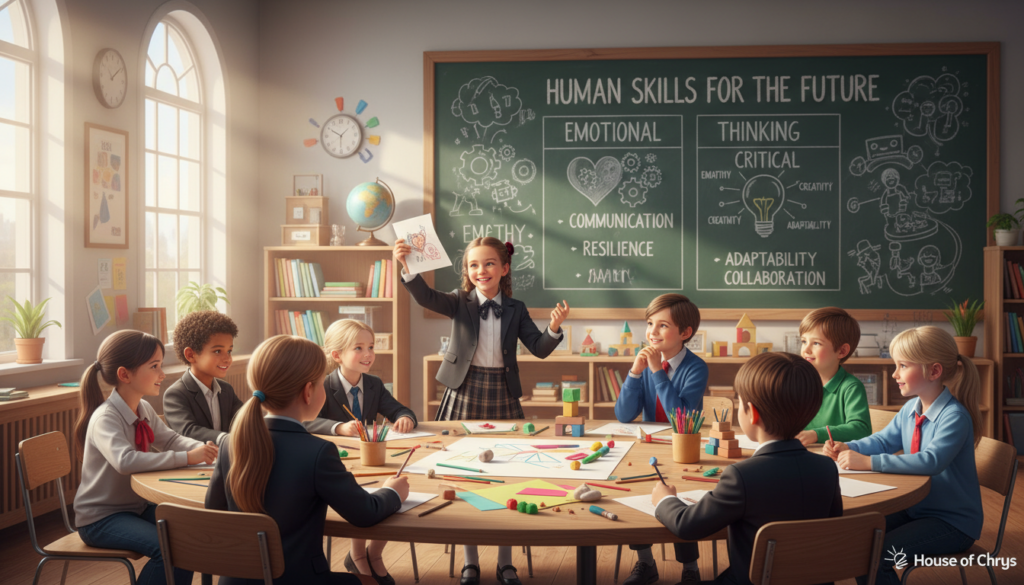
Forget competing with silicon on calculation or memory. The winning strategy is to dominate where machines are forever clumsy: in the arena of being human. This is your most strategic investment.
These are not soft skills. They are the hard, essential currency of the coming age. Your home is the primary training ground.
Creativity: Beyond Algorithmic Art
Creativity isn’t about pretty pictures from a prompt. It’s your child‘s chaotic, joyful, original spark that solves problems we don’t even see yet.
AI can generate art or mimic styles. It doesn’t understand the true spark of an idea born from human experience. That original thought is your young one’s superpower.
Nurture this by valuing the process over the product. The messy sketch, the wild story, the bizarre Lego invention—this is where genius lives.
Critical Thinking: Questioning and Problem-Solving
Critical thinking is their mental armor. It’s the ability to ask “why,” to spot flawed logic, and to solve puzzles AI can’t even frame.
Machines follow rules based on past data. They cannot challenge assumptions or think outside their programming. Your child can.
This way of thinking turns them into a detective of their own world. It’s the ultimate tool for navigating a life filled with information.
Social-Emotional Intelligence: Empathy and Connection
Social-emotional intelligence is their superpower for connection. AI simulates conversation, but your son or daughter will build trust, heal hurts, and lead with genuine feeling.
A machine cannot experience emotions or understand human joy and pain. This depth of feeling is irreplaceable.
This intelligence is the glue of teams, the heart of leadership, and the foundation of a meaningful life. It’s cultivated through real conversation and shared experiences.
Adaptability: Thriving in Constant Change
Adaptability is their secret weapon for an unstable future. It’s the resilience to pivot, learn, and grow when old paths become obsolete.
It is a human skill that algorithms cannot replicate. Systems are built on patterns. People are built to break them and create new ones.
Foster this by celebrating curiosity over perfection. Each new challenge is a way to strengthen this core muscle for the learning journey ahead.
This focus shifts the pressure from “keeping up with tech” to “digging deep into humanity.” You are building the foundation no code can ever replace.
Nurturing Creativity Through Everyday Activities
True innovation doesn’t start with a screen. It starts with a question, a blank page, and permission to explore.
You don’t need a curriculum or expensive kits. The most potent creative activities are woven into your daily routine. They turn ordinary moments into engines for original thought.
This is about building a mindset, not a portfolio. It’s the quiet work of showing your child that their ideas matter—long before anyone else validates them.
Consider this table. It maps simple projects to the deep cognitive muscles they train.
| Activity | Household Materials | Core Skill Strengthened |
|---|---|---|
| Cardboard Box Construction | Boxes, tape, markers, recyclables | Spatial reasoning & iterative problem-solving |
| Impromptu Story Theater | Stuffed animals, blankets for a fort | Narrative intelligence & emotional projection |
| Kitchen Instrument Band | Pots, pans, wooden spoons, containers with rice | Rhythm, pattern recognition, & collaborative expression |
| Nature Collage Art | Leaves, sticks, glue, paper from the yard | Observation, composition, & symbolic thinking |
| “What If” Bedtime Stories | None—just imagination | Conceptual flexibility & consequence forecasting |
Art and Imagination Projects
Art is not about the pretty picture on the fridge. It’s the decision-making behind it. It’s the expression of an inner landscape.
Put away the instructions. Give your young one blank paper and a bin of random objects. The goal is the glorious mess—the process of trying, failing, and trying a new way.
Painting together or sculpting with dough isn’t just fun. It’s problem-solving in its purest form. Each choice of color or shape is a tiny hypothesis tested.
These projects send a clear signal. Your unique perspective has value. This builds the confidence to innovate long before any formal art class begins.
Storytelling and Creative Play
When your child narrates their day or invents a character, they are building a superpower. They are structuring chaos into meaning.
This is foundational creativity. Imaginative bedtime stories where they decide what happens next train narrative intelligence. They learn to sequence events and understand motive.
Creative play—like pretending to run a restaurant or build a fort—rehearses real-world scenarios. It allows for innovative thinking with zero risk.
Integrate music and rhythm. A family dance party isn’t just noise. It’s a lesson in non-verbal expression and joyful collaboration.
These activities are the antidote to passive consumption. They remind your child that they are a creator, not just a user.
Remember, machines can only remix existing data. Your kid’s job is to dream up what does not exist yet. You are the guardian of that sacred space for ideas.
Nurturing this creativity is a daily practice. It’s in the questions you ask and the unstructured time you protect. It’s how you prepare them for a world that will always need new music, new art, and new stories.
Building Critical Thinking from an Early Age
Critical thinking isn’t a subject taught in school. It’s a survival skill for the information age, built one ‘why’ at a time.
This is the mental muscle that separates a passive consumer from an active architect of their own learning. Your role is to be the coach who helps your young one strengthen it every single day.
This work turns everyday moments into a training ground. It’s about equipping your child with a lens to see through noise and find truth.
Open-Ended Questions and Discussions
Forget yes or no. The most powerful questions begin with “why” and “how.” This simple shift changes everything.
Instead of “What color is the sky?” ask “Why do you think the sky changes color at sunset?” You are inviting reasoning, not just recall.
Your dinner table is a critical thinking gym. Debate a storybook character’s motives. Plan a hypothetical family trip and weigh the consequences of each choice.
The important thing is not to stop questioning. Curiosity has its own reason for existing.
When your child states a fact, gently challenge them. Ask, “How do we know that’s true?” You’re not breeding doubt. You’re teaching them to verify and build knowledge on solid ground.
This skill becomes their essential filter. It helps them interrogate the persuasive algorithms and synthetic content flooding their world.
| Type of Question | Example | Cognitive Skill It Builds |
|---|---|---|
| Closed (Factual) | “What is 5 + 7?” | Memory recall, basic knowledge. |
| Open-Ended (Analytical) | “Why did the character make that difficult choice?” | Reasoning, empathy, understanding motive. |
| Probing (Evaluative) | “How could we test if that idea is correct?” | Hypothesis formation, verification. |
| Reflective (Metacognitive) | “What part of solving that puzzle was hardest for you?” | Self-awareness, strategic planning. |
Logic Games and Science Experiments
Strategic games are a stealthy way to train the mind. Puzzles, chess, and certain board games force sequential thinking.
They teach patience and the ability to anticipate outcomes three moves ahead. This is the foundation of strategic thought.
Simple science experiments are pure gold for critical thinking. The question “What will happen if we mix vinegar and baking soda?” starts a journey.
It leads to prediction, careful observation, and analysis. This is the scientific method in action on your kitchen counter.
This learning is often hard thinking. It’s okay if it frustrates them. Your one job is to sit with them in that frustration.
Guide them to break big problems into smaller, manageable parts. Celebrate the process of figuring it out, not just the right answer.
By making thinking a visible, celebrated process, you show them their mind is their most powerful tool. It’s more powerful than any search engine or AI model.
You are building a detective, a scientist, a sage. This is how you fortify your child for a future that demands discernment above all else.
Developing Emotional Intelligence and Empathy
Empathy is the silent language that algorithms will never truly speak. It’s the core human software for connection—and it must be actively installed.
This isn’t about being nice. It’s about building your child‘s capacity to navigate the complex emotional landscapes of real life. In a digital age, this skill is their non-negotiable advantage.

Your home is the primary training ground. The daily activities you choose forge this essential growth. They build the confidence to lead with heart.
Practicing Gratitude and Emotional Awareness
Emotional intelligence begins with vocabulary. Help your young one name their feelings. Say, “That sounds frustrating,” or “I see you’re feeling proud.”
This simple act builds profound self-awareness. It gives them the tools to understand their inner world.
A daily gratitude practice rewires the brain for resilience. Share one good thing at bedtime. This trains their mind to scan for positive connections.
It builds a buffer against the digital negativity they will encounter. This habit is foundational for mental well-being.
When upset feelings arise, don’t just fix the problem. Guide them through the emotional arc. Ask, “I see you’re sad. What might help you feel better?”
This teaches vital emotional regulation. It turns moments of distress into powerful learning opportunities.
Role-Playing and Collaborative Projects
Role-playing is empathy in action. Ask, “How would you feel if that happened to you?” Let them act out both sides of a simple conflict.
Pretend to comfort a friend who is upset. This exercise builds perspective-taking—the muscle of understanding another’s view.
Collaborative projects are microcosms of the future workplace. Build a Lego city together. Cook a meal or assemble a puzzle as a family.
These tasks teach negotiation, shared responsibility, and clear communication. They are the bedrock of teamwork.
Your child learns that success often depends on others. This is the antithesis of the transactional, efficiency-obsessed digital realm.
These skills are about depth, nuance, and the messy, beautiful work of human relationships.
People will forget what you said, people will forget what you did, but people will never forget how you made them feel.
Your young one will enter spaces where genuine empathy is scarce. Their ability to read a room and offer real support will make them an invaluable leader.
This development isn’t separate from academic learning. It is the foundation for all effective collaboration and personal growth.
Tell stories that highlight kindness and courage. This is a powerful way to model emotional depth. It builds their moral imagination.
Nurturing this confidence in feeling is how you future-proof their heart. You are preparing them to connect in a disconnected world.
Cultivating Adaptability and Resilience
Your child’s greatest armor for an uncertain tomorrow is a flexible mind.
Adaptability isn’t about being agreeable. It’s the core strength to bend without breaking. Resilience is the power to spring back, stronger.
These are the meta-skills for a life of constant change. In a rigid world, the flexible thrive.
This growth happens in the small, daily moments you design. It’s not a lecture. It’s a lived experience you build together.
Your home is the primary training ground. Your way of framing challenges becomes their blueprint.
Encouraging New Experiences and Challenges
Start with tiny, safe disruptions. Take a different route to the park. Swap Tuesday’s dinner for Thursday’s.
Normalize flexibility so change isn’t a threat. It becomes an adventure.
Present challenges just beyond their comfort zone. A slightly harder puzzle. A new vegetable to try. A complex block tower to build.
The struggle is where the resilience muscle is forged. Your role is to sit with them in that effort.
Avoid the trap of over-scheduling. Leave white space in their week.
Boredom is the fertile ground for improvisation. It sparks self-directed exploration and new ideas.
Celebrate the effort, not just the outcome. Praise their persistence in trying a new approach.
This builds the confidence to face the unknown today and every day.
Teaching That Mistakes Are Learning Opportunities
Frame mistakes as data, not failure. The question isn’t “What went wrong?” It’s “What did this attempt teach us?”
This mindset shift is critical. Job roles will morph. Technologies will become obsolete.
The ability to learn, unlearn, and relearn is the learning superpower that never expires.
Vulnerability is not winning or losing; it’s having the courage to show up when you can’t control the outcome.
Share your own mistakes and what you learned. Model adaptability openly.
Let your child see you try something new and be awkward at it. Your vulnerability is their permission slip.
Your home must be a safe laboratory for failure. When they know they are loved regardless of outcome, they gain courage.
They gain the courage to adapt and take necessary risks for true growth.
Remind them gently, “It’s okay. Mistakes help us learn and grow.” This simple phrase validates feelings and redirects focus.
You are building a child who sees challenges as puzzles, not threats. A person who views setbacks as information, not identity.
This is how you future-proof their spirit. You equip them not just to survive change, but to lead it.
Introducing AI Literacy and Digital Skills
Your daughter asks her smart speaker a question. The answer she gets is powered by a form of intelligence that didn’t exist when you were her age.
This new layer of basic literacy is non-negotiable. It’s about making the invisible technology visible so your young one can critique it, not just consume it.
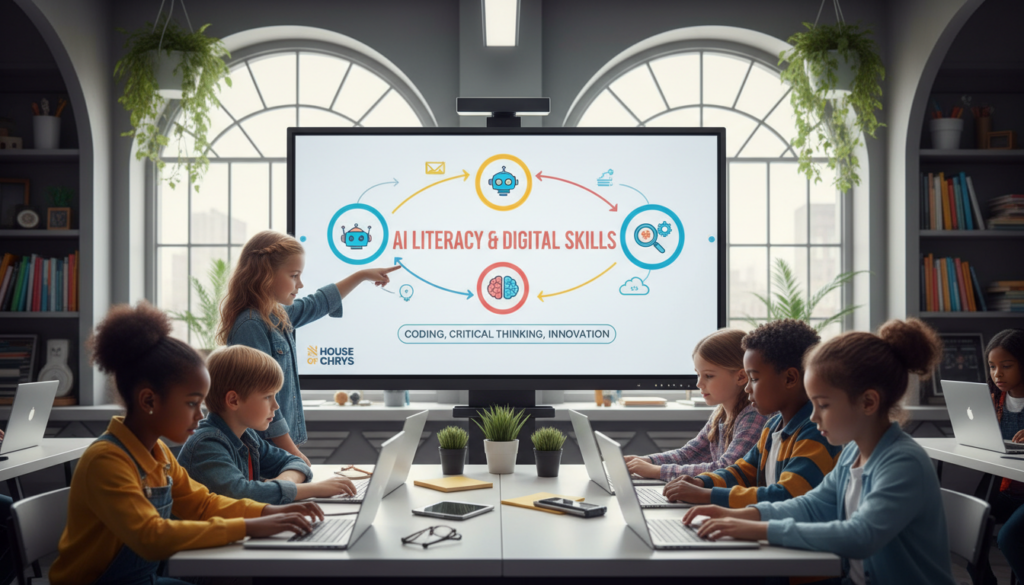
Think of it as digital self-defense. The Brookings Institution’s global study highlights a “Prepare” pillar—building holistic AI literacy from the ground up.
Programs like the Day of AI curriculum are exemplars. They help students grasp how this artificial intelligence works, where it fails, and how to use it responsibly.
Your goal is simple: turn passive users into informed, critical shapers of their digital world.
Basic Coding and Computational Thinking
This isn’t about career training. Coding with visual blocks, like in Scratch, teaches computational thinking.
That’s a fancy term for a vital way of working. It means breaking a big problem into small, logical steps.
It’s problem-solving literacy. Your child learns to sequence actions and anticipate outcomes.
Start with a simple analogy. “This video game enemy uses rules to chase you. Let’s guess what those rules might be.”
This work builds a foundational mental model. It shows them that complex tools are built from simple, understandable parts.
That model is more valuable than any single programming language.
Understanding How AI Works and Its Limits
The most crucial lesson is about limits. This intelligence is not magic—it’s math on data.
It has biases baked into its training. It makes confident errors. It lacks common sense.
Your child must know it’s a tool, not an oracle. Demystification prevents blind trust.
The real danger is not that machines will begin to think like men, but that men will begin to think like machines.
Use real-world examples. Discuss how a streaming service’s recommendation algorithm works.
Talk about what facial recognition is and its potential for error. Make the invisible technology visible so they can ask hard questions.
Pair this with essential digital skills:
- Understanding privacy settings on apps and games.
- Recognizing phishing attempts and online scams.
- Knowing what personal data they create with every click.
This knowledge is power. It ensures no artificial intelligence or tech career can ever take advantage of their ignorance.
You are building a discerning critic and a responsible user. That is the core of true learning for this age.
Practical Steps for Parents: Activities and Routines
Forget expensive tutors; the best educational tools are already in your pantry and laundry basket.
The most powerful learning happens not in a school building, but in the daily rhythm of your home. This is where theory meets practice—where ideas become real.
Your role isn’t to become a teacher. It’s to be a curator of experiences. The Brookings report is clear: families need support to manage tech use. The answer is hands-on, holistic development.
This is about turning intention into simple, repeatable action. Start today.
Hands-On Learning at Home
Your home is the most important classroom. Every routine holds a lesson waiting to be unlocked.
Cooking dinner teaches fractions, chemical reactions, and sequential thinking. Sorting laundry is a masterclass in categorization and organization.
These activities build real-world competence. They show your child that knowledge has a purpose.
Create a dedicated “creativity corner.” Stock it with open-ended materials: cardboard, tape, fabric scraps, and markers.
This space signals that invention is welcome any day of the week. It’s a laboratory for the mind.
Establish a weekly family project night. Build a model volcano. Design a cardboard castle. The goal is collaboration, not perfection.
Connect these projects to real impact. If you learn about composting, start a small bin. This links learning to agency.
Your child sees that their actions matter. This builds the confidence to shape their life and community.
Balancing Screen Time with Human Interaction
Screens are a reality. The goal isn’t elimination—it’s transformation.
Shift from passive consumption to active creation. An hour making a digital storybook is fundamentally different from an hour mindlessly scrolling.
Set clear, consistent boundaries. Tech-free zones are non-negotiable. Protect meals and bedtime.
This protects the space for eye contact, conversation, and the deep human connection no AI can provide.
Use technology with your child. Co-play an educational game. Research a topic of interest side-by-side.
Your presence transforms the device from a babysitter into a shared tool for exploration. It becomes a way to connect, not disconnect.
Your modeling is everything. If you are constantly on your device, you teach that human interaction is interruptible.
Be intentional with your own tech use. Put your phone away during playtime. This silent lesson speaks volumes.
Remember, you are not managing a checklist. You are curating an environment.
Consistency in these small routines builds the habits that shape their future mindset. It prepares parents and child alike for the world ahead.
Navigating the Risks: Protect Your Child in an AI World
Your son’s digital shadow grows longer with every click—a permanent record he cannot see.
This new frontier demands more than good intentions. It requires a guardian’s clear-eyed vigilance. The Brookings Institution’s “Protect” pillar makes the mandate plain.
We must safeguard student privacy, safety, and well-being against systemic threats. Your home is the first line of defense.
This protection isn’t about fear. It’s about empowerment. You are building their internal compass for a wilderness of data and persuasion.
Privacy and Data Security Concerns
The information your young one generates is a permanent digital footprint. Teach them young: not everything needs to be shared online.
Privacy is a right, not an optional setting. This lesson is foundational for their life in a connected world.
Use parental controls as training wheels, not surveillance. Explain why certain sites are restricted.
You are protecting their time, attention, and personal information. This turns rules into understandable tools for safety.
Talk about deepfakes and misinformation openly. Show them how easily media can be manipulated with simple technology.
This inoculation protects their trust in reality. It is a critical part of their modern learning.
In the digital age, privacy is the new currency of personal freedom.
Comprehensive frameworks are needed, but your daily guidance is what truly shields your child. Their data is their own.
Your vigilance at home defends against risks to their cognitive development and social-emotional well-being. This is non-negotiable content for their growth.
Promoting Mental Health and Well-Being
Many platforms are engineered for engagement addiction. This design harms mental health.
Watch for subtle signs in your kids: increased anxiety, social comparison, or withdrawal linked to digital use. Your awareness is their early warning system.
Promote digital well-being by teaching mindful use. Encourage them to notice how different apps make them feel.
Ask, “Does this leave you inspired or inadequate?” This simple question builds powerful self-regulation.
The Brookings report is clear. Unregulated use of certain intelligence can diminish genuine learning and overall well-being.
Your role is to enforce balance. Ensure their self-worth is rooted in offline accomplishments and face-to-face friendships.
Family bonds must be stronger than algorithmic validation. This is the way you fortify their spirit.
Your protection doesn’t build a bubble. It builds resilience. You equip them to navigate complex content with critical awareness.
They gain the confidence to engage with technology on their own terms. This is how you protect your child for the world ahead.
Collaborating with Schools and Educators
Your child’s classroom is a frontier where the future is being negotiated every day.
You cannot prepare your young one alone. The institution they spend most of their waking hours in must be your ally. This partnership is non-negotiable for true growth.
The Brookings Institution’s global study is clear. We must shift educational experiences inside the school building. This means co-creating tools with teachers and communities.
Your role is to be an informed, supportive force. You push for evolution, not revolution. Together, you and educators can build a system that doesn’t just distribute devices, but cultivates minds.
Advocating for AI-Integrated Curricula
Start with a simple, powerful question at your next parent-teacher conference. Ask, “How is our school integrating AI literacy and fostering critical human skills?”
Demand a plan that goes beyond gadget handouts. The goal is enriched learning, not diminished thinking.
Support your teachers. They are on the frontlines without all the answers. Share resources like the Day of AI curriculum to foster productive dialogue.
Advocate for education that uses this technology to teach, not tell. Tools should encourage problem-solving, not just deliver answers.
This is about preparing educators to teach with and through new systems. It’s a fundamental shift in pedagogy.
| Aspect | Traditional Model | Future-Ready, Collaborative Model |
|---|---|---|
| Primary Focus | Standardized test scores and content recall. | Holistic development: creativity, collaboration, resilience. |
| Technology Use | Devices for consumption and rote practice. | AI as a tool for exploration, creation, and critical analysis. |
| Parental Role | Passive supporter of school decisions. | Active advocate and co-creator of the learning journey. |
| Success Metrics | Letter grades and attendance records. | Portfolios of projects, problem-solving logs, social-emotional growth. |
| Teacher Preparation | Training on classroom management and curriculum. | Professional development in AI literacy and human-centric pedagogy. |
Supporting Holistic Development in Early Learning
Push for report cards that value creativity as much as math scores. This aligns with what the future truly demands for your child.
Encourage project-based learning that mirrors real-world challenges. These collaborative projects build the adaptable skill set needed.
Volunteer for or request workshops for parents. Schools should be partners in preparing the whole family.
Your voice matters. When parents collectively ask for human-centric education, institutions listen and adapt.
Remember, collaboration means listening too. Understand the constraints educators face. Your role is to be a supportive partner.
This work ensures your kids see learning as connected to life. It values art and expression alongside science.
You are your child‘s chief educational advocate. This advocacy is the bedrock of their long-term success.
Education is not the filling of a pail, but the lighting of a fire.
Foster environments where your kids can take intellectual risks. Celebrate the process of their projects, not just the polished result.
This partnership transforms the school experience. It builds a community invested in every child‘s growth.
Your active engagement tells your kids that their education matters. It shows them that home and school are united for their future.
Conclusion: Empowering the Next Generation for an AI-Driven Future
The arc of the future bends not with code, but with the character we build in our homes. The Brookings report confirms a hopeful path—it is not too late to ensure this technology enriches your child‘s learning and development.
Your work is not a tech race. It’s a heart-and-mind marathon. You are building the human who will guide the machine.
This journey begins with a single conversation. A chosen activity. A protected boundary. Consistency in these small acts compounds into unshakable readiness for your kids.
Do not fear the future. Shape it. Your child‘s creativity and empathy are the levers. You have the agency and the imperative to prepare them.
Empower them. Trust yourself. The most future-ready tool your child will ever have is a parent who acted with love and clarity. Start building that capacity today.