
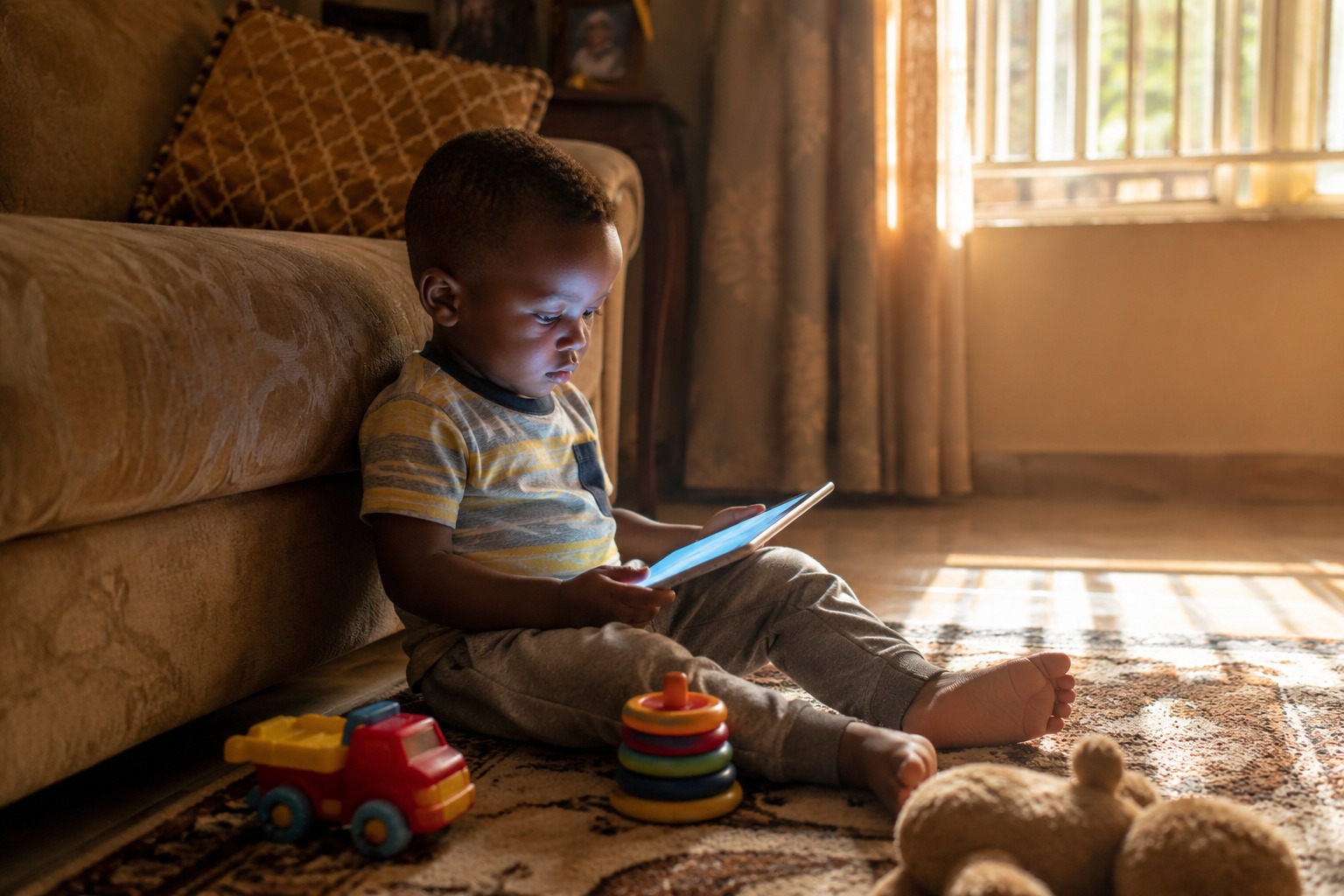
10 Terrifying Signs of Screen Addiction in Toddlers Every African Parent Is Ignoring Right Now

Screen addiction in toddlers is the parenting emergency nobody in Calabar, Owerri, or Minna is calling by its name.
We have given it softer names. Educational content. Keeping them busy. Just for a little while. The child likes it.
The child likes it. That sentence is doing a lot of work to justify something worth examining more honestly.
Because what the child likes and what the child needs are two different things entirely. And a two year old’s preferences are not a reliable guide to their developmental requirements — which is precisely why they have parents.
Here are ten signs the screen has crossed from tool to dependency in your toddler’s life. Read them without defensiveness. That is the only way this helps you.
1. They Reach for a Screen Before They Reach for You
A toddler wakes up in the morning. First instinct. What do they go for?
If the answer is a tablet, a phone, or a television remote before they look for your face, your voice, your body — something has shifted in the hierarchy of what comforts them.
Human attachment is supposed to be the primary regulator of a toddler’s nervous system. Your face is the screen they were designed to stare at. When a device starts competing with that and winning the competition screen addiction in toddlers has already begun establishing its architecture.
This is not guilt. This is neuroscience. The attachment system and the dopamine reward system are fighting for dominance in a very small brain and right now the device is running an unfair algorithm.
2. They Cannot Transition Off a Screen Without a Full Emotional Collapse
Omo.
You have seen this. Everyone has seen this.
The child is fine. You take the phone. The world ends. Not a small protest. A full physiological crisis — screaming, floor-dropping, breath-holding, the kind of distress that looks disproportionate to the stimulus until you understand what is actually happening.
What is happening is withdrawal.
The brain adapted to a reliable dopamine source. That source was removed. The stress response activated. This is the same neurochemical sequence that occurs in adults withdrawing from substances, scaled to a toddler’s body and expressed through the only emotional vocabulary they have.
Screen addiction in toddlers does not produce adult-style cravings. It produces exactly this — disproportionate emotional collapse at the point of removal. If this is a weekly or daily occurrence in your home it is a sign worth taking seriously.
3. Real World Stimulation Bores Them Rapidly
Take the screen away and give them something real. Blocks. Sand. Water. Crayons. A garden. Another child.
How long before boredom arrives?
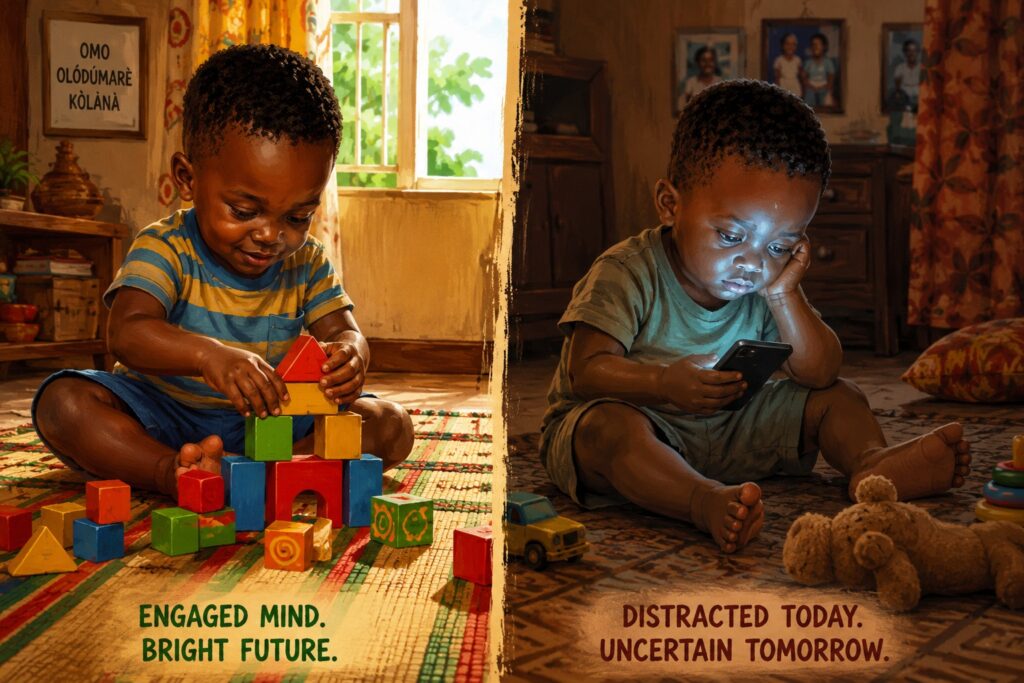
If a toddler who used to lose themselves in imaginative play for forty minutes now cannot sustain interest in anything physical for more than five — something has changed in the brain’s baseline expectation for stimulation.
Screens deliver novelty at a pace no physical environment can match. Every three seconds something new. Every minute a different scene. The brain recalibrates to expect that pace. Everything slower than that pace registers as boring.
The consequence is a child who finds the actual world — with all its textures, relationships, and open-ended possibilities — genuinely unstimulating. That recalibration does not correct itself automatically when the screen is removed. It requires deliberate, sustained exposure to slower stimulation over time.
A child in Jos playing in red dust for an hour is building something a tablet cannot build. The ability to tolerate and enjoy the pace of real life.
4. Eye Contact Has Decreased
This one is quiet. Easy to miss. Worth paying close attention to.
Toddlers are supposed to be obsessive eye contact makers. They study your face to regulate their emotions, to learn language, to understand social cues, to feel safe. It is one of the primary mechanisms of early development.
Excessive screen time — particularly content that delivers faces without reciprocal attention, faces that never look back, voices that never respond to the child — gradually erodes the instinct to seek human eye contact as the primary source of information and comfort.
If your toddler makes noticeably less eye contact than they did six months ago and the screens have increased in that same period — that correlation is worth your attention.
Screen addiction in toddlers shows up in the face before it shows up anywhere else. Watch the eyes.
5. They Have Started Talking to Screens as Though They Are People
Not cute. Concerning.
When a toddler starts directing questions, complaints, and emotional expressions at a screen — talking to a cartoon character, arguing with a YouTube presenter, crying when a screen figure disappears — the boundary between the mediated world and the real one is blurring in a brain that is not yet equipped to manage that distinction.
Children are supposed to learn the difference between real relationships and representations of relationships during exactly the developmental window that heavy screen use occupies. When that window is filled primarily with screen interaction the learning gets disrupted.
The toddler who tells the tablet goodnight before they tell you goodnight has been spending more time with the device than its developmental appropriateness allows.
6. Language Development Has Stalled or Regressed
Language is learned through interaction. Back and forth. Prompt and response. The caregiver says something. The child attempts a reply. The caregiver responds to the attempt. The loop continues thousands of times a day in a healthy language development environment.
Screens do not provide this loop. They provide language input without language interaction. A child can sit in front of rich verbal content for hours and receive zero of the conversational scaffolding that actually builds language competence.
Research from pediatric development institutions has consistently shown that children with high passive screen exposure and low interactive conversation time develop language more slowly than their peers — not because they are less capable, but because the environment is giving them the wrong kind of input.
Screen addiction in toddlers manifests in language as a quieter child who receives a lot of verbal content and produces less of their own. If your two year old used to babble constantly and now watches in relative silence — the ratio of input to output has shifted in the wrong direction.
7. Sleep Has Become a Battle
The blue light problem is real and it is not the whole story.
Yes, screen light suppresses melatonin and disrupts the sleep onset signal. That is a physiological fact. But the deeper issue with screens and toddler sleep is neurological arousal.
Content designed to hold a toddler’s attention is designed to keep the nervous system activated. Novelty, movement, sound, color, pace — all of it keeps the arousal system engaged. A nervous system that spent the last hour before bed in a state of screen-induced activation does not transition smoothly into the parasympathetic state required for sleep onset.
The toddler who was fine falling asleep at seven thirty six months ago and now fights sleep until nine or ten — and whose screen time has increased in that same period — is showing you a neurological pattern, not a behavioral one.
Screen addiction in toddlers disrupts sleep architecture. Disrupted sleep disrupts everything else. Mood, immunity, memory consolidation, emotional regulation, growth hormone release. The screen at bedtime is not a harmless wind-down tool. It is doing the opposite of what wind-down requires.
8. They Are Eating in Front of Screens and Cannot Eat Without Them
Mealtime became a negotiation. Then a bribe. Then a dependency.
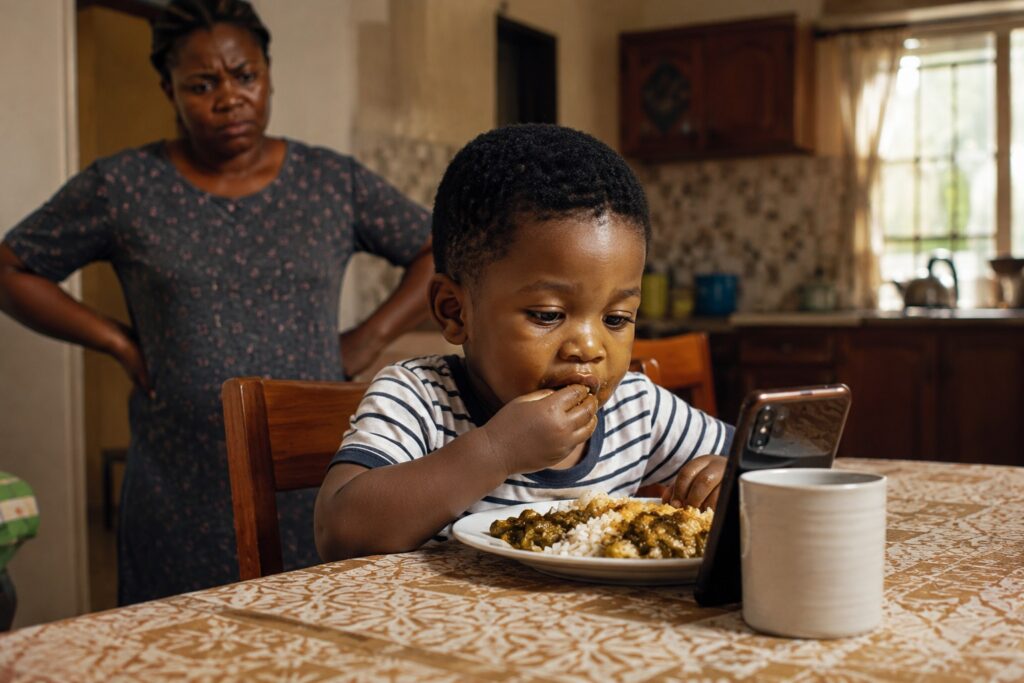
The phone goes on so the child eats. Without the phone the child does not eat. Or eats with such distress that the phone feels like the only reasonable option.
This pattern — while understandable as a survival strategy for exhausted parents — has consequences worth naming clearly.
Eating in front of screens disconnects the child from the physical experience of eating. They stop noticing hunger and fullness cues. They stop tasting food with full attention. They stop experiencing mealtime as a social, relational, sensory event.
More relevantly for this conversation — it means the screen has been installed as a prerequisite for a basic biological function. That is dependency by any honest definition.
Screen addiction in toddlers often takes root at mealtimes specifically because the compliance payoff for parents is immediate and the developmental cost is invisible until later.
9. Imaginative Play Has Disappeared
Watch what a toddler does with an empty afternoon and no screen.
A child with healthy imaginative development fills that space. They create scenarios. They assign roles to objects. They narrate out loud. They invent. They get lost in the architecture of a world they are building in real time from nothing but their own cognition.
This is not charming behavior for Instagram. It is serious developmental work. Imaginative play is how toddlers process experience, develop language, build empathy, practice emotional regulation, and strengthen executive function.
Screen addiction in toddlers erodes it.
Not because screens are evil. Because screens fill the space that imaginative play requires. The cognitive restlessness that used to drive a child toward invention now resolves itself by reaching for a device. The boredom that used to be the entry point to creativity is now something to be immediately eliminated rather than tolerated and worked through.
The toddler in Akure who no longer plays pretend — who used to spend an hour making a cardboard box into a car, a shop, a house, a spaceship — is telling you something important about what the screen has replaced in their developmental economy.
10. You Feel Guilty Every Time You Hand Them the Phone But You Do It Anyway
This last sign belongs to the parent.
Because screen addiction in toddlers does not develop in isolation. It develops inside a household where adults are managing exhaustion, managing the child’s distress, managing the ten thousand competing demands of modern African family life — and the screen is the most immediately effective tool available for buying twenty minutes of peace.
The guilt is your nervous system telling you something your prefrontal cortex already knows. That the short term solution is creating a long term pattern. That the twenty minutes of peace today is building the dependency that makes tomorrow harder.
This is not condemnation. Parents in Minna and Bauchi and everywhere else are doing the best they can with the energy they have. The guilt does not mean you are a bad parent. It means you are a paying-attention parent who has not yet found the alternative that works.
The alternative starts with understanding what you are managing. A developing brain that was designed to attach to faces, interact with environments, move through physical space, and build competence through doing — encountering a device that delivers stimulation at a pace and intensity that the real world cannot match.
You are not fighting laziness. You are fighting a product engineered by some of the most sophisticated behavioral psychologists on earth to capture exactly this demographic.
Knowing that changes how you respond to it.
What to Do About It
This is where The Prepared Child and the House of Chrys philosophy matters in a way that might not be immediately obvious.
We are not anti-technology. We have never been anti-technology.
We are pro-intentionality. We are pro-preparation. We are pro-the parent who understands what technology does to a developing brain specifically enough to make deliberate choices about when, how, and how much.
The goal is not a screen-free toddler. The goal is a toddler whose relationship with technology is shaped by a parent rather than by an algorithm. A child who encounters screens as a tool their parent introduces purposefully — not as the default response to every uncomfortable moment.
That distinction is everything.
Visit For Parents for practical guidance on building a healthy technology environment at home from the earliest years. Visit The Prepared Child page to understand how we introduce AI concepts to young children in ways that build curiosity and agency rather than dependency.
The signs are observable. The pattern is reversible. The window for shaping your toddler’s relationship with technology is the one you are standing in right now.
In all things, prepare.