

What if the greatest threat to your child’s future isn’t a lack of opportunity, but a technology moving too fast?
You’ve seen the headlines. You feel the uncertainty. Recent reports confirm it—artificial intelligence is reshaping the world of work at a pace we’ve never seen.
This isn’t a distant forecast. The professional landscape for your children is shifting right now. They need to be prepared for a reality where technology drives change.
This conversation provides the essential truth about how this transformation will impact the continent. More importantly, it reveals what you can do to protect your family’s tomorrow.
You have a responsibility—a duty—to guide them through this. It’s about focusing on the skills that truly matter for a new era.
We are looking at a fundamental shift in how we define success. It’s not just another trend. It’s the new reality.
Key Takeaways
- The speed of technological change is faster than any in history.
- Parents hold the key to preparing the next generation.
- This is a deep, structural shift in the global employment landscape.
- Future-ready skills, not just degrees, will determine success.
- Understanding the impact is the first step toward proactive protection.
- Action and guidance are required now, not later.
- The very definition of a stable career is being rewritten.
Setting the Stage: AI’s Role in Africa’s Economic Transformation
When leaders gathered in Mozambique’s capital, they confronted a single, pressing question: how do we turn technological upheaval into our greatest advantage?
That Maputo meeting was a signal. Policymakers and researchers agreed—this moment is both a significant challenge and a monumental opportunity for the continent.
The transformation of our economy is not a maybe. It is a certainty.
Global and local perspectives on technological change
From a global view, change is about efficiency and scale. Locally, it’s about survival and leapfrogging.
Our focus must be different. We are building for our unique context, our growing population, our own future.
| Perspective | Primary Focus | Key Concern | Immediate Opportunity |
|---|---|---|---|
| Global | Market dominance & innovation speed | Widening the digital divide | Access to advanced tools & investment |
| Local (African) | Inclusive growth & job creation | Preparing the existing workforce | Tailored solutions for community development |
| Your Family’s | Future-proof skills & stable income | Being left behind by automation | Early adaptation and digital literacy |
“We cannot be passive observers of this shift. Our active participation today writes the story of our prosperity tomorrow.”
The urgency of preparing for a transformed workforce
You need to realize this is happening now. The reshaping of labor markets is not a future event.
Your involvement is the only way to ensure success for your family. Millions of workers are already affected.
The integration of new automation tools into our systems is critical. It will support our people and drive national development.
This is about preparing for a new reality. The time for guidance and action is now.
Technological Evolution and AI Waves in Africa
We are witnessing a fundamental leap in machine capability—from simple prediction to active creation and management.

From predictive to generative and agentic AI
The first wave gave us tools that could forecast. The current wave builds things—text, images, code.
Now, we enter a new phase. Agentic systems can manage complex workflows independently.
This evolution changes everything. It’s not just better software. It’s a new form of operational intelligence.
How shifting AI capabilities reshape industries and labor
This shift in technology is impacting key sectors right now. Manufacturing and logistics are being redesigned.
Smart automation drives new demands for efficiency. It defines the growth trajectory of local economies.
Consider this: in South Africa, productivity gains from generative tools could add 0.5% to total GDP growth.
That number is a signal. It shows how this technology changes how we produce value across every sector.
Your child’s future work will be shaped by these waves. Understanding them is the first step to being prepared.
Will AI take jobs in Africa – An In-depth Analysis
Millions of young Africans are stepping into a job market that is being rewritten by intelligent automation before their eyes. The International Labor Organization confirms it—25% of global jobs are susceptible to this transformation.
With over 70% of the population under 30, the pressure is immense. Twenty-two million new workers enter the fray each year.
Opportunities versus risks in formal and informal sectors
The risk is real, especially for entry-level roles. But the narrative isn’t just about unemployment.
It’s about change. The formal sector—offices, banks, call centers—faces direct automation of routine tasks.
The vast informal economy faces indirect shifts. New tools will change how service is delivered and productivity is measured.
| Sector Type | Primary Exposure | Immediate Risk | Adaptive Opportunity |
|---|---|---|---|
| Formal Sector | Direct task automation in clerical & support roles | Displacement of repetitive job functions | Upskilling for higher-value oversight and tech management |
| Informal Sector | Indirect via new delivery models & digital platforms | Market disruption from efficient digital services | Access to broader markets and streamlined operations |
Impacts on clerical, customer support, and manual labor
These roles won’t vanish. They will evolve. Intelligent systems will handle data entry and basic queries.
Human workers will provide empathy, complex problem-solving, and relationship management. This is the new support structure.
Your child’s first job might involve managing these tools, not being replaced by them. The right opportunities await those who are prepared.
Transforming Workforce and Education: Building Future Skills
The bridge between today’s education and tomorrow’s economy is built with digital bricks. And many are missing.
Your child’s success depends on crossing that gap. We must transform how we prepare our people.
Reskilling, upskilling, and lifelong learning initiatives
Lifelong learning is no longer optional. It is the only way to keep a job secure.
Companies integrate new technologies daily. The demand for workers literate in new intelligence tools grows 66% faster than for others.
This applies across every sector—from manufacturing to services. Your role is to ensure your child gains these skills.
Continuous education is the new career ladder. It is how we protect our family’s future.
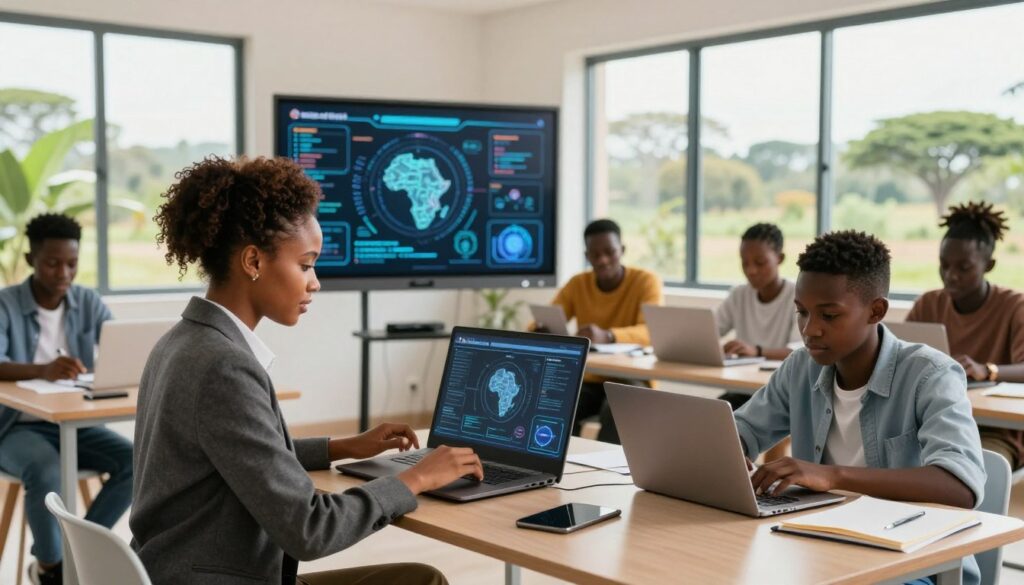
Bridging the digital divide for inclusive growth
True growth must include everyone. Statista projects over 1.1 billion internet users here by 2029.
That connection is critical infrastructure. But research from Nampula, Mozambique, reveals the hard truth.
Less than 15% of youth there regularly use a computer. This is the gap we must close.
Digital literacy is not a luxury. It is the foundation for all other skills and opportunities.
We need investment and smart policies now. Our young population cannot be left behind as the continent advances.
This is how we build an inclusive workforce ready for the new world of work.
Regional Perspectives: Policy, Infrastructure and Africa-Centric AI Platforms
A stark reality defines our starting point. Just 100 firms control nearly half of all advanced intelligence research.
Our continent is playing catch-up. This gap is not just about technology. It’s about policy and infrastructure.

Government initiatives and ethical AI frameworks
Governments must lead. They need clear policies that drive adoption of new tools while protecting our people.
Think of African workers tagging data for global companies. Ethical frameworks ensure they are treated fairly.
This is about building trust for a just transformation.
Investments, innovations, and AI-driven development in key African countries
Real growth needs local investment. We must fund startups and institutions that understand our population.
They create systems for our unique economies. This is how we unlock true potential.
Your advocacy for better infrastructure and education is critical. It’s the foundation for your child’s future skills.
Our countries can compete. But we must build our own platforms for our own development.
Conclusion
Your child’s path to a stable career no longer follows a map from the past—it requires a compass you help them build.
That compass is built with practical skills and digital literacy. It points toward work that is meaningful and productive.
The future is not something that happens to us. It is something we create, choice by choice, in our homes and communities.
Your role is clear. Stay informed. Be proactive. Guide the next generation with confidence.
Together, we can ensure these powerful tools serve our people. We can build a continent where every young person has the opportunity to succeed.
Let that be our shared commitment—starting today.