

Your daughter asks her smart speaker how clouds are made. Your son gets homework help from an app that adapts to his mistakes. This is their normal.
That moment of curiosity—or frustration—is a doorway. It’s a glimpse into the world they will build and lead. This is not a trend to watch from the sidelines.
It’s the foundational skill your child needs. We’re cutting through the noise right now. This is your ultimate, action-oriented guide.
You’ll discover what true understanding of artificial intelligence means for your young ones. It goes far beyond knowing how to use a chatbot.
This isn’t about raising a tech genius. It’s about building a future-ready human. This guide translates complex ideas into practical steps you can start tonight.
You will learn how to turn everyday technology into powerful teaching moments. We connect the dots between your child’s development and the AI-driven world they will inherit.
This is your map. It’s for navigating the risks and seizing the incredible benefits. By the end, you’ll have a clear plan to build essential skills that no machine can replicate.
Key Takeaways
- Everyday tech interactions are teaching moments about artificial intelligence.
- True AI literacy is a foundational skill, not a optional trend.
- The goal is to raise future-ready humans, not just tech experts.
- This guide provides immediate, practical steps for parents.
- It connects your child’s development to the world they will lead.
- You will learn to navigate risks and maximize benefits.
- The focus is on building human skills machines cannot copy.
Introduction: Why AI Literacy Is No Longer Optional for Kids
This isn’t a coming trend—it’s the present reality your son or daughter navigates with each swipe and tap.
From the video recommendations that keep them watching to the voice assistant that settles a dinner-table debate, artificial intelligence is woven into the fabric of their daily life. It’s not a separate tool they use. It’s the environment they live in.
If you wait for the school system to formally introduce this idea, you take a serious risk. The world has already moved on. Your child cannot afford to play catch-up.
This isn’t about spreading fear. It’s about achieving clarity. Your child’s capacity to think critically, create original work, and form genuine connections now depends on understanding the systems that shape their reality.
Preparing a child for the future is no longer about teaching them to use technology. It’s about teaching them to understand the intelligence behind it.
Think of this new layer of understanding as fundamental safety. You taught them to look both ways before crossing the street. Now you must teach them to navigate a digital landscape powered by machine learning.
Without this foundation, they remain passive consumers in an era that demands active, informed creators. They receive information but lack the skills to question its source or purpose.
| Aspect | With AI Literacy | Without AI Literacy |
|---|---|---|
| Engagement with Tech | Active, informed creator | Passive consumer |
| Critical Thinking | Questions sources, understands bias | Accepts information without scrutiny |
| Future Opportunities | Prepared for an evolving job market | At risk of being left behind |
| Safety & Ethics | Navigates the digital world with awareness | Vulnerable to misinformation |
The gap between young person who grasp these concepts and those who don’t will define their opportunities. It will influence the friends they make, the problems they solve, and the careers they build.
The conversation about waiting is over. You hold the power to close this gap starting today. This guide provides the exact steps.
Your role as parents is not to become technical experts. It is to guide your children and kids toward becoming resilient, future-ready humans. The time for action is now.
What Is AI Literacy for Children? Defining the Goal
The toy that remembers your child’s favorite color isn’t magic. It’s a simple form of artificial intelligence.
This understanding is the first step. True literacy in this area has nothing to do with writing code. It’s about building a critical mind.
Research from Harvard’s Dr. Ying Xu clarifies the mission. It’s about teaching young ones to grasp the limits of these systems. They must learn to spot potential misinformation.
AI literacy means promoting critical evaluation of AI-generated content. It’s understanding that the tool has constraints.
The goal is straightforward. Help your son or daughter see this intelligence as a powerful tool. It is not a magical oracle. It is never a substitute for your hug or your conversation.
It’s about constructing a mental model. Your child learns that these systems make predictions. Those predictions are based on data—and that data can be flawed or incomplete.
Real learning here means interacting with technology with confidence. Your young one knows its strengths. They also know its very real limits.
This includes several core concepts. The machine cannot feel empathy. It sometimes “hallucinates” or invents facts. Most importantly, it is designed by people with specific goals.
This education transforms your child. They shift from being a passive user to an informed questioner. They learn to command the technology. They refuse to be commanded by it.
The foundation is laid through simple ideas. Use age-appropriate conversations, not complex theory. Defining this goal clearly is your first move from anxiety to action.
| Core Concept | What Your Child Understands | Everyday Example |
|---|---|---|
| AI Makes Predictions | Output is based on patterns in data, not certainty or truth. | A video app suggesting the next clip to watch. |
| Data Can Be Flawed | If the training data is biased or limited, the results will be too. | A voice assistant consistently misunderstanding a regional accent. |
| No Human Empathy | The system doesn’t feel or care; it simulates a response. | A chatbot offering a generic “sorry” when hearing about a problem. |
| Designed by People | Humans create the goals, rules, and values for these tools. | Knowing a parent programmed the smart speaker’s daily routines. |
This is the new way of thinking. It prepares a young person to evaluate information critically. They ask better questions: “Is this true? Why did the system say that?”
Their development now includes navigating digital content with this lens. That is the definitive goal. It turns everyday tech moments into lessons for the future.
The Urgent Case: Why We Can’t Afford to Wait
The next video that plays automatically on your child’s screen isn’t random—it’s a calculated suggestion.
This urgency isn’t manufactured. It’s woven into the fabric of their daily world. The moment you pause is the moment the gap widens.
Waiting for a formal school lesson or the “right age” is a luxury you no longer have. Your son or daughter is already forming habits with these systems.
Their assumptions about technology are being set without your guidance. This is the risk of inaction.
AI is Everywhere, Even Where You Don’t See It
Artificial intelligence is the invisible architect. It shapes more of your child’s experience than you might realize.
It’s in the YouTube auto-recommendation system that suggests the next clip. It’s in the search results that prioritize certain information.
Your young ones directly engage with agents like Siri and ChatGPT. They ask curiosity-driven questions. They seek homework help. They get practical information.
These are not neutral tools. They are active participants in your child’s development.
Consider the video game that adjusts its difficulty. Or the voice assistant that remembers a preference. These are everyday examples of machine learning at work.
The content they consume, the friends they meet online, even the ads they see—all are filtered through this lens.
This pervasive presence demands a new way of thinking. Ignoring it is no longer an option.
Bridging the Gap Between Adoption and Understanding
Young children adopt new tools with astonishing speed. Their understanding of how those tools function lags far behind.
That gap is where danger grows. A passive, trusting relationship with machines forms. They sound authoritative but can be wildly wrong.
Bridging this divide means proactive parenting. It means pointing out the artificial intelligence in their life. You start the conversation tonight.
The cost of waiting is a generation that can use AI but can’t critique it. They become users, not thinkers.
Without this bridge, your child is vulnerable. Misinformation and manipulation find easy targets. Critical ideas about bias and truth get lost.
You have the chance to build understanding now. Before the gap becomes a chasm.
- Act Before Habits Set: Once a child assumes a machine is always right, unlearning that is hard.
- Turn Use into Lesson: Every interaction with a smart speaker or app is a teachable moment.
- Empower, Don’t Just Protect: The goal isn’t to shield them from technology. It’s to equip them to command it.
- Start Simple: Explain that people design these systems. They have goals and limits.
The world your children will lead is being built now. Your action—or inaction—today writes the first chapter.
Understanding AI’s Impact on Child Development
That sharp command your child barks at the smart speaker is more than a habit—it’s a social experiment.
Every interaction with intelligent machines is actively shaping your son or daughter’s mind. It molds how they think, communicate, and solve problems.
This impact is not theoretical. It’s happening in real-time within your home. Your guidance determines whether this influence builds them up or holds them back.
Cognitive and Learning Pathways
Well-designed artificial intelligence can function as a personal tutor. It offers practice that adapts to a young one’s pace.
Dr. Ying Xu’s research confirms this. AI companions during reading activities improve story comprehension and vocabulary growth. They provide immediate feedback.
This is a powerful tool for reinforcing specific learning objectives. But the science draws a critical line.
AI is a supplement, not a replacement. Human conversation drives deeper language development and complex thinking.
Children are more engaged with humans. They steer the conversation and ask follow-up questions. This back-and-forth builds neural pathways that a machine cannot replicate.

Think of it this way. The machine provides information. The human connection builds understanding.
| Learning Aspect | AI-Driven Support | Human-Driven Development |
|---|---|---|
| Vocabulary Practice | Immediate correction, repetitive drills | Contextual usage, nuanced meanings |
| Problem Solving | Adaptive difficulty, hints | Creative exploration, “what-if” scenarios |
| Motivation | Points, badges, automated praise | Genuine encouragement, shared joy |
Your role is to harness the machine’s efficiency while fiercely protecting the human elements of your child’s cognitive development.
Social Development and Etiquette
The way your young one talks to a device matters. It can spill over into how they talk to people.
If they learn to shout demands or even insult a voice assistant, they practice disrespect. This is a real risk.
Tech companies know this. Amazon’s Echo Dot has a “polite mode” that requires “please” and “thank you.” But this is just a start.
You must teach the why behind the courtesy. Respect is for humans, not just a trick to get a machine to cooperate.
Use these moments. When your child barks an order, pause. Ask, “How would you ask me for that?” This connects digital behavior to real-world manners.
It turns a potential social minefield into a lesson in empathy. Your guidance here is non-negotiable.
Academic Integrity and “Productive Struggle”
A chatbot can draft a perfect essay in seconds. This improves short-term task performance. But what about long-term learning?
The real academic danger isn’t cheating. It’s skipping the “productive struggle.” This is the frustrating, fruitful process of figuring things out.
Getting stuck and working through mistakes is where resilience and deep understanding are built. It’s where ideas truly take root.
Technology should be a scaffold for that struggle. It must not become a shortcut that collapses the entire learning structure.
Consider this example. A math app gives the answer after one wrong try. Your child gets the grade but misses the concept.
Now, imagine a different example. The app offers a hint, then another. It encourages your young one to think. The final “aha!” moment belongs to them.
This is the critical difference. One approach creates dependency. The other builds an independent, capable person.
Your job is to monitor the work. Ensure the tool supports the struggle. Do not let it eliminate the struggle entirely.
This protects academic integrity at its core. It prepares your child for the hard, rewarding content of real school and life.
AI vs. Human Interaction: Drawing the Critical Line
A machine can answer a question, but only a person can understand the ‘why’ behind asking it.
This is the non-negotiable line. Your young one must internalize this distinction to thrive. Intelligent technology is a powerful tool. The people in their life are not.
Children might initially treat a voice assistant as human-like. Many quickly recognize it lacks shared experiences. It cannot offer genuine empathy.
The most sophisticated algorithm is a mirror. It reflects data, not a soul. Your child’s humanity is reflected in your eyes, not a screen.
A machine simulates a conversation. It cannot share a memory. It will never love your child.
Human interaction is messy and unpredictable. It’s rich with emotional cues—a smile, a sigh, a tear. This messy soil is where social intelligence grows.
Drawing the line means being transparent. Say this: “Siri is a program. It’s smart, but it doesn’t have feelings or thoughts like you and me.”
This clarity protects your child’s development. It ensures technology serves their growth. It must never define it.
Prioritize face-to-face time. This is where your son or daughter learns to read a room. They negotiate conflict. They feel true belonging.
Use smart tools to spark human connection. Here is a simple example. Ask a chatbot a crazy question as a family.
Then discuss the answer together. The machine provides the content. Your family discussion builds the relationship.
This way of engaging turns consumption into collaboration. It teaches young people to ask questions critically.
They learn that ideas are meant to be debated, not just downloaded. This is foundational learning.
| Interaction Aspect | AI-Driven Interaction | Human-Driven Interaction |
|---|---|---|
| Primary Purpose | Task completion, information delivery | Relationship building, shared understanding |
| Emotional Depth | Simulated response based on patterns | Genuine empathy, unconditional care |
| Core Learning Outcome | Acquisition of specific facts or skills | Social nuance, critical thinking, self-awareness |
| Role in Development | Supplemental tool for specific work | Essential foundation for all aspects of life |
Your voice, your hugs, your unpredictable talks—these are irreplaceable. No code can replicate that connection.
This critical line safeguards your child’s future. It prepares them to use artificial intelligence wisely. More importantly, it prepares them to connect with other people deeply.
The goal is a whole person. One who commands the machine but cherishes the human heart.
The Risks of an AI-Illiterate Generation
The confident answer from a chatbot feels like truth, but it might be a well-crafted mistake.
This is the core risk. Young minds may struggle to evaluate machine-generated information. The conversational style feels friendly. The lack of clear sources hides its origins.
Without this understanding, children risk trusting these systems without question. They accept outputs as fact. This is especially concerning for young ones with learning differences.
They might anthropomorphize the technology more. They see a caring voice where there is only code.
The danger isn’t that artificial intelligence becomes too smart. It’s that our children become passive. They stop questioning the content they receive.
An unprepared child cannot discern a fact from a confident fabrication. They become easy targets for misinformation. Their development is shaped by unseen algorithms.
Social habits suffer too. They might treat people with the impatience they use on a smart speaker. Courtesy erodes. Real connection frays.
Curiosity gets outsourced. Why wrestle with ideas when a machine gives an instant answer? This way of thinking atrophies critical muscles.
Academically, they risk competence without originality. They can use a tool to generate an essay. They cannot develop a unique argument.
On a community level, a generation that doesn’t understand the systems shaping their world cannot shape it for the better. They become passengers, not drivers.
The ultimate risk is a loss of agency. Your child’s future choices could be guided by invisible code. They follow paths set by others.
Knowing these dangers isn’t meant to scare you. It’s to fuel your resolve to act. You must build their defenses now.
| Area of Risk | Immediate Consequence | Long-Term Impact |
|---|---|---|
| Critical Evaluation | Accepts AI-generated information as fact | Vulnerable to misinformation, poor decision-making |
| Social Development | Transfers rude commands from devices to people | Strained relationships, lack of empathy |
| Academic Integrity | Uses tools to avoid “productive struggle” | Superficial learning, inability to think independently |
| Intellectual Curiosity | Stops asking deep questions | Diminished creativity, reliance on external answers |
| Future Agency | Choices influenced by unseen algorithms | Loss of control over life direction and career |
Consider this example. A student uses a chatbot for history homework. It provides a compelling but incorrect narrative.
Without the skills to check sources, the mistakes become their truth. This error follows them to school discussions and beyond.
Your role is clear. You must intervene before these patterns set. Turn every interaction into a lesson in scrutiny.
Ask together: “How does this machine know that? Could it be wrong?” This simple practice builds lifelong discernment.
The world awaits their contribution. Ensure they enter it as thinkers, not just users.
The Proven Benefits of Early AI Education
Early exposure to intelligent systems builds more than skills—it builds a mindset of command.
The advantage is tangible and measurable. Your child gains a head start in the world they will enter.
Studies confirm this. When used as a scaffold, these tools improve task performance. Students produce higher-quality essays. They grasp complex ideas with better support.
The key is design. The technology must guide development, not provide direct answers. This approach has a lasting impact.
When AI acts as a thinking partner, it elevates student work. The focus shifts from finding answers to constructing understanding.
Access to knowledge is supercharged. Your young one can explore a volcano’s interior before breakfast. They can untangle a math problem with a patient, always-available tutor.
This personalizes the learning journey. It adapts to your child’s pace in ways a crowded classroom cannot. Confidence grows as hurdles become manageable.
Future-ready skills are forged here. Prompt engineering—ask questions effectively—is becoming vital. Knowing how to query is as important as knowing the answer.
Creativity flourishes. Young minds use these systems to bring wild ideas to life. Imagine drawing a parrot with pigeon wings just by describing it.
Early education demystifies the tool. It transforms a black box into something they can understand and control.
| Benefit Area | With Early AI Education | Traditional Approach Alone |
|---|---|---|
| Knowledge Access | Vast, immediate, and interactive | Limited by textbooks and schedules |
| Skill Development | Personalized pacing, scaffolded support | One-size-fits-all instruction |
| Critical Thinking | Enhanced through prompt design and evaluation | Focused on memorization and recall |
| Creative Expression | Amplified by collaborative ideation with technology | Constrained by manual work and resources |
These benefits compound. An informed person doesn’t just use artificial intelligence. They leverage it to learn faster, create more, and think deeper.
Consider this example. Two children receive a history assignment. One only has a textbook. The other can query a database with a natural voice.
The second child accesses primary sources, different perspectives, and engaging content. Their work reflects nuanced understanding, not just recited information.
This is the proven edge. It prepares your son or daughter not just for next year’s grade, but for a lifetime of agile learning.
The way forward is clear. Start building these advantages today.
Start Before Kindergarten: Seizing the Early Window
The brain builds its core wiring before the first day of kindergarten.
This isn’t a metaphor. It’s neuroscience. Researcher Tammy Kwan presents an urgent case. Waiting until formal school misses the most critical development window your child will ever have.
Young children are not just tech users. They are natives to a world where talking to maps is normal. Their capacity to grasp complex ideas is remarkable—when taught in ways that match their growth.
Early understanding of artificial intelligence isn’t about more screens. It’s about fostering the human skills machines lack: creativity, critical thinking, empathy, and resilience.
Starting early means conversations, not coding. Point to the smart speaker and say, “It played your song because it heard your voice. It’s a machine that listens.”
You are planting a vital seed. Technology is a helper, not a human. This distinction must take root now. Before the line permanently blurs in a young person‘s mind.
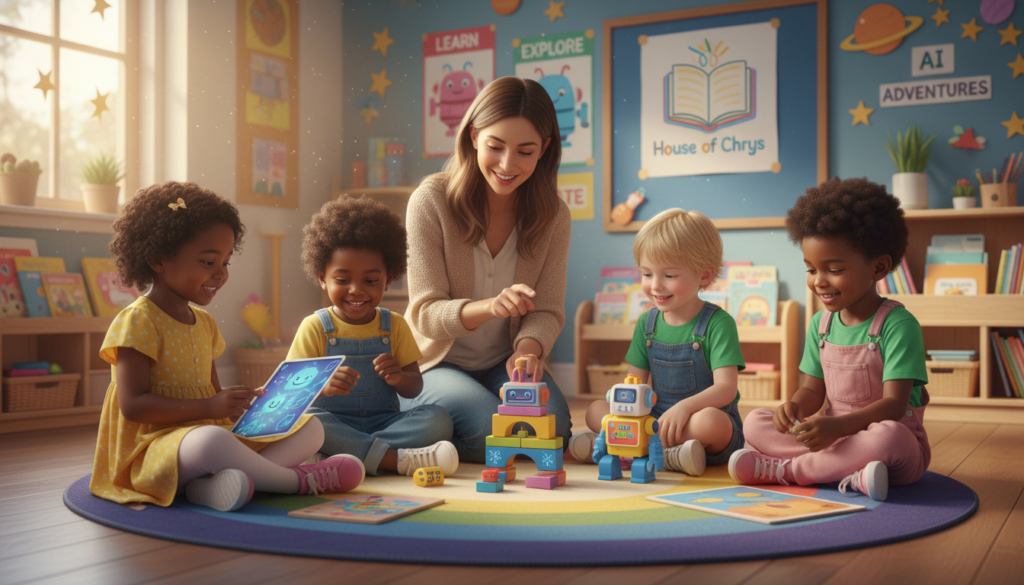
The most rapid brain development happens before age five. This is when you lay the foundation for all future learning. That includes how to interact with the intelligent tools shaping their reality.
Your preschooler is already an AI native. They chat with voice assistants without a second thought. That early window is wide open right now.
Seizing it builds natural comfort from the start. Good habits form before bad ones do. Critical thinking becomes their default way of engaging with digital content.
Early childhood educators are ideal guides for this education. But they need support and clear frameworks. Advocate for this understanding in your preschool’s curriculum.
This proactive way forward ensures equity. All kids, not just those with tech-forward parents, get an equal start in the digital world.
Do not wait for a formal class. Your home is the first and most important classroom. Every interaction is a lesson.
| Strategy | Starting Early (Before Kindergarten) | Waiting Until Formal School |
|---|---|---|
| Foundation for Learning | Built during peak brain plasticity; concepts integrated naturally. | Attempted after neural pathways are less malleable. |
| Relationship with Technology | Established as a tool to command; healthy skepticism begins early. | Often formed through passive consumption without critical lens. |
| Skill Development Focus | Human skills (creativity, empathy) are centered; tech is the helper. | Risk of focusing on technical use over critical understanding. |
| Equity & Access | Can be promoted universally at home, reducing future gaps. | Depends on school curriculum, risking unequal exposure. |
| Parental Role | Proactive guide using everyday moments as teachable opportunities. | Often reactive, trying to correct established habits later. |
Consider this simple example. When your child asks a device a question, you add one more. Ask, “How do you think it knew that?” This turns use into insight.
The early window is a gift of timing. It allows you to build the right framework before wrong assumptions set. Your action today shapes their understanding for a lifetime.
Parents and teachers together can harness this period. The goal is a child who sees the machine clearly. They use it without being used by it.
That journey begins long before the backpack is packed. It starts with your next conversation.
Practical AI Literacy Strategies by Age Group
The same strategy will not work for your toddler and your teenager—their minds are built differently.
Your approach must evolve. It must match their cognitive and social development. This is not a single lesson. It is a progressive journey.
Research confirms even preschool-aged learners can grasp core concepts. They can assess a system’s strengths and limits through play.
Your role is to provide the right strategies at the right time. You build a ladder of understanding, one rung at a time.
For Preschoolers (Ages 3-5): Play-Based Concepts
At this stage, everything is play. This is your most powerful tool.
Use a voice assistant together. Explain plainly: “It’s a machine that follows instructions. It heard your voice.”
Play “robot and commander.” Your child gives clear, simple commands. You act them out. This teaches clear communication—a foundational skill.
Ask direct questions. “Can this toy feel happy?” Guide them to the answer: “No. Only people can feel.”
This plants the vital seed. Technology is a helper. It is not a friend with feelings. The line is drawn with gentle clarity.
Their learning is embodied. It happens through movement and simple conversation. You are building their first mental model of intelligent machines.
For Elementary Students (Ages 6-10): Interactive Exploration
Curiosity explodes here. Channel it into interactive discovery.
Have your child ask a smart system a question. Then, fact-check the answer together. Use a book or a trusted website.
This single activity teaches a monumental lesson. The machine’s output is a starting point, not a final truth.
Discuss how platforms pick their next video. Say, “The computer guessed you’d like that. It’s making a prediction.” Introduce the idea that these systems can be wrong.
Progressive understanding turns users into investigators. They stop consuming and start questioning.
Show them a funny, obviously incorrect AI-generated image. Laugh about it. Then ask, “How did it get this so mixed up?”
This way of engaging transforms them from passive viewers to active explorers. They begin to see the technology as something to interrogate.
For Tweens and Teens (Ages 11+): Critical Evaluation & Ethics
The conversation shifts dramatically. Now it’s about critical evaluation and ethics.
Have them debate a real-world dilemma. Should an automated system be used to grade essays? Where is the line between help and cheating?
Analyze a generated response together. Hunt for bias, inaccuracy, or hidden assumptions. Teach them to look for the warning labels on these tools.
This is where digital citizenship takes center stage. Discuss their responsibility in using and questioning these powerful systems.
Their work should involve these tools as thought partners, not answer keys. Encourage them to use a chatbot to brainstorm, then to refine and verify the ideas themselves.
The goal is self-guided critical thinking. They learn to command the tool with sophistication and ethical awareness.
These strategies turn abstract ideas into daily practice. They meet your young person exactly where they are.
The journey moves from guided play to self-guided critique. You are building progressive independence.
| Age Group | Core Strategy | Key Activities | Desired Outcome |
|---|---|---|---|
| Preschool (3-5) | Play-Based Foundation | “Robot & Commander” game, simple machine explanations, emotion differentiation. | Understands technology as a non-feeling tool that follows commands. |
| Elementary (6-10) | Interactive Exploration | Fact-checking AI answers, discussing recommendation algorithms, finding humorous errors. | Sees systems as fallible predictors; begins to question digital content. |
| Tweens & Teens (11+) | Critical Evaluation & Ethics | Debating AI use cases, analyzing outputs for bias, practicing digital citizenship. | Commands technology ethically; evaluates information with a critical, independent mind. |
Consider this example. A ten-year-old fact-checks a science answer. A sixteen-year-old debates the ethics of facial recognition.
Both are climbing the same ladder. Each step is tailored to their age and stage.
Your guidance provides the structure. Their growing minds do the work. This is the way to prepare them for the world ahead.
Tools and Resources for Building AI Literacy
That small warning label on your chatbot holds more wisdom than you might realize.
It’s a gateway to understanding. You don’t need a PhD in computer science. You need the right tools and resources to start the conversation with your young one.
This is about practical support. We translate complex ideas into actions you can take tonight.
Begin with what already exists in your home. The smart speaker, the tablet, the search engine—these are your first tools. Use them with intention.
Activate “polite mode” on your voice assistant. This simple setting teaches respect for both machine and human.
Point directly to that warning message. Say, “See this? It means the system can make mistakes. Let’s check its answer together.”
The most effective resources aren’t always new purchases. They’re the conversations you build around the technology you already own.
Seek out free, reputable resources designed for families. Organizations like Common Sense Media and Day of AI offer excellent starting points.
Their free toolkit includes videos and interactive activities. These materials help families explore intelligent systems together.
Many comprehensive programs exist in research settings. They are not yet widely available commercially. This gap makes your role at home even more critical.
Look for apps and games that teach computational thinking through play. These involve simple programming logic. They build foundational skills in a fun way.
Curate a shortlist of YouTube channels or podcasts. Find those that explain complex concepts in a kid-friendly manner. This content sparks curiosity and questions.
The best resource is often a simple conversation prompt. Try this: “Let’s ask the assistant this question. Then we’ll look for the same answer in your book.”
This way of learning transforms consumption into investigation. Your child becomes an active participant in their own development.
Remember this truth. The most powerful tool is your own guidance. Your questions and discussions turn any piece of technology into a literacy lesson.
You provide the critical lens. Your young one learns to evaluate information with a discerning eye. This work builds future-ready minds.
We will point you to specific, vetted starting points. You won’t waste time searching through endless options. Here is a clear path forward.
| Resource Type | Specific Example | Primary Benefit | Best For Age Group |
|---|---|---|---|
| Free Educational Toolkits | Common Sense Media & Day of AI Family Toolkit | Structured activities for co-learning at home | Elementary & Middle School |
| Built-in Tool Features | “Polite Mode” on voice assistants; ChatGPT warning labels | Teaches critical evaluation and digital etiquette | All ages (with parental guidance) |
| Play-Based Learning Apps | Games teaching basic programming logic (e.g., Lightbot, ScratchJr) | Develops computational thinking through engagement | Preschool & Elementary |
| Curated Digital Content | Kid-friendly YouTube channels explaining how technology works | Makes complex ideas accessible and interesting | Elementary & Tweens |
| Conversation Prompts | “Let’s fact-check the assistant’s answer together.” | Turns everyday use into critical thinking practice | All ages |
Consider this real example. A parent uses the Day of AI video with their ten-year-old. They pause to discuss each key point.
The child begins to ask questions about their own games. “Does this app learn from what I do?” This is the moment of true learning.
Your school may not yet have formal programs. Your home becomes the primary classroom. You are the most important teacher.
This approach to education is proactive. It builds understanding before confusion sets in. Your child gains confidence with these systems.
They learn to see technology as a tool they command. They are not passive consumers of its content.
The goal is to equip your young person with practical skills. These resources provide the map. Your guidance lights the path.
Start with one item from the table above. Choose the one that fits your family’s rhythm. The conversation you begin today shapes their tomorrow.
The Parent’s Role: Guiding Healthy AI Habits at Home
Your calm explanation about the smart speaker being just a program is the first defense against digital confusion.
This clarity is your primary support. It prevents your young ones from forming a fuzzy relationship with machines.
You are the chief ethics officer for technology in your home. Your role is not to police. It is to guide.
Model the behavior you want to see. Say “please” and “thank you” to voice assistants.
Explain you are practicing good habits for talking to people. This simple act builds a bridge between digital interaction and real-world respect.
Your transparency about the nature of these systems is non-negotiable. Tell your son or daughter plainly: “It’s a program, not a person.”
This understanding strengthens their ability to engage effectively. They know its limits from the start.
Create tech-free zones and times. Meals and bedtime are sacred for human connection.
This practice reinforces a vital truth. Your family’s life together comes first. Screens are tools, not the center.
Co-engage with intelligent systems. When your child uses a chatbot, sit with them.
Read the output together. Ask, “Does that sound right to you?” This turns a solitary activity into a shared investigation.
You are building critical thinking in real time. Your questions model how to interrogate information.
The parent provides the context machines cannot: the values, the empathy, the big-picture ‘why.’ That is the irreplaceable human role.
Set clear rules of engagement. One family rule might be: “We always fact-check important information from these tools with another source.”
This isn’t about distrust. It’s about teaching discernment. You are showing a way to verify and learn.
Your role is to provide the context machines lack. You supply the values, the empathy, the moral compass.
This guidance is an extension of what you already do. You teach kindness, honesty, and hard work.
Guiding technology use is simply the new frontier for those same lessons.
| Parent’s Guiding Role | What Machines Cannot Provide | Practical Family Habit |
|---|---|---|
| Ethical Framework | Moral judgment, understanding of right and wrong | Discussing why we don’t use tools to cheat on homework |
| Emotional Context | Genuine empathy, shared joy, comfort | Prioritizing a hug over asking a device for comfort |
| Critical Verification | Independent fact-checking, sourcing | Looking up an answer in a book after hearing a chatbot’s reply |
| Intentional Modeling | Demonstrating respectful communication | Using “please” with a voice assistant to practice politeness |
You are building a family culture. In this culture, technology is used intentionally. It is not mindlessly consumed.
This support system you create is your child’s greatest asset. It frames the tool within a world of human values.
Consider this example. Your child gets a confusing answer from a search. You sit down and trace the content together.
You ask, “Where else can we look?” This way of learning builds resourcefulness. It turns a moment of confusion into a lesson in problem-solving.
Your development as a parent now includes this digital layer. It is not another chore.
It is the natural next step in preparing your children for their future. You are guiding healthy habits that will last a lifetime.
The goal is a young person who commands the tool. They do so with your wisdom as their compass.
The Educator’s Role: Integrating AI Literacy into School
The most important professional development many educators haven’t received is training for the AI-driven classroom.
They stand on the front lines. Yet, they often lack the resources and formal support to teach this new layer of understanding. This gap is a systemic risk to our students.
Your child’s teacher is not a technician. Their role is to integrate these ideas across subjects. It’s not a separate class. It’s a lens for all learning.
In English, students can analyze a poem generated by a machine. They discuss what feels human—and what feels hollow. In social studies, they debate the ethics of autonomous systems in modern conflict.
In math, they examine how a simple algorithm makes a prediction. This cross-curricular way of teaching builds true comprehension.
An educator’s job is no longer to be the sole source of information. It is to be the guide who helps students navigate a world overflowing with it.
Professional development is non-negotiable. Schools must invest in training for all educators. This includes early childhood teachers, who are too often left out of national initiatives.
These teachers shape young minds during the most formative years. Excluding them creates a foundational gap before a child even enters first grade.
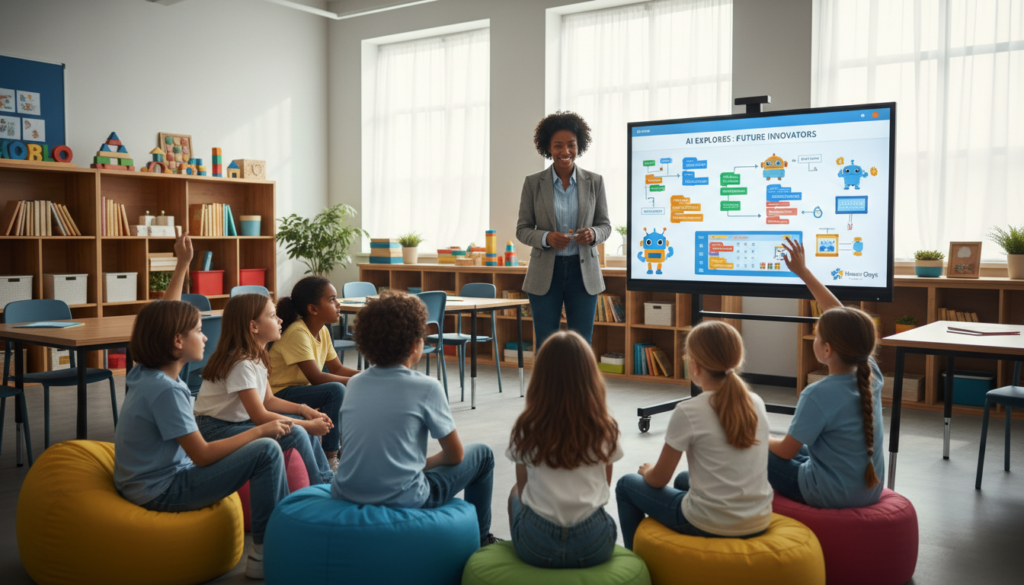
Empowered educators create a classroom culture of critical questioning. They model the questions: “What can this tool do? Where might its information be wrong or biased?”
This shifts the entire dynamic. Students learn to interrogate technology, not just consume its content.
They don’t need to start from scratch. Free, high-quality curricula exist. Organizations like Day of AI provide structured lessons. These materials offer a clear starting point for busy teachers.
Collaboration with parents magnifies the impact. A teacher can send home simple conversation starters. “Ask your child about the algorithm we discussed today.” This bridges the school and home learning environments.
When educators are equipped, they undergo a powerful transformation. They move from being gatekeepers of knowledge to becoming guides in a complex landscape.
They help students discern signal from noise. They turn every piece of technology into a tool for deeper inquiry.
| Teaching Aspect | Traditional Approach | AI-Literate Teaching Approach |
|---|---|---|
| Primary Role | Deliverer of content and information | Guide for evaluating and applying information |
| Classroom Culture | Focused on memorization and correct answers | Fosters critical questioning and productive skepticism |
| Curriculum Integration | Technology taught as a separate, siloed subject | AI concepts woven into English, history, math, and science lessons |
| Student Output | Individual work judged for accuracy | Collaborative analysis of machine-generated content for depth and bias |
| Professional Development | Focus on classroom management and standard pedagogy | Includes training on evaluating digital tools and teaching digital citizenship |
Consider this concrete example. A history teacher uses a chatbot to generate two accounts of the same event. The students‘ task is to find the discrepancies and hypothesize why they exist.
This way of teaching builds skills no machine can replicate. It builds historians, not just note-takers.
The support system for educators must be robust. It’s the only way to ensure every child, in every classroom, gains this essential understanding.
Your advocacy matters. Ask your school about their professional development plans in this area. The teacher your child has next year needs that support today.
When educators are empowered, they light the path. They prepare your young ones not just for tests, but for the world they will lead.
Building a Support System: Schools, Policy, and Community
State standards for early learning are not bureaucratic paperwork. They are blueprints for future-ready minds.
You cannot build this understanding alone—and you should not have to. A robust support system multiplies your efforts. It turns your guidance into a cultural norm.
Your home is the first classroom. The community and the schools are the pillars that hold up the entire structure. This triad must work together.
Clear policy is the engine for change. Many districts reacted with panic—banning tools like ChatGPT outright. This is a missed opportunity.
Advocacy is your new work. Attend PTA meetings. Demand policies that promote understanding, not fear. Push for education on how to use these systems wisely.
Embedding these concepts into frameworks like Head Start is a two-generation strategy. It prepares both the child and the parent for the world ahead.
Policy must fund teacher training. It must include early childhood standards. The Head Start Early Learning Outcomes Framework guides state-level standards.
This is a powerful lever. It presents an opportunity to embed core ideas at scale. Young children learn that technology is a helper.
They also learn its limits. This early foundation is non-negotiable. It ensures equity from the start.
Community organizations are the third pillar. Libraries and after-school programs can offer workshops. They create access for all families.
These spaces turn abstract ideas into hands-on learning. A library workshop demystifies a smart tool. It builds confidence in both students and parents.
Your own network of parents is vital. Share resources and discuss challenges. Create a united front of informed guidance.
This shared support is powerful. You are not navigating this new terrain in isolation. You have a team.
| System Element | Fragmented Approach | Integrated Support System |
|---|---|---|
| School Policy | Reactive bans on new technology; creates confusion and fear. | Proactive literacy frameworks; teaches critical use and digital citizenship. |
| Teacher Training | Underfunded, optional professional development; leaves educators unprepared. | Funded, mandatory training; empowers teachers to integrate concepts across subjects. |
| Early Childhood Standards | Ignore intelligent systems as a domain of learning and development. | Embed concepts in state frameworks (e.g., Head Start); builds foundation during peak brain plasticity. |
| Community Role | Sees tech as purely home or school responsibility; creates access gaps. | Libraries & orgs host workshops; provides equitable, hands-on education for all families. |
| Parental Network | Isolated efforts; inconsistent messages at home. | Shared resources & strategies; amplifies guidance and creates cultural consistency. |
Consistency is the magic. Your child hears the same message about critical thinking from you, their teacher, and their mentor. This repetition builds deep understanding.
A strong support system turns individual action into a cultural shift. It prepares an entire generation, not just one child.
Your voice as a parent is powerful in demanding this systemic support. Use it in school board meetings. Use it when talking to other parents.
Here is a simple example. Your school district is debating a new tech policy. You speak up. You ask not for a ban, but for a committee to create guidelines for responsible use.
That single action shifts the entire way a community approaches the technology. It moves from fear to empowerment.
The goal is a seamless ecosystem. Home, school, and community work in harmony. They provide a consistent stream of good information and critical content.
This is how we build future-ready humans. Not through one lesson, but through a world that teaches them to think.
- Advocate for Policy: Push your schools to adopt literacy frameworks, not blanket bans.
- Demand Teacher Training: Ensure educators get the professional development they need.
- Leverage Community Hubs: Support library and after-school programs that offer tech education.
- Build Your Parent Network: Create a group to share resources and strategies.
- Speak with One Voice: Ensure your child hears consistent messages from all the adults in their life.
The system is waiting to be built. Your action is the first brick.
Ethical Considerations and Digital Citizenship
Digital citizenship begins when your young one questions not just how a tool works, but whether it should be used that way.
This is the final layer of true understanding. It moves beyond mechanics into morality. Your child learns to command the technology with a conscience.
Without this, they are powerful users with no moral compass. That is a dangerous way to navigate the digital world.
Teach this core idea: intelligent systems reflect human biases. They learn from data created by people.
If that data is flawed or unfair, the outputs will be too. Discuss a real example. A hiring tool that unfairly filters resumes.
Ask your child: “Who might be hurt by a machine’s mistake?” This builds the critical thinking that questions systems, not just accepts them.
Ethics is the guardrail. It keeps powerful technology in service of humanity, not the other way around.
Responsible use is non-negotiable. Digital citizenship means your child does not use these systems to plagiarize work.
They do not create deepfakes to harm others. They are transparent when artificial intelligence helps with school projects.
This honesty is a mark of character. It turns a shortcut into a learning moment with integrity.
Every search and command leaves a data trail. This is their digital footprint.
The information they feed these systems today shapes the responses for all students tomorrow. Your child is not just a user—they are a contributor.
Understanding this connection is vital. It teaches them to be mindful of the content they create and share.
| Scenario | Unethical Use | Ethical, Citizen-Like Use |
|---|---|---|
| School Assignment | Copying a chatbot’s essay and submitting it as original work. | Using the tool to brainstorm ideas, then writing original analysis and citing the assistance. |
| Online Interaction | Using a voice clone or deepfake to mislead or bully a peer. | Creating transparent, labeled experiments with generative technology for a class project on media. |
| Encountering Bias | Accepting a biased search result or recommendation without question. | Noticing skewed information, asking questions about its source, and seeking diverse perspectives. |
Look behind the screen. Encourage your young person to think about the humans in the loop.
Consider the programmers who set the goals. The data labelers who make judgments. The communities impacted by automated decisions.
This perspective builds empathy. It reminds them that code is written by people with values—and sometimes, blind spots.
These conversations are where moral reasoning grows. They move your son or daughter from a consumer to a conscientious participant.
You are not just raising a smart user. You are raising a good neighbor in a global digital community.
Start the dialogue with simple, powerful questions:
- “Is this fair?” When a recommendation seems off, explore why.
- “Who made this?” Trace the technology back to human creators.
- “What if everyone did this?” Apply the golden rule to digital actions.
- “What data am I giving away?” Discuss privacy as part of their digital footprint.
This ethical development is the ultimate learning. It prepares your children to lead with both skill and heart.
The way forward is clear. Build the guardrails today, so they can build a better tomorrow.
Looking Ahead: The Future Skills AI-Literate Kids Will Need
Tomorrow’s leaders won’t be defined by what they know, but by how they learn and adapt alongside intelligent tools.
The coming world belongs to young people who can do what machines cannot. They will empathize deeply. They will create from a blank page.
They will ask the novel question that no dataset has seen. Most of all, they will build genuine trust.
Technical skills will change with each software update. Human skills are eternal. Double down on creativity, collaboration, and complex problem-solving.
These are the muscles your child must exercise every day.
One new capability will be essential: “prompt literacy.” This is the art of crafting clear questions and instructions. It guides a tool to useful outcomes.
The most valuable employee won’t be the one who knows the most facts. It will be the one who can best collaborate with the system to discover new ideas.
Adaptive learning will be a core discipline. Your child must update their knowledge constantly as technology evolves. This is a mindset, not a one-time lesson.
They will need the wisdom to choose. When should they rely on machine output? When must they trust human intuition and judgment?
This discernment separates a savvy user from a wise leader.
The nature of work is shifting. It will involve partnering with these systems, not being replaced by them. Teach your son or daughter to see it as a collaborator.
Show them a practical example. Use a voice assistant to brainstorm story plots. Then, they write the final draft with their own voice and heart.
This collaborative way of working builds the future.
These future-ready skills are not built tomorrow. They are built on the foundation you lay today. Every conversation about how a machine thinks is a brick in that foundation.
Your child won’t just consume digital content. They will evaluate its source and purpose. They will become creators of new information.
Their development now prepares them to shape the systems that will shape everyone’s lives.
- Empathy and Creativity: The irreplaceable human core. Nurture these through unstructured play and deep conversation.
- Prompt Crafting: Practice turning vague curiosity into precise, effective questions with any digital helper.
- Adaptive Mindset: Celebrate the process of learning how to learn, not just getting the right answer.
- Ethical Judgment: Discuss real-world dilemmas. Should an algorithm decide who gets a loan? Why or why not?
- Collaborative Partnership: Frame technology as a teammate for complex projects, handling data while the human provides strategy and heart.
Students who grasp this today won’t just survive the automated future. They will help design it.
Your role is clear. You are building more than a skilled person. You are building a future architect.
Conclusion: Empowering the Next Generation for an AI-Driven World
The journey you begin today is not about mastering a machine—it’s about mastering the future your child will shape.
You hold the map. Start early. Draw that critical line between human and machine. Use age-appropriate strategies. Build a support system with school and community.
True power comes from knowledge, not anxiety. Every conversation builds essential learning. You nurture a person who generates new ideas and evaluates information critically.
This work starts in your home. It grows in their classroom. It expands into the world. Your love is the most powerful tool for their development.
Breathe. Move forward with hope. Your children, equipped with understanding, will help write the next chapter.