
What if the most important story for your child’s future hasn’t been written yet—and you’re the one who must write it?
The digital landscape is evolving at a breathtaking pace. Your child will navigate a world intertwined with artificial intelligence. You have a responsibility—right now—to prepare them.
This isn’t about panic. It’s about purposeful action. In late 2023, even Apple’s Education Community highlighted guides for using this technology to craft stories for young readers. The signal is clear.
By taking control of the creative process, you ensure the narratives your family consumes are educational and deeply personal. You move from spectator to author.
This guide provides the foundational knowledge to transform your parental inspiration into a tangible, high-quality book. We will explore leveraging modern tools to craft meaningful experiences that resonate with your child’s unique interests.
Key Takeaways
- Your active role is crucial for guiding your child through a rapidly evolving digital future.
- Building AI literacy skills early is a core component of being future-ready.
- Personalized stories you create have more educational impact and personal connection.
- Foundational knowledge empowers you to turn inspiration into a real, physical book.
- Modern creative tools are designed to help you craft experiences that truly engage young minds.
- Starting this journey ensures the media shaping your child’s worldview aligns with your values.
Unleashing the Power of AI for Children’s Storytelling
Your child’s favorite things are not generic—why should their stories be?
This technology builds a direct bridge. It connects your parental insight to their vibrant inner world. You are not generating text. You are crafting a shared language of wonder.
Consider a real example. A fellow parent recently used ChatGPT. He needed a unique children book for his seven-year-old daughter. Her passions were specific: purple, princesses, and pandas.
The tool delivered a complete story about a purple princess panda in minutes. The tale was perfectly tailored. It resonated deeply because it spoke her language.
This is the core power. You can iterate rapidly. Adjust the hero’s quest or the lesson learned until it clicks. The tool is a partner. It helps you overcome the blank page—that initial hesitation that stops so many.
By embracing this approach, you provide your family with something priceless. You create narratives that are engaging and profoundly personal. They far surpass any mass-produced tale from a store shelf.
Brainstorming and Developing Creative Story Ideas
That quirky bedtime ritual or the way your child arranges their toys—these are the raw materials of a great narrative.
The initial idea might seem small. A mispronounced word. A collected rock. Yet it contains immense potential.
Your most compelling story does not come from a generic template. It emerges from the habits and traditions that define your home. Observe closely during daily routines.
Bath time splashes or mealtime conversations hold perfect seeds. These moments are your blueprint.
When you focus on these personal details, you build a narrative that feels authentic. It connects deeply to your family’s shared history. This authenticity resonates with young readers.
Do not fear unconventional ideas. The most memorable outcomes often spring from the unexpected. A child’s unique fear of the dark can become a powerful plot.
Your goal is clear. Weave the fabric of your family’s life into a tangible format. This creation becomes a cherished artifact for years to come.
How to Write an AI Children’s Book
Your first draft is a map—it guides the journey from a simple idea to a finished tale.
Start with a rough outline. Capture the beginning, middle, and end. This skeleton provides direction. It prevents creative drift.
Define character motivations clearly. Why does your hero act? This clarity ensures the narrative flows logically from one scene to the next.
Structure is the silent teacher within every great children’s book.
Incorporate repeated phrases or playful sound effects. These rhythmic elements keep your young audience fully engaged. They build anticipation.
| Planning Phase | Key Action | Outcome |
|---|---|---|
| Outline Drafting | Sketch beginning, middle, end | A clear narrative path |
| Character Definition | Clarify motivations and desires | Logical, relatable story flow |
| Engagement Design | Add repeated phrases & sounds | Sustained young reader interest |
Invest time in this planning phase. The actual process of crafting the story becomes smoother. It becomes more enjoyable for you.
Your primary objective is clear. Create a book that serves as a meaningful educational tool. This story you build prepares them for the future.
Crafting Engaging Characters with AI Support
The most relatable characters often live right under your roof—observe and listen.
Your tools provide structure. Your family provides the soul. This partnership creates figures that leap off the page.
Developing Relatable Character Personalities
When writing for children, build detailed profiles. Reflect the quirks and passions of people you know best.
Ask what they desire. Discover what brings them joy. This depth moves beyond a simple sketch.
| Trait Source | Profile Detail | Narrative Impact |
|---|---|---|
| Real-Life Inspiration | Specific & Personal | Deep Emotional Connection |
| Generic Template | Vague & Common | Surface-Level Engagement |
| Family Tradition | Unique & Cultural | Lasting Memorability |
Consistency in these characters is non-negotiable. It maintains your narrative’s integrity from start to finish.
Drawing Inspiration from Family and Tradition
Ground your creations in reality. My own story drew from my sons, Vince and Lewis.
They were four and two years old. Their real traits became my heroes’ blueprints.
This method ensures every scene resonates on a profound emotional level. Your child sees their world reflected back at them.
That connection is your ultimate goal. It turns a simple tale into a cherished family artifact.
Designing Memorable Settings and Scenes with AI
The world your characters inhabit is not a backdrop—it is a living, breathing character itself.
You must describe the environment with precise detail. This allows the technology to visualize the setting accurately for your story. Generic prompts produce generic images.
I used a specific detail from our life. I described the red asphalt road near our home. This made the final image feel familiar and deeply grounded for my children.
Focus on lighting and atmosphere in your description. Are you creating a beautiful summer’s day? Is the mood playful or serene? These elements define the emotional tone of your scenes.
The visual setting acts as the stage. Every background element must support the action on the page. A cluttered or mismatched environment distracts from your characters’ journey.
By crafting your visual prompts with care, you build stunning worlds. You bring your unique family narrative to life in vivid, tangible detail.
Integrating Moral Lessons and Educational Value
Your child’s emotional toolkit is built one story at a time.
Every meaningful narrative should incorporate a moral lesson. It helps young minds navigate their feelings and understand the world. This guidance is not an extra feature—it is the core purpose.
My sister pushed me to include such a lesson in my own tale. She reminded me of the Pixar films from my childhood. Those stories entertained while teaching resilience and kindness.
You can show your family that anger is a natural emotion. The key is learning to channel that energy appropriately. Your characters can model this healthy expression.
Educational value deepens when you tackle real-world issues. Discuss a problem like pollution within the plot. Brainstorm solutions together with your heroes on the page.
By weaving these lessons into the adventure, you provide essential tools. Your children gain strategies for complex feelings and social duties. This preparation is your lasting gift.
Writing a Compelling Story Outline for Young Readers
Structure is the invisible scaffold that turns whimsical ideas into unforgettable journeys. Your story outline is not a constraint—it is the foundation for a meaningful adventure.
I studied the craft by watching behind-the-scenes documentaries of Pixar’s Finding Nemo countless times. That effort revealed the meticulous planning behind every great narrative.
Building a Structured Narrative from Scratch
To craft tales that captivate, follow the classic arc of a hero’s journey. This framework provides a reliable path from beginning to end.
Your outline must clearly define why your characters act. This clarity eliminates confusion for the young mind following along.
| Outline Component | Essential Question | Impact on Young Reader |
|---|---|---|
| Character Motivation | Why does the hero seek this goal? | Builds empathy and understanding |
| Plot Progression | What obstacle must be overcome next? | Maintains suspense and engagement |
| Thematic Depth | What core lesson is being taught? | Provides lasting educational value |
A strong outline acts as your roadmap. It prevents you from getting lost during the creative process of developing your manuscript.
By focusing on structure early, you ensure your narrative has the depth and cohesion needed. This keeps children interested until the final page of your book.
Refining Your Story with AI Feedback and Iteration
Your initial draft is a starting point—not the final destination. Every great narrative undergoes a process of refinement. This is where your story transforms from good to unforgettable.
You should use tools like Claude as a writing assistant. Its role is to push back on your ideas and suggest meaningful improvements. This partnership provides the honest critique every creator needs.
When I asked for feedback, the AI suggested a monster wanting to eat kids might be too scary for a two-year-old. That external perspective is invaluable. It protects your young audience from unintended fear.
Iteration is the key to success. Be prepared to rewrite entire sections based on constructive criticism you receive. This willingness to revise separates a draft from a polished tale.
You can ask the AI to help expand on how characters become friends. This adds emotional weight to the final resolution. The narrative gains depth and lasting impact.
By constantly refining your work, you ensure the final product is perfectly suited for your specific audience. It becomes age-appropriate, polished, and deeply resonant. That is your ultimate goal.
Creating Stunning AI-Generated Illustrations
Your investment in illustrations is not just about cost—it’s about creative control. I spent €16,16 testing DALL-E and €11,60 on a Leonardo.ai subscription. This comparison was essential.
When you create visual content for your book, the right model is critical. It determines the quality of your final images.
Comparing AI Image Tools: DALL-E vs. Leonardo.ai
Each tool offers a different path to your visual story. Your choice defines your workflow.
| Tool | Key Trait | Best For |
|---|---|---|
| DALL-E 3 | Automatic Prompt Augmentation | Rapid, varied concept art |
| Leonardo.ai (Phoenix) | Precise Prompt Control | Consistent, page-to-page style |
I initially struggled with DALL-E 3. It constantly rewrote my prompt. This made maintaining a single visual style nearly impossible.
Switching to the Phoenix model on Leonardo.ai changed everything. I gained the control needed for consistent characters and scenes.
You must experiment with different prompts. See which tool delivers the best results for your vision. This process teaches budget and time management.
By comparing, you learn to produce professional-looking images efficiently. Your final image for each page will feel cohesive and intentional.
Ensuring Consistent Character Imagery in AI Artwork
The magic of a great story is broken when the hero looks different from one scene to the next.
Your child needs to recognize their friends on every page. This visual trust is non-negotiable.
I used the character reference feature in Leonardo.ai. It locked the appearance of my sons, Vince and Lewis, across the entire manuscript.
Your tools have this power. You must learn to wield it.
Using Reference Images and Detailed Prompts
Start with a clear reference image. Upload a portrait of your hero. This gives the model a blueprint to follow.
Then, craft a detailed description for every single prompt. Include hair color, eye shape, and favorite outfit.
My most difficult character was a foam monster. A precise description of its texture and size finally yielded the perfect image.
These techniques generate reliable results. Your characters become constant companions.
| Technique | Implementation | Result |
|---|---|---|
| Character Reference Images | Upload an initial portrait | The AI recalls exact features page after page |
| Detailed Text Prompts | Include specific traits in every prompt | Reliable generation of consistent characters |
| Style Guidance Settings | Adjust parameters for uniformity | Cohesive visual content throughout the story |
Master these technical aspects. Your images will form a unified visual world.
The final content feels professional. It honors the story you worked so hard to build.
Overcoming Technical Challenges in AI Illustration
The path to a polished visual narrative is paved with patience and technical precision. Expect each generated image to take 30 seconds or more. This wait is normal—your creative partner is building a world from your words.
When the results deviate from your vision, do not get discouraged. Simply regenerate the image. Refine your prompt and adjust the model settings until it matches your character description perfectly.
Post-generation work is often required. I spent two hours in Pixelmator making small edits. This ensured the text was legible on every page of the final book. Your persistence defines the quality of the final artifact.
| Common Challenge | Your Action | Final Result |
|---|---|---|
| Slow generation times | Practice patience; queue multiple prompts | Steady workflow without frustration |
| Inconsistent characters | Use reference images & detailed descriptions | Cohesive visual content throughout the story |
| Low text legibility in images | Use editing software for final touches | A professional, readable book |
Document your process. Note which prompts yield the best results. This turns today’s hurdles into tomorrow’s efficiency. You become more adept at creating illustrations for future projects.
Merging Traditional Storytelling with Modern AI Tools
For years, the desire to create a tangible family heirloom felt just out of grasp. I have always wanted to write a book. Merging traditional habits with modern tools finally made it possible.
I spent five focused hours in Obsidian. This tool became my digital notebook. It organized my content and kept the story structured.
The AI acted as a brainstorming partner. It provided sparks of inspiration when my own ideas stalled. This partnership is powerful.
Your process becomes about weaving the fabric of your family’s history. You transform memories into something you can hold. The final artifact is deeply personal.
By combining your unique voice with technological efficiency, you create a hybrid. It blends human emotion with modern capability. The result feels authentic.
This approach yields a high-quality narrative. It resonates because it is connected to your core values. You are not just creating—you are preserving.
Budgeting and Time Investment for AI Story Projects
The final tally of hours and euros tells only part of the story—the rest is written in personal connection.
My total investment was 15 focused hours. This included just 21 minutes finalizing the layout in the printing service app. Your time is the most precious resource.
In financial terms, the project cost €368,33. The bulk went toward printing high-quality final copies. This is a tangible investment in your family’s legacy.
I wanted write a book to share. So, I inscribed a personal message in each copy for friends and family. That human touch is priceless.
Track every detail in a post or simple spreadsheet. This reveals the true cost of creating your own literature. You manage your content and resources with clarity.
Plan your budget and schedule from the start. This ensures the entire process remains sustainable and deeply enjoyable. Your commitment yields a holdable treasure.
Publishing and Distributing Your AI Children’s Book
Your journey from idea to artifact culminates in a choice—keep it private or share it with the world.
In practical terms, a photo book printing service transforms your digital content into a holdable treasure. Simply upload your formatted pages. I ordered 12 final books for our closest friends.
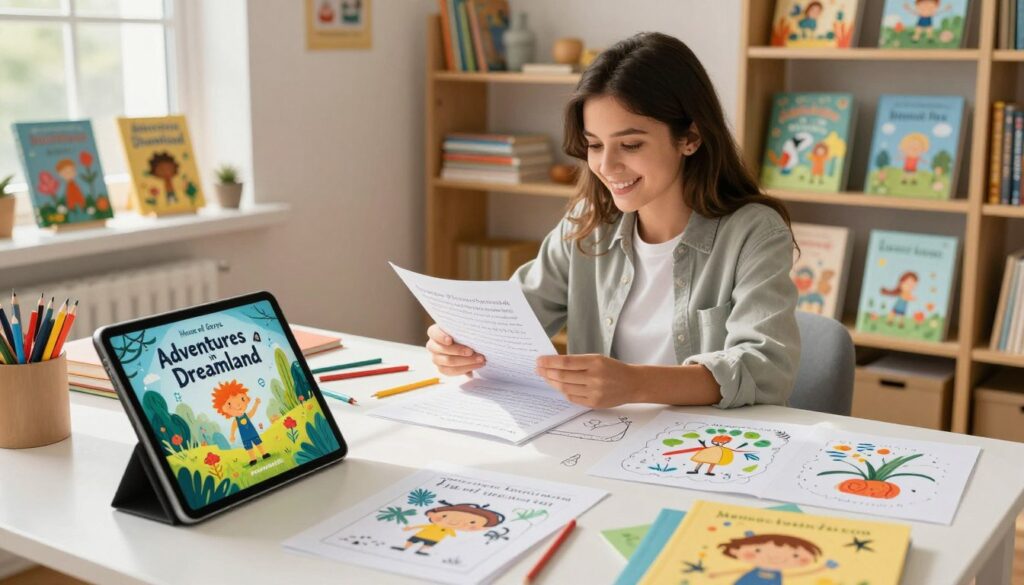
Each copy contained a personal message of thanks. This is your legacy, made tangible.
Your distribution path is yours to define. You might keep the book solely for your kids and family. Alternatively, consider platforms like the Apple Book Store for a wider audience.
Ensure your file specifications match the printer’s requirements. This attention guarantees the final quality of your children’s book.
Sharing your work is a profound, shared celebration. It honors the effort you invested in creating something truly special.
Leveraging User Testing and Feedback for Story Refinement
Your most honest critic is also your smallest audience member—watch their face as you read.
The final verdict on your narrative’s success doesn’t come from a software tool. It comes from the living room floor. This is your ultimate quality check.
Incorporating Real-Life Reactions from Kids
Conduct your test by reading the story aloud. Observe every reaction in real time. This is the only way to know if your language truly fits.
I recorded my son’s reaction for several minutes. His captivated silence was the proof I needed. He asked to read it one more time immediately after.
Your child’s engagement is the only metric that matters. Their laughter, questions, or fidgeting provide raw data. This tells you if your characters and scenes are resonating.
| Testing Method | Your Action | Key Insight Gained |
|---|---|---|
| Passive Observation | Watch for body language & focus | Identifies engaging vs. confusing pages |
| Active Prompting | Ask “What happens next?” | Reveals if the plot and characters are memorable |
| Post-Reading Review | Discuss favorite images and moments | Highlights which descriptions and words land best |
This real-life feedback is invaluable. It allows you to refine your description of events. You can ensure the words on all pages are perfectly balanced.
Watching your daughter or son enjoy the final product is the ultimate reward. It validates every minute of effort across the years. Your central idea has passed the only test that counts.
Conclusion
Your legacy is not a distant concept—it is the story you choose to tell today.
This creative process transforms you. You build lasting books for your children to cherish. These are not just tales. They are tangible pieces of your family’s heart.
By embracing these tools, you prepare your kids for tomorrow. AI literacy becomes a fundamental skill. You give them a head start in a world they will shape.
The deepest value lies in connection. Shared ideas and laughter forge bonds that last a lifetime. Use the language of technology to reflect your unique history and dreams.
Your commitment yields a treasure. Your children grow up with narratives as special as they are. This is your purposeful action—a gift for generations.