

Where Will AI Be in the Next Few Years? Elon Musk’s Question and What It Means for African Children


Elon Musk asked a question that stopped 39 million people mid scroll.
Where Will AI Be in the Next Few Years? In his exact words: Where Will AI Be in 1, 2 and 3 Years?
I noticed the engagement and I can say for free it was not accidental. It was the digital equivalent of a packed auditorium going completely silent when someone finally says out loud the thing everyone in the room has been privately thinking. Because the honest answer to that question is both more extraordinary and more urgent than most people are prepared to sit with comfortably.
This post is that honest answer. And more importantly it is the answer to the question nobody thought to ask alongside Musk’s — what does where AI is going mean for the African child sitting in a classroom right now waiting to be prepared for a world that is being rebuilt around them at a pace no classroom curriculum has ever moved?
Understanding where AI will be in the next few years is not a technology conversation. It is a parenting conversation. It is an education conversation. It is a conversation about whether Africa arrives at the next phase of human civilization as a participant or as an observer.
Where AI Is Right Now Before We Talk About Where It Is Going
You cannot understand where something is going without being honest about where it currently stands.
As of today AI systems can write, code, design, diagnose, translate, compose music, generate images, analyze legal documents, predict weather patterns, discover drugs, and hold conversations that the majority of humans cannot distinguish from interactions with other humans in controlled settings.
That is not science fiction. That is the documented baseline from which the next one, two, and three years of development begin.
The question Elon Musk asked is not really about whether AI will become more capable. That is settled. The question underneath his question is how much more capable, how fast, and what that acceleration means for human beings who are trying to figure out where they fit in a world increasingly shaped by systems they did not build and do not fully understand.
According to Stanford University’s AI Index Report AI capabilities are advancing across every major benchmark faster than researchers predicted even five years ago. https://aiindex.stanford.edu/report/
That acceleration is the most important single fact any parent, educator, or policymaker needs to understand before making decisions about children’s preparation right now.
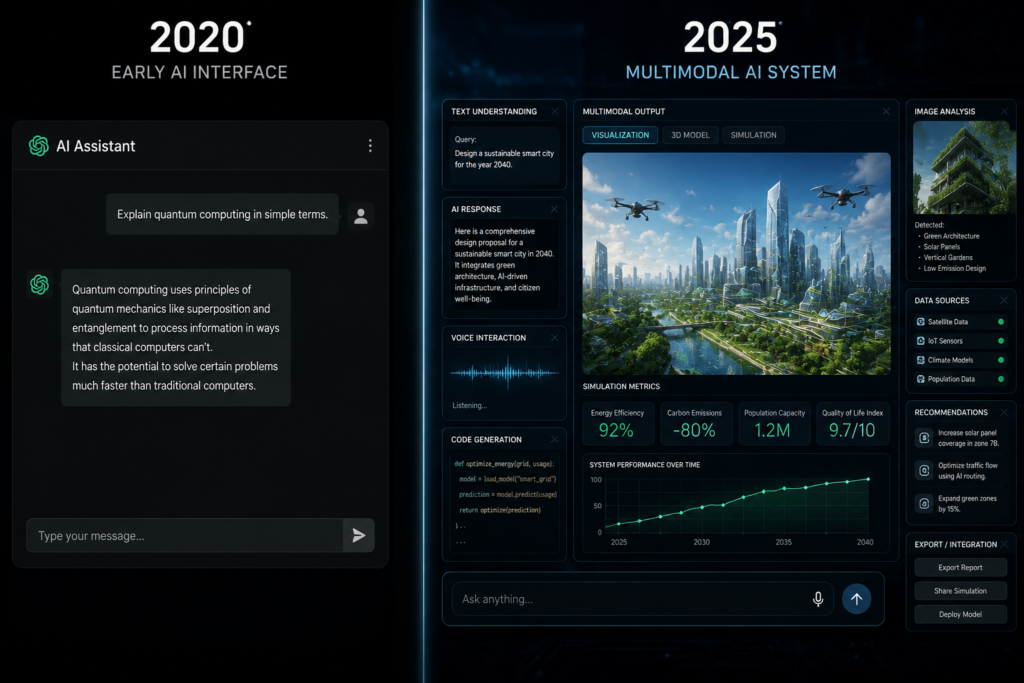
Where AI Will Be in One Year
One year in AI development is not like one year in most other fields. Given the current pace of advancement one year represents a meaningful leap rather than incremental progress.
In one year from now AI systems will be significantly more capable at what researchers call multimodal reasoning — the ability to simultaneously process and reason across text, images, audio, video, and data in ways that mirror how humans naturally think rather than how computers traditionally process information. An AI that can watch a video, read a document, listen to a conversation, and synthesize insights across all three simultaneously is not a distant concept. It is the direction every major AI laboratory is currently racing toward.
In one year the integration of AI into everyday professional tools will have deepened substantially. The software lawyers use, the platforms doctors use, the tools engineers use, and the systems teachers use will have AI capabilities embedded so deeply that the question will no longer be whether to use AI in professional work but whether you can do your job competitively without it.
For Africa specifically one year means the gap between AI adoption in developed economies and AI adoption across the continent will either narrow or widen depending entirely on decisions being made right now by governments, institutions, and individual parents. The technology does not wait for anyone to be ready. It arrives regardless.
The African parent who uses this one year to introduce their child to AI concepts, tools, and ways of thinking is making a decision that compounds for decades. The one who waits for the school system to catch up is making a different decision with equally compounding consequences.
This is what The Prepared Child was built for — the one year window that is open right now and closing gradually with every month that passes without intentional action.
Where AI Will Be in Two Years
Two years from now the conversation about AI and employment that currently feels theoretical will feel very concrete to very specific groups of people.
The roles most immediately at risk are not the ones people typically imagine. The imagination defaults to factory workers and truck drivers. The reality is more uncomfortable for educated professionals — the entry level positions in law, finance, medicine, marketing, and content creation that traditionally absorbed university graduates are the roles AI is replacing fastest because they involve processing information, applying rules, and producing structured outputs. Exactly what AI does best.
Two years from now the graduate who cannot demonstrate skills that complement rather than compete with AI systems will find the job market significantly more challenging than their predecessors found it two years before them. That is not speculation. It is the documented trajectory of every previous automation wave applied to the current one.
On the opportunity side two years from now will have produced entire new categories of work that do not have clear names yet. The person who positioned themselves at the intersection of AI capability and human judgment — who learned to direct, evaluate, and collaborate with AI systems rather than simply use them as tools — will be operating in a professional environment that rewards that positioning handsomely.
For African children two years is roughly one to two academic years. A child in primary four today is in primary six in two years. A child in JSS1 today is in JSS3. The question of whether those years include any meaningful AI literacy education is almost entirely determined by what their parents decide to do right now rather than what their schools decide to offer.
Visit our For Parents page to understand practical ways to build AI literacy at home during these two critical years regardless of what your child’s school is or is not doing.

Where AI Will Be in Three Years
Three years from now we will be living in a world that looks recognizably different from today in ways that are difficult to fully articulate right now because some of the most significant changes will be in how people think rather than just what technology can do.
The generation of children who are between the ages of four and ten right now will be between seven and thirteen in three years. The cognitive habits, the relationship with technology, the comfort with AI tools, and the fundamental orientation toward problem solving that they develop between now and then will shape their entire relationship with work, creativity, and contribution for the rest of their lives.
Three years from now AI will likely be capable of what researchers call Artificial General Intelligence at some functional level — systems that can perform intellectual tasks across domains at human level or above without being specifically trained for each individual task. Whether that milestone arrives in exactly three years is debated among experts. That it is coming within the decade is the majority scientific consensus.
The implications of that trajectory for African children are simultaneously the most urgent and the most underappreciated aspect of the entire AI conversation on this continent.
Three years from now the African child who has spent those years building familiarity, curiosity, and practical experience with AI tools will be positioned at the front of a generational shift. The one who spent those years in a school system that treated AI as someone else’s concern will be positioned significantly further back with a gap that compounds in difficulty with every passing year.
The Thinking Paradigm Shift Nobody Is Talking About
Here is what the question Elon Musk asked does not capture and what 39 million people engaging with it suggests everyone is searching for without knowing exactly what they are looking for.
The most significant thing about where AI will be in one, two, and three years is not what the technology will be able to do. It is what thinking alongside that technology will do to human cognition, creativity, and problem solving over time.
Every major technology shift in history changed not just what people could do but how people thought. The printing press changed how humanity related to knowledge. The internet changed how humanity related to information and each other. AI is changing how humanity relates to thinking itself — to the process of generating ideas, evaluating options, constructing arguments, and arriving at decisions.
The children growing up alongside AI as a natural tool are not just learning to use software. They are developing cognitive frameworks — ways of breaking down complexity, iterating rapidly on ideas, and operating at the intersection of human intuition and computational power — that will make them fundamentally different thinkers from those who came to AI late and with resistance.
That cognitive difference is the real answer to Elon Musk’s question that no technology analyst is naming directly. Where will AI be in one, two, and three years? Inside the thinking patterns of the generation currently being formed. And whether African children are inside that formation or outside it depends on decisions being made right now.
This is the founding conviction of House of Chrys. AI is neither good nor bad. We are also not saying exactly that technology solves all problems. But that the child introduced to AI literacy early enough develops a relationship with thinking and problem solving that compounds into genuine advantage across every dimension of their future life.

What African Parents Must Do With This Information
Understanding where AI will be in the next few years is only useful if it changes what you do today. Information without action is simply anxiety with better vocabulary.
Here is what the trajectory of the next three years demands from African parents specifically.
Start the conversation about AI at home regardless of your child’s age. Children between four and eight are at the optimal age for building the foundational curiosity and familiarity that makes everything else easier. The conversation does not need to be technical. It needs to be honest — AI is a tool made by people to solve problems and your child can grow up understanding it rather than being afraid of it.
Introduce age appropriate AI tools deliberately rather than letting your child’s relationship with technology be shaped entirely by entertainment algorithms. The difference between a child who uses technology passively and one who uses it actively and with intention is the difference between a consumer and a creator in the economy of the next three years.
Advocate for AI literacy in your child’s school. Ask the proprietor what the school is doing to prepare students for an AI world. The question itself creates pressure that accumulates across parent communities into eventual institutional change.
Resource your child’s preparation with the same seriousness you resource their academic tutoring, their extra lessons, and their examination preparation. The examination your child is being prepared for by the school system is largely irrelevant to the economy they are entering. The preparation that matters most right now is not happening in classrooms.
Visit The Prepared Child page to get the book that starts this preparation at the age when it matters most. Visit For Schools to bring AI literacy workshops directly into your child’s school through House of Chrys. Visit About House of Chrys to understand the full vision behind everything we are building for African children and their future.
The Question Behind the Question
Elon Musk asked where AI will be in one, two, and three years and 39 million people engaged because it is the question of our moment. But the question behind that question — the one that matters most to the African parent reading this post — is where will my child be in one, two, and three years relative to the world AI is building around them.
That question does not have a technological answer. It has a parenting answer.
The child who arrives at year one with AI curiosity already formed. The child who arrives at year two with practical AI familiarity already built. The child who arrives at year three with a thinking architecture shaped by early, intentional, fearless engagement with artificial intelligence.
That child is not guaranteed success in a world nobody can fully predict. But they are positioned at the front of the most significant human transition since the industrial revolution with something that matters more than talent, connections, or family wealth.
They are prepared.
In all things, prepare.



Really solid advice, will apply it immediately.