


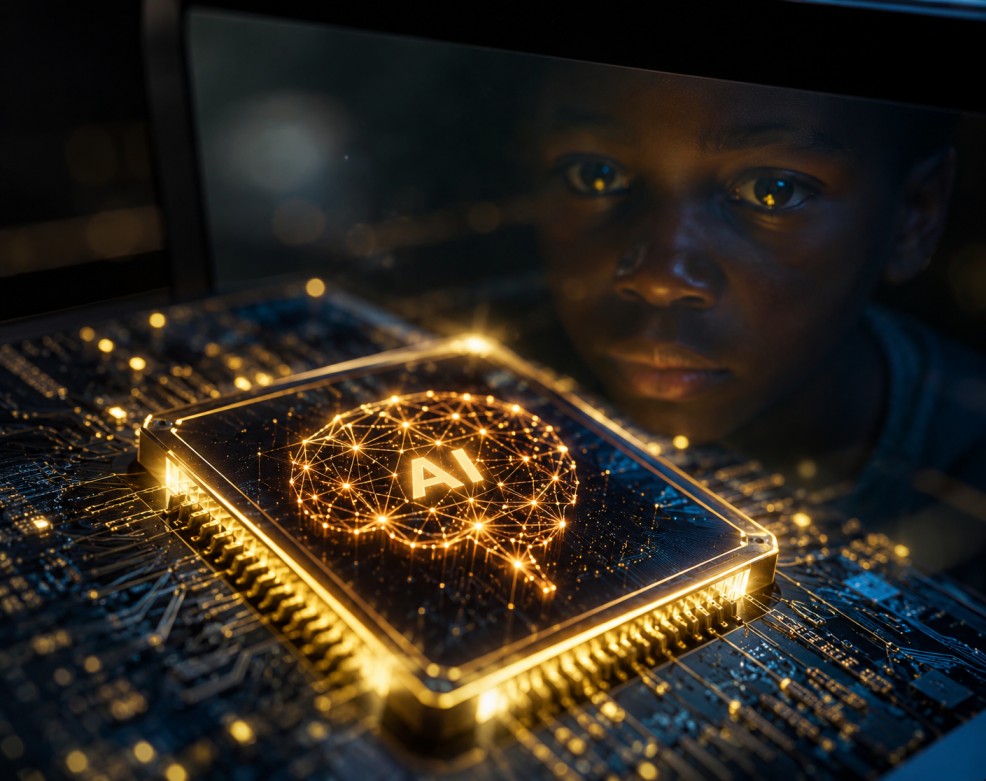
Nvidia’s Superchip Just Made African Schools More Obsolete is not a sentence that appeared in any of the coverage when Jensen Huang walked onto a stage in Taipei on June 1 2026 and announced that the personal computer was being reinvented.
It should have been.
Because what Nvidia unveiled at Computex 2026 is not simply a faster chip for gamers and content creators in Silicon Valley. It is the moment when advanced artificial intelligence stopped living in distant data centers accessible only through internet connections and moved permanently into the device sitting on a desk — or that should be sitting on a desk — in your child’s bedroom, their classroom, their school library.
Nvidia unveiled a powerful chip that would bring advanced artificial intelligence functions into laptops and desktop computers, with new personal computer models from brands including Microsoft and Dell set to roll out later this year.
Jensen Huang called it a reinvention of the PC. He compared it to the transformation of the phone into the smartphone. He said this is going to be the new PC.
He was not being modest. And the implications for African children — for what preparation means, what access means, and what the gap between the prepared and unprepared is about to become — are more urgent than any technology announcement this year has made them.
What the RTX Spark Actually Is
Before the implications the facts deserve precision because precision is what separates useful analysis from hype.
The RTX Spark is a superchip combining a 20-core Grace CPU, Blackwell GPU with 6,144 CUDA cores, and up to 128 gigabytes of unified memory, designed to enable local AI agents and high-performance tasks on laptops and desktops.
In plain language — this chip puts the equivalent of what previously required a server room worth of hardware directly inside a laptop. The AI that previously required an internet connection to access because the computing power to run it lived in distant data centers now runs locally. On the device. Without needing the cloud.
RTX Spark PCs will be available this fall from ASUS, Dell, HP, Lenovo, Microsoft Surface, and MSI with models from Acer and Gigabyte to follow.
Nvidia’s emphasis on AI agents running locally on PC hardware echoed comments by Qualcomm’s CEO who described 2026 as the turning point for agentic AI, saying the industry is moving past AI as a simple prompt-answering tool toward fully autonomous agents.
The year of agents. AI that does not wait to be prompted but operates autonomously on behalf of its user — researching, creating, managing, building — running entirely on a personal device without depending on cloud infrastructure.
That is what just arrived. And the school computer your child is currently using was not built for any of it.
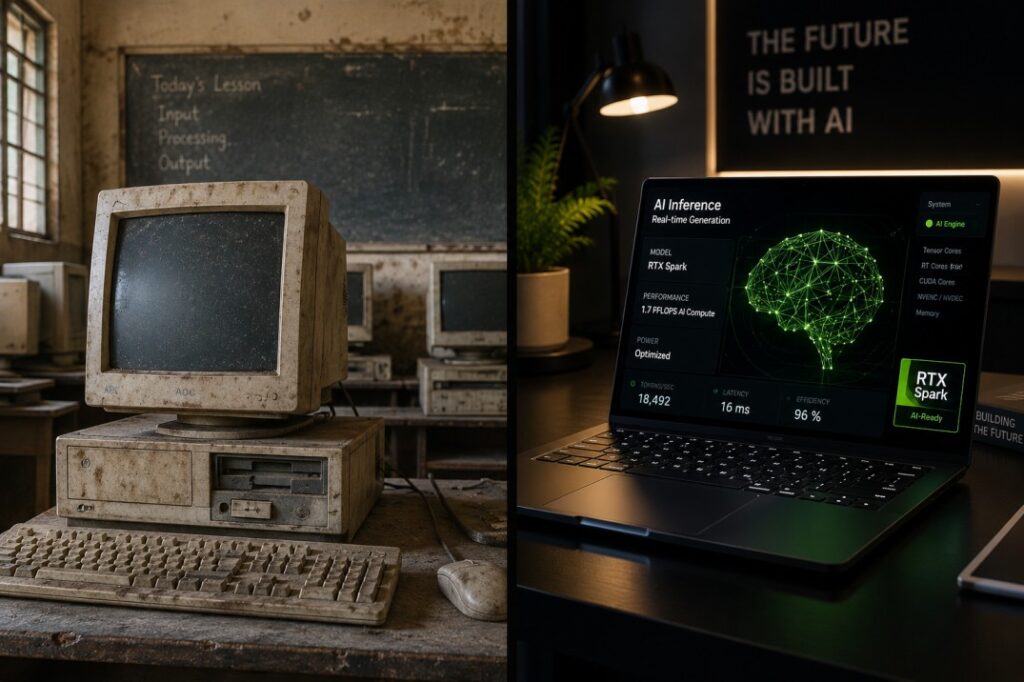
The Gap This Creates and Why Africa Feels It Hardest
Nvidia’s Superchip Just Made African Schools More Obsolete should be in the mind of every African right now. Every major technology transition in history creates a gap between those who access the new capability early and those who access it late. The smartphone created that gap. The internet created it before that. Each time the gap produced real and measurable differences in economic opportunity, information access, and the ability to participate in the economy being built around the new technology.
The RTX Spark transition creates a specific version of that gap that hits Africa with particular force.
The chip runs AI locally. Without internet. That detail sounds technical until you consider that a significant portion of African internet infrastructure is still unreliable, expensive, and unavailable in the areas where large numbers of African children live and study.
Cloud-based AI was already creating a two-tier access reality — those with reliable fast internet who could use advanced AI tools fully and those with intermittent or expensive connectivity who could not. Local AI chips like the RTX Spark solve that problem structurally. AI that runs on the device without needing the cloud is AI that works in a Lagos neighborhood with unreliable connectivity, in a school in Kano where the internet goes down three times a day, in a rural Ghanaian community where broadband infrastructure has not arrived.
The cruel irony is that the technology solving the connectivity barrier is the technology that will be hardest for African schools and African families to access first — because it arrives in premium laptop models from Dell, HP, and Microsoft at price points that reflect their primary markets.
The gap between the child whose family can access RTX Spark equipped devices and the child whose school is still running decade-old computers without reliable internet is not a gap that closes itself. It widens with every year that passes without deliberate intervention.
We have written before about the disadvantages of AI in Africa now and about how Africa’s infrastructure cannot support AI at scale. The RTX Spark announcement changes one dimension of that infrastructure problem — the connectivity requirement — while leaving the device access and economic barrier entirely unaddressed.
What Jensen Huang Said That Every African Parent Should Hear
Nvidia CEO Jensen Huang said the reinvention of the computer is as big a deal as the reinvention of the phone into what we now know as the smartphone, indicating that agentic AI will run across all the new computers.
Think carefully about what the smartphone reinvention actually did to Africa.
Mobile money transformed African financial inclusion in ways that Western banking infrastructure never managed in decades of trying. M-Pesa in Kenya, mobile banking in Nigeria, digital payment systems across the continent — all built on the smartphone’s democratization of computing power. Africa leapfrogged the landline era entirely and built financial infrastructure on mobile that rival what established economies took generations to construct.
The smartphone arrived and Africa found ways to use it that the people who built it had not anticipated. That is the pattern worth paying attention to when Jensen Huang says the PC reinvention is as significant as the smartphone transformation.
Africa does not need to follow the adoption path the Western market takes with RTX Spark equipped devices. It needs to identify the specific African applications — in education, in agriculture, in healthcare, in local content creation, in the particular problems African communities face — where locally running AI on accessible devices creates the most transformative value.
That identification requires African people who understand both the technology and the African context deeply enough to see the possibilities that neither Nvidia nor Microsoft has the proximity to imagine.
Which brings the conversation back to the prepared child.
The Skill Set RTX Spark Makes Urgent
We have written before about the best AI coding platforms for kids and teens and about OpenAI Robotics and what it means for African children. The RTX Spark announcement adds urgency to both conversations because it accelerates the timeline for when AI capability becomes a standard feature of personal computing rather than a specialized tool requiring special access.
When every new laptop sold in the next two to three years has local AI capability built into its fundamental architecture the question of whether your child understands AI stops being a question about future readiness and becomes a question about present competence.
The child entering secondary school in 2027 or 2028 will be doing so into an educational environment where AI capable devices are the expected standard in well resourced schools. The child who arrives understanding how to use those capabilities — how to direct AI agents, how to evaluate their outputs, how to use local AI for research, creation, and problem solving — will have a measurably different educational experience from the child who arrives confused by tools their classmates are already using fluently.
The industry is moving past AI as a simple prompt-answering tool toward fully autonomous agents — AI that acts on behalf of its user rather than waiting to be asked.
The child who understands how to work with autonomous AI agents — who has developed the judgment to direct them, evaluate them, and apply them to real problems — is operating in a different category of capability from the child who has never engaged with AI at anything beyond the surface level of asking it questions.
That capability gap does not form at university. It forms in the years when children are building their fundamental relationship with technology — the years when the curiosity, confidence, and conceptual understanding that makes everything else possible are either developed or not.
The Leapfrog Opportunity Africa Cannot Afford to Miss
Here is the argument that should be made in every African government ministry, every school proprietor’s office, and every parent’s home right now.
Africa has a documented history of technological leapfrogging — adopting technologies at the stage most useful for its current context rather than following the sequential adoption path of more developed economies. The mobile money example is the most cited but not the only one. Solar energy adoption, satellite internet infrastructure, digital payment systems — Africa has repeatedly demonstrated the capacity to take a technology and deploy it in ways that solve African problems more directly than the applications the technology’s inventors were focused on.
The RTX Spark represents a leapfrog opportunity specifically because it removes the connectivity dependency that has been the primary barrier to AI adoption in African contexts with unreliable internet infrastructure.
Local AI on accessible devices — if those devices can reach African markets at accessible price points, if African educators understand what they enable, if African children are prepared to use them — could do for African education what mobile money did for African finance.
But leapfrogging requires preparation. The communities that successfully leapfrogged with mobile money were not the ones that waited for the technology to arrive and then figured out what to do with it. They were the ones that had people who understood both the technology and the local context well enough to see the application before it was obvious.
Africa needs those people for the RTX Spark transition. And those people are currently children.

What This Means for The Prepared Child
Every technology announcement in this series — from Sam Altman’s OpenAI Robotics hiring post to Bernie Sanders’ argument that AI belongs to the people to Jensen Huang’s RTX Spark unveiling — points to the same conclusion from a different angle.
The AI transition is not coming. It is here. It is accelerating. And its most consequential dimension for African families is not the technology itself but the preparation gap between children who arrive at the technology understanding it and children who arrive at it confused by it.
The Prepared Child was written before RTX Spark was announced. It will still be relevant after RTX Spark’s successors have made it look primitive — because what it builds is not familiarity with a specific chip or a specific platform. It builds the foundational relationship with AI as a concept, a tool, and a domain of human activity that makes every subsequent engagement with every subsequent technology possible rather than overwhelming.
The child who understands at age six that AI is a tool made by people to solve problems — that it learns from data, that it has limitations, that human judgment shapes what it does and whether what it does is valuable — is the child who encounters an RTX Spark equipped laptop at age twelve and sees possibility rather than intimidation.
That understanding does not come from school. Nigerian schools are not teaching it. Ghanaian curriculum reform committees are not prioritizing it. The ministry of education is not moving at the speed Jensen Huang is moving.
It comes from home. From the conversation a parent starts today. From the book a child reads this week. From the decision a parent makes right now to treat AI literacy as urgent rather than optional.
Visit The Prepared Child page to start that conversation today. Visit For Parents for practical guidance on building AI familiarity at home before the RTX Spark generation of devices arrives in your child’s classroom. Visit For Schools to bring House of Chrys AI literacy workshops into your school before the technology gap between AI ready and AI unprepared students becomes impossible to ignore.
Jensen Huang said this is going to be the new PC. He was right. The question for every African parent is whether their child will be the one using it or the one watching someone else use it.
In all things, prepare.