

What if the single most powerful force shaping your child’s world is one you can’t see, touch, or fully control?
That force is here. It’s evolving at a breathtaking pace, weaving itself into homework, play, and friendships. This isn’t science fiction—it’s the reality of artificial intelligence reshaping daily existence.
The seeds were planted decades ago at a 1956 conference. But the launch of tools like ChatGPT made this intelligence explode into public view. Its impact is now immediate and personal.
You are the primary guardian of your child’s digital future. Understanding these systems is not optional—it’s your most urgent responsibility. This rapid evolution creates new challenges for safety and healthy development.
This guide provides the essential information you need. We cut through the complexity so you can navigate this landscape with confidence. Your goal is clear: keep your family secure and future-ready.
By taking these steps, you ensure your kids are not just passive consumers. You empower them to use these powerful tools with wisdom and discernment. Their future depends on the foundation you build today.
Key Takeaways
- Artificial intelligence is actively reshaping your child’s daily environment in significant ways.
- Parental oversight is no longer just about screen time, but about understanding intelligent systems.
- The rapid advancement of this technology presents unique safety and developmental considerations.
- Practical knowledge is your best tool for navigating this new digital landscape confidently.
- Your active involvement transforms kids from passive users into empowered, critical thinkers.
- Building a foundation of digital literacy today prepares your family for tomorrow’s world.
- Safety in this age means guiding your child’s interaction with evolving machine intelligence.
Understanding AI’s Role in Child Development
Early childhood development meets artificial intelligence—this collision is happening right now in homes and classrooms. The period from birth to age six is a critical window. Every experience shapes a young mind’s cognitive, social, and emotional foundation.
Since the 1956 Dartmouth conference, this field has evolved from theory to daily reality. A pivotal 2017 study changed everything. Google’s Transformer model redefined how we build intelligent systems for learning.
You must see these technologies as complex tools, not simple toys. They influence your child’s foundational growth during their most formative years.
AI in Early Education Settings
In school environments, adaptive learning platforms personalize lessons. They respond to a student’s pace and understanding. This creates a tailored educational journey.
These systems provide immediate feedback. They help identify strengths and areas needing support. The goal is to enhance the learning process, not replace the teacher.
AI in Home and Community Environments
At home, smart toys and interactive apps are common. They offer engaging play with educational layers. Community libraries and centers also deploy similar technologies.
This constant exposure integrates machine intelligence into daily routines. Your awareness of its role is the first step toward guided, safe interaction.
| Developmental Area | Traditional Influence | AI-Enhanced Influence | Parental Action |
|---|---|---|---|
| Cognitive | Books, puzzles, conversation | Adaptive learning apps, interactive stories | Monitor content, encourage balanced use |
| Social | Playdates, family meals, group games | Multiplayer educational platforms, social AI characters | Prioritize face-to-face interaction |
| Emotional | Parental comfort, role-playing, empathy lessons | Emotion-recognition games, therapeutic chatbots | Discuss digital vs. human empathy |
| Language | Reading aloud, singing, direct conversation | Language tutor apps, speech-generating tools | Ensure technology supplements, not replaces, human talk |
Our analysis confirms it. How your young one interacts with these systems today has lasting implications. It will affect their cognitive and emotional maturity for years to come.
Benefits and Challenges of AI in Learning Environments
The promise of personalized education is real. But so is the peril of passive consumption in modern learning.
These systems offer tailored lessons and instant feedback. They adapt to each student’s pace. Yet this convenience carries a hidden cost.
Enhanced Learning Through AI Tools
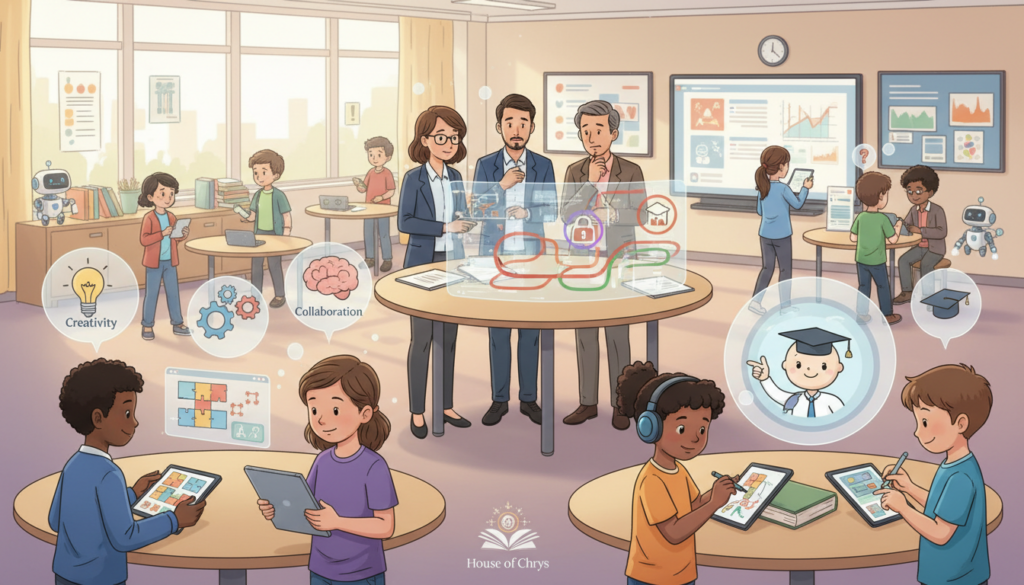
Ying Xu from Harvard notes young learners can thrive with well-designed digital tools. Effective tools are built on solid learning principles. They provide structured support for complex topics.
Imagine a tutor that never tires. It adjusts difficulty in real-time. This creates a powerful, personalized study session.
Potential Risks of Overreliance on AI
ChatGPT gives easy access to information. It often lets pupils bypass the productive struggle essential for deep learning. A student named Cash saw classmates copy generated content for homework.
They submitted work without reading or understanding the material. The tool solved the problem, but the mind did not grow.
You must encourage curiosity-driven questions. Ask what is inside a volcano. Do not let machine intelligence solve every math problem.
| Learning Aspect | Benefit of AI Tools | Potential Risk | Your Action |
|---|---|---|---|
| Personalized Instruction | Adapts to individual pace and level | May reduce effort and productive struggle | Encourage questions beyond assigned work |
| Homework Assistance | Provides explanations and resources | Promotes copying without comprehension | Review submissions together for understanding |
| Information Access | Immediate answers to complex questions | Undermines research and critical analysis | Teach verification and source evaluation |
The challenge is clear. Ensure these tools support the learning process. They must not replace the critical thinking skills your child needs.
Impacts of AI on Social Behavior and Interpersonal Skills
Polite requests to a smart speaker might seem harmless. They establish communication patterns that extend far beyond the device.
Your young one learns social etiquette through daily observation. The robotic nature of these tools can undermine polite behaviors.
Amazon introduced a “polite mode” on its Echo Dot system. This feature encourages kids to say “please” when interacting with voice assistants.
This design acknowledges a critical risk. Children might begin treating machine intelligence with demands rather than respect.
Social Etiquette and Human Interaction
That habit can impact how they communicate with teachers and peers every day. Human interaction remains the most important factor for social development.
No machine can fully replicate this role for your family. You hold the power to guide these interactions effectively.
Ensure your child understands the difference between a robot and a human being during play. This awareness shapes their interpersonal skills.
| Social Skill | Traditional Development | AI-Influenced Development | Parental Guidance |
|---|---|---|---|
| Polite Requests | Modeled by parents and elders | Shaped by device interaction patterns | Reinforce “please” and “thank you” consistently |
| Conversation Flow | Natural turn-taking in dialogue | Instant, command-based responses | Practice active listening during family meals |
| Emotional Cues | Reading facial expressions and tone | Limited or absent emotional feedback | Discuss feelings after screen time ends |
| Conflict Resolution | Negotiation with peers | System always complies or ignores | Role-play disagreement scenarios together |
The way your child speaks to a system today shapes their communication tomorrow. Your active guidance makes all the difference.
Prioritize face-to-face connection within your home. This foundation protects their ability to form meaningful human relationships.
Practical Guidance for Parents on AI and Children Safety
Your living room holds a powerful new tool—one that can either build vocabulary or build dependency. This intelligence demands clear boundaries and your watchful eye every day.

Think of the Sesame character that reads alongside your child. Researchers like Ying Xu designed it to ask thoughtful questions. It supports young minds while keeping the human connection warm.
Setting Healthy Boundaries with AI
Your first duty is transparency. Explain that this is a clever program, not a person. This understanding shapes all future interactions.
Embrace these tools to support children, but only when they encourage real-world talk. Set firm limits for screen access within your family. Use technology to enhance shared moments, not replace them.
Monitoring and Guiding AI Interactions
Watch these engagements closely. Your daily involvement ensures digital play supplements physical exploration. It keeps your child grounded in the tangible world.
Ask about the conversations they have with smart devices. Use their questions as gateways to deeper discussion. Your guidance turns simple access into meaningful learning for their lives.
How Educators Can Support Responsible AI Integration
Teachers stand at the frontline of a new educational frontier. They guide pupils through a landscape shaped by algorithms.

Their role is vital. In the school environment, they must show young minds how to use this intelligence as a scaffold. It is not a shortcut for homework.
Organize workshops that unpack how these tools work. Pupils need knowledge to evaluate strengths and limits every day.
Foster a culture of responsible use. This supports children in building critical thinking skills. These skills are required for a future driven by smart systems.
You can partner with your child’s teachers. Ensure the technology in the classroom aligns with values taught at home. This collective effort prepares our families.
| Educator Action | Immediate Benefit | Long-Term Goal |
|---|---|---|
| Teach tool evaluation | Pupils understand limitations | Builds discerning users |
| Design scaffolded assignments | Prevents overreliance | Encourages independent thought |
| Host parent workshops | Aligns school and home values | Creates unified support network |
| Model critical questions | Promotes deeper inquiry | Develops lifelong learning habits |
This partnership is the only way forward. It ensures our young ones are future-ready without losing their humanity. Your active collaboration makes it real.
Integrating AI Literacy Programs in Schools
We teach reading, writing, and arithmetic. The fourth foundational skill can no longer be ignored.
Your child must comprehend the machines shaping their world. This new literacy is about understanding, not just use.
Programs in a school setting demystify the technology for young minds. They reveal the mechanisms behind the magic.
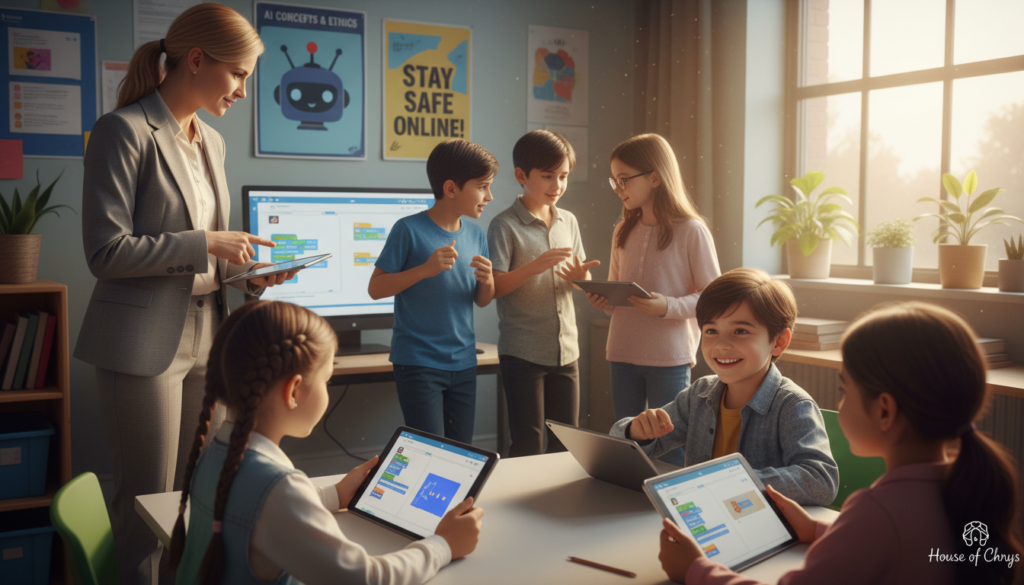
A recent study confirms even preschool-aged pupils grasp basic concepts. Interactive workshops make this possible.
Developing Interactive AI Literacy Workshops
Effective workshops are hands-on and age-appropriate. They turn abstract intelligence into tangible lessons.
The core goal is teaching students to ask the right questions. Who made this tool? What can it not do?
This skill builds confidence and healthy skepticism. It prepares them for a digital day.
These initiatives must provide ongoing support. Children need continuous access to guidance as they grow.
You should advocate for this literacy in your district. Ensure your families are future-ready, not left behind.
Ensuring Safe Digital Engagement: ai and children Best Practices
You hold the blueprint for your child’s safe journey through the digital landscape—build it with intention.
Clear rules form the foundation. Define which technologies are welcome in your home. Specify when and how your young ones can access them.
Keep all interactions in common areas like the living room. This simple step allows for natural supervision. You see the content they encounter every day.
Use these moments as opportunities for talk. Ask about the information they find. Discuss the machine intelligence behind responses. Pose a simple question: ‘Can we trust this source?’
Remain vigilant. New challenges emerge rapidly. Your proactive approach keeps your families future-ready.
| Best Practice | Your Action | Family Benefit |
|---|---|---|
| Define Access Zones | Limit use to common rooms | Visible supervision, shared experiences |
| Establish Time Limits | Set daily screen allowances | Balanced routine, prevents overuse |
| Promote Critical Questions | Ask “Who made this tool?” | Builds discernment, counters misinformation |
| Schedule Tech-Check Talks | Weekly family discussions | Open dialogue, aligned values |
These structured ways turn potential risks into teaching moments. Your guidance ensures technology serves your household. For example, a weekly review of online activity builds trust.
Evaluating AI-Generated Content and Misinformation
Your child encounters a flood of machine-made information every single day—can they tell fact from fabrication?
Generative systems remix content without clear citations. A small warning sign on the ChatGPT interface hints at the problem. It states the tool can make mistakes.
Building Critical Evaluation Skills in Students
Researcher Ying Xu emphasizes critical engagement. Young minds must learn to ask probing questions.
Who created this information? What sources are missing? This analysis is a core skill. Consistent practice builds this ability over time.
Ensuring Source Transparency in AI Outputs
Take the student named Cash. His classmate copied content with unreadable handwriting. The information was useless without source transparency.
Teach your family to look for those warning disclaimers. Verify important research through other studies. This is one of the best ways to ensure safe access.
Building discernment is a long-term process. Your guidance prepares students for a future filled with synthetic intelligence.
Innovations in Child-Centered AI Tools
The next wave of educational technology is quietly shifting its focus—from delivering answers to building minds.
New tools act as a scaffold for learning. They prompt questions instead of giving direct replies. This design builds your child’s own ability to construct understanding.
A recent study confirms this approach. When machine intelligence is designed to prompt reflection, student comprehension improves significantly.
We now see a number of new technologies. They prioritize safety and developmental needs over the speed of information delivery.
These systems provide unique opportunities for personalized learning. Your young one can explore complex topics at their own pace with gentle guidance.
This creates a supportive access point every day. For example, a tool might ask, “What is your first thought?” before offering a hint.
| Tool Feature | Traditional Approach | New Child-Centered Approach | Benefit for Your Family |
|---|---|---|---|
| Response Style | Instant, final answer | Prompts reflection with guiding questions | Encourages independent problem-solving |
| Pace Control | Fixed, one-speed delivery | Adapts to your child’s natural learning rhythm | Reduces frustration, builds confidence |
| Safety Design | Focus on content filtering | Built-in pauses for caregiver check-ins | Promotes co-use and shared analysis |
| Learning Goal | Task completion | Process understanding and skill development | Fosters long-term critical thinking in children |
Ongoing research and studies are vital. They ensure these tools evolve with our children.
By supporting the development of ethical technologies, we secure a future focused on well-being. Your advocacy creates better ways for all families.
Future Research and Development in AI for Early Childhood
Long-term studies are the missing cornerstone for building safe, intelligent tools for the formative years.
Future inquiry must zoom in on the zero-to-six age range. This window is the most critical for early development and intervention. Our youngest learners are uniquely vulnerable to their digital environment.
Current analysis of existing research reveals a glaring gap. We lack the longitudinal data to see how machine intelligence shapes the long-term trajectory of children lives. A twenty-year study tracking digital exposure from infancy is now essential.
Scholars are working to identify the most effective ways to weave these technologies into the home. The microsystem of your family is where daily development happens. Smart integration here offers powerful opportunities for support.
We need a greater number of rigorous studies examining this intersection. This is the only path to ensure these tools are safe for all families. For example, research must ask the right question: does this tool build independence or create dependency?
The future of this field depends on our collective ability. We must conduct research that puts the child’s developmental needs above all else. Your advocacy for ethical science prepares the next generation.
Conclusion
The path forward is clear—your active role today determines how your child engages with technology tomorrow.
You hold the power to guide your family through this new landscape. Stay informed. Stay involved in their digital lives every day.
Remember, the most important factor in your child’s development remains the human connection you provide. No machine can replace your warmth and wisdom.
Foster AI literacy and critical thinking. This prepares your young ones for a future where intelligence is woven into society. They will navigate it with confidence.
Use the tools and insights from this guide. Ensure your family remains safe, prepared, and ready for what comes next.
Your commitment to growth is the best evidence. Your children will thrive in this world.