
Picture your child, deeply focused, trying to fit a square block into a round hole. They try one angle, then another. That moment of trial and error isn’t just play—it’s the foundation of their problem-solving skills. The choices you make today directly shape their tomorrow.
To prepare a child for the future, you need more than school knowledge. It demands a holistic blend of life skills, emotional intelligence, and digital awareness. This is not a distant concern. It starts in your home, right now.
Your daily routines are packed with powerful learning moments. Cooking dinner teaches math and chemistry. Managing an allowance builds financial literacy. Every conversation can spark critical thinking.
This guide is your map. We will walk through practical, actionable steps. You will learn how to build the non-negotiable pillars of literacy and numeracy. You’ll discover how to nurture curiosity and resilience. Your role is to transform inspiration into concrete preparation.
Key Takeaways
- Your daily actions today are actively shaping your child’s tomorrow.
- Effective preparation combines academic knowledge with essential life skills and emotional intelligence.
- Simple, daily activities and routines are the most powerful teaching tools you have.
- Building a strong foundation in literacy and numeracy is critical for all future learning.
- Intentional parenting focuses on teaching problem-solving, digital responsibility, and empathy.
- You have the power to turn everyday moments into lessons that build confidence and independence.
Introduction: Navigating the AI-Driven World with Your Child
Your child’s world is being rewritten by algorithms, and the clock is ticking—not for panic, but for purposeful action. The dream is clear: to see your young one grow into a confident, capable person. Yet the path is new. Traditional school studies are vital, but they are no longer the whole story.
Your daily role has expanded. You are now the guide for a journey that blends book knowledge with street smarts. This is about navigating an AI-driven landscape with intention. It starts with a single, powerful shift in perspective.
The Urgency of Preparing Kids for Future Challenges
Change is the only constant now. Technology evolves faster than any curriculum can be updated. This creates a gap—a space between what is taught and what will be needed.
Your child will face challenges we can only imagine. These are not just academic tests. They are complex problems requiring adaptability, ethical judgment, and creative thinking. The urgency is real. It stems from a simple truth.
The foundational habits you help build today determine their adaptability and confidence tomorrow. Waiting is not a strategy. This is a call for action, rooted in care, not fear.
Your role is pivotal. Move beyond overseeing homework. Intentionally cultivate the complete set of skills for the future. This is how you truly help children thrive.
Beyond Academics: The Holistic Approach to Future-Readiness
Future-readiness is a mosaic. It combines cognitive skills, emotional strength, and practical life mastery. Think of it as building a whole person, not just a student.
Teaching life skills is as important as algebra. Time management, decision-making, teamwork—these prepare your child for challenges everywhere. This holistic approach values empathy as much as literacy.
Showing your youngster how to cook, manage money, or resolve a conflict is not extra. It is essential. These activities turn everyday life into your most powerful classroom.
Every interaction is a training ground. Every chore is a lesson in responsibility. Every question is a spark for learning. You have the power to fill the gaps left by traditional education.
| Traditional Focus | Holistic Future-Readiness |
|---|---|
| Academic grades and test scores | Problem-solving and critical thinking abilities |
| Rote memorization of facts | Adaptability and learning how to learn |
| Limited classroom-based learning | Integrated learning from daily routines and real-world tasks |
| Emphasis on individual achievement | Value on collaboration, empathy, and social intelligence |
| Financial literacy as a distant topic | Practical money management through playful activities |
| Digital use as entertainment | Responsible tech use, safety, and computational thinking |
This table isn’t about discarding the old. It’s about building upon it. The goal is to transform your anxiety into agency. You now have a clear starting point.
Define what future-readiness truly means for your family. Move from abstract worry to concrete understanding. Then, take that first step on this critical journey together.
What Are Future-Ready Kids? Defining the Goal
Consider a scene where your child navigates a disagreement with a friend using words, not tears, to find a fair solution. That moment captures the goal. It is not about raising a prodigy.
It is about nurturing a resilient, adaptable human being. Your aim is to cultivate a young person who meets the world with competence and calm. They possess a toolkit of skills that go beyond the textbook.

Core Characteristics of Future-Ready Children
These children share distinct traits. First, they have rock-solid literacy and numeracy foundations. This is the bedrock for all other learning.
Second, they wield analytical ability like a flashlight. They question, analyze, and connect ideas. They are taught how to think, not what to think.
Digital awareness is a third pillar. They understand technology as a tool, not just entertainment. They navigate apps with purpose and caution.
Emotional intelligence is their superpower. They recognize feelings in themselves and others. This supports strong relationships and teamwork.
Finally, practical competence turns daily challenges into simple tasks. From cooking to budgeting, they handle real needs with growing independence.
The brain’s plasticity means the skills and mindsets you instill now become the default operating system for life.
Together, these traits form a complete profile. Your youngster sees problems as puzzles. They possess the ability to craft solutions.
This is the concrete picture you are building toward. Daily activities become training grounds for these traits. This is part of a larger journey.
Why Future-Readiness Matters in a Rapidly Changing World
The world is transforming at a dizzying speed. Many of today‘s jobs will look different tomorrow. Specific technical knowledge may become outdated.
What remains valuable? Adaptable skills. The capacity to learn, unlearn, and relearn. This meta-skill future-proofs your child against uncertainty.
Starting at an early age is non-negotiable. The young mind is malleable. The habits formed now set a trajectory for lifelong growth.
Future-readiness matters because it translates directly to life outcomes. Empathy leads to better collaboration. Critical thinking drives innovation.
Core competencies grant true autonomy. Your role is to help children develop this toolkit. Every conversation and chore is a chance to teach kids these ways.
You give children the ultimate advantage: the confidence to thrive in any future. This investment of time pays lifelong dividends.
This is not a luxury. It is an urgent necessity for every young person. You are the most important catalyst in making it happen.
Building a Strong Foundation with Literacy and Numeracy
Think of your child’s mind as a house. Literacy and numeracy are the concrete foundation—everything else is built upon it. Without this solid base, higher-order thinking and problem-solving simply cannot stand.
This is the non-negotiable first step. Your goal is not to create a prodigy overnight. It is to give your child the ability to make sense of complex ideas and express them with clarity.
Strengthening these core skills early supports all future academic growth. More importantly, it builds the confidence your youngster needs to tackle new subjects without fear.
Your home is the primary classroom. You do not need expensive tools—just consistent, intentional engagement. Turn ordinary moments into powerful learning adventures.
Daily Reading Habits to Boost Comprehension and Expression
Daily reading is not about finishing books. It is about building comprehension and expanding vocabulary. This habit gives your child the tools to express complex ideas.
Set a simple, non-negotiable ritual. Dedicate twenty minutes each evening to read together. Discuss the story. Ask what might happen next.
This practice turns abstract letters into vivid worlds. It builds the muscle for focused attention. Your role is to encourage child-led exploration within those pages.
“Reading is the gateway skill that makes all other learning possible.”
Pair reading with writing. Have your young one help write the grocery list or a thank-you note. This connects decoding words with creating them. It fuels creativity and logical thinking.
Fun Math Games for Everyday Numeracy Skills
Math games transform abstract numbers into tangible understanding. The goal is to make numeracy joyful, not a chore. Associate numbers with curiosity, not anxiety.
Use cooking to teach fractions. Let your youngster measure ingredients. Shopping teaches subtraction—compare prices and calculate change.
Board games are perfect for mental math practice. Simple puzzles build logic and patience. These activities build essential skills without feeling like schoolwork.
This playful approach develops critical ways thinking. Your child begins to see patterns and relationships. They learn to craft solutions to numerical challenges.
Integrating Learning into Daily Routines
See every moment as teachable. This is the heart of lifelong learning. Count steps on the stairs together. Read labels aloud at the grocery store.
These integrated lessons show the real-life applications of knowledge. They prove that learning is not confined to a desk. It is a living, breathing part of daily life.
This method requires no extra time—just a shift in perspective. You are not adding more to your day. You are enriching what you already do.
By strengthening these core skills, you give your child the keys. They can unlock any door in their future education and career path. You build a foundation of confidence that lasts a lifetime.
Teaching Essential Life Skills for Daily Independence
The true test of learning isn’t a graded paper—it’s your child calmly and effectively handling a scraped knee all by themselves. Life skills are the bridge. They connect school knowledge to real-world competence.
Your young one must move from dependency to capability. This is about feeding themselves, managing money, and caring for their well-being. These competencies form the backbone of daily life.
We break down four core areas. Each builds a sense responsibility that transforms anxiety into action. You use what you already have at home.
Cooking Basics: From Sandwiches to Kitchen Safety
Start with simple, safe tasks. Spreading butter or washing vegetables is the first step step. This teaches following instructions in sequence.
Kitchen safety and hygiene are non-negotiable lessons. They build focus and patience. The pride of making a sandwich fuels growth in independence.
Your child gains more than a meal. They gain the ability to provide for a basic need. This practical skill is a cornerstone of self-reliance.
Smart Money Management Through Playful Activities
Use play money and create a home “shop.” This game builds an intuitive sense of value. It makes abstract numbers tangible.
Your youngster learns smart spending versus saving. They grasp delayed gratification. This playful approach is foundational money management.
“Do not save what is left after spending, but spend what is left after saving.”
These activities teach kids to make choices. They see the consequence of a purchase. You give children the tools for financial literacy early.
First Aid Fundamentals for Safety and Empathy
Teaching wound care does more than ensure safety. Cleaning a small cut and applying a bandage cultivates calm under pressure.
It builds quick thinking and problem-solving. Your child learns to assess a situation and act. This is responsibility in its purest form.
Most importantly, it nurtures empathy. Caring for a wound is caring for others. It turns a challenge into an act of support.
Time Management and Organizational Techniques
This is not about rigid schedules. It is about helping your young one prioritize. They learn to estimate how long tasks take.
Motivate them to make a simple timetable for reading, studying, and playing. This improves planning and self-discipline. It balances duty with joy.
Organizational skills help, too. Making a bed or arranging books instills order. A clear space creates mental space for focused thinking.
Together, these skills are not extras. They are essential for everyday life. They build a confident ready and resilient young person.
You help children move from needing you to knowing how. That is the ultimate sense responsibility you can instill today.
Cultivating Critical Thinking and Problem-Solving Abilities
Watch your child encounter a broken toy—their first instinct isn’t to hand it to you, but to turn it over, inspecting the pieces. That moment of inspection is the spark. Your task is to fan it into a flame.
Critical thinking is the engine that drives innovation. It is the ability to analyze information, question assumptions, and connect disparate ideas. This is not a talent reserved for a few. It is a skill you must build in your child.
We move from abstract concept to daily practice. This is about giving your young one a reliable process for facing any challenge. You will turn confusion into curiosity and fear into focused action.
Puzzles, Riddles, and Logic Games for Young Minds
These are not just play. They are structured workouts for the developing brain. A simple jigsaw puzzle teaches pattern recognition and spatial reasoning.
A well-crafted riddle during a car ride invites logical deduction. Strategy games, even basic ones, require planning several moves ahead. These activities train the mind to look for connections others miss.
This playful learning builds mental muscle without strain. It associates hard thinking with joy and discovery. You encourage children to see problems as engaging puzzles waiting to be solved.
Encouraging Step-by-Step Solution Finding
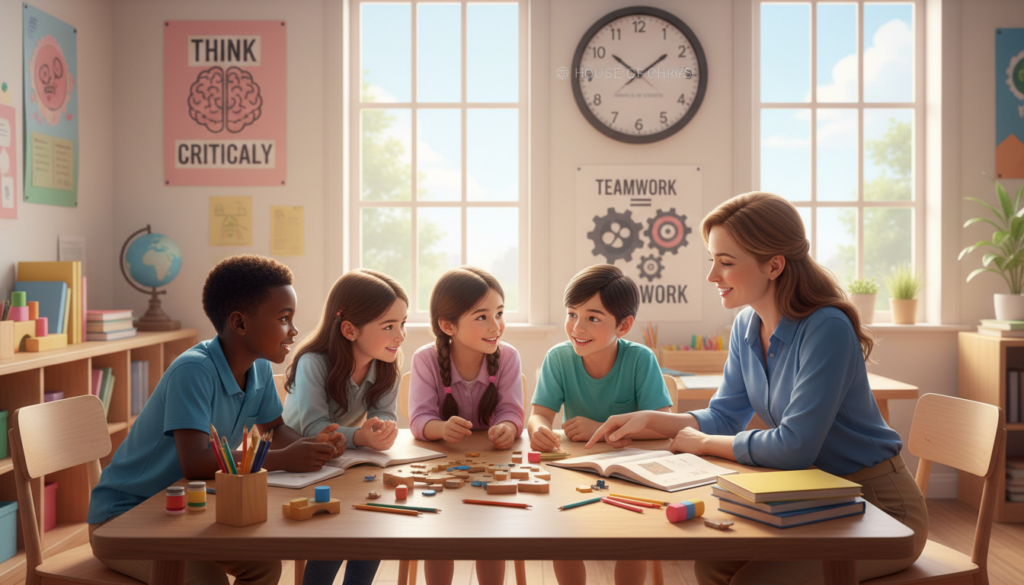
Overwhelm is the enemy of clear thought. Your role is to help children break big problems into small, manageable parts. This methodical approach is a life skill.
Instead of “Clean your room,” try “First, gather all the books. Second, make your bed. Third, put the toys in this bin.” You model the sequence. This turns chaos into an achievable checklist.
The table below contrasts two ways thinking about problems. It shows why a step-by-step process leads to better solutions and less frustration.
| Category | Methodical Step-by-Step | Haphazard Approach |
|---|---|---|
| First Action | Stop and define the problem clearly. | Jump in and start trying things at random. |
| Emotional State | Calm, focused, and in control. | Frustrated, anxious, and scattered. |
| Process | Break it down, plan steps, execute in order. | No clear plan, frequent do-overs, wasted effort. |
| Likely Outcome | A effective solution and a clear understanding of why it worked. | Mixed results, confusion, and reliance on luck. |
| Skill Built | Strategic planning, patience, and executive function. | Impulsivity and a tendency to give up easily. |
Apply this to homework or planning a family project. Guide them through the step step process. Your support here builds immense confidence.
Learning from Mistakes to Build Resilience
A mistake is not a failure. It is data. This shift in perspective is everything. Your child must see errors as feedback, not a measure of their worth.
When a puzzle piece doesn’t fit or a science experiment fizzles, your reaction is key. Avoid fixing it for them. Instead, ask, “What did you try? What happened? What could we try differently?”
“The only real mistake is the one from which we learn nothing.”
This questioning teach kids to analyze outcomes. It builds resilience and a growth mindset. They learn that effort and strategy matter more than a perfect first attempt.
Praise the effort, the creative attempt, the revised strategy. This reinforces intellectual courage. It gives them the tools to navigate complex situations, from school projects to disagreements with others.
Together, these practices forge a confident problem-solver. Your youngster begins to trust their own thinking process. They face the world with curiosity, not fear, because they know how to craft their own solutions.
Nurturing Curiosity and a Lifelong Love for Learning
Imagine your child staring at a puddle after rain, not just seeing water, but a universe of floating leaves and swirling reflections. That deep observation is curiosity in its purest form. It is the spark that ignites lifelong learning.
Without this spark, knowledge is inert information. With it, your young one becomes an active, hungry seeker of understanding. This section moves from abstract wonder to daily practice.
We provide concrete ways to fuel that spark at home. You will learn to turn simple questions into grand adventures. The goal is a child who doesn’t just tolerate learning but passionately loves it.
Encouraging “Why” Questions and Exploratory Play
Every “why” is a gift. It is not about having all the answers. Your role is to validate the inquiry and explore together.
During story time, pause and ask, “What do you think happens next?” This simple act shifts your youngster from passive listener to active participant. It builds critical thinking.
Exploratory play is the laboratory for young minds. Provide open-ended materials like blocks, clay, or empty boxes. Do not give instructions. Watch what they create.
This unstructured time is where creativity and problem-solving skills flourish. Your support here is quiet but powerful. You create a safe space where questions are celebrated.
“The important thing is not to stop questioning. Curiosity has its own reason for existing.”
This approach teach kids that the search for knowledge is a shared journey. It builds their confidence to ask harder questions. That is how you help children develop intellectual courage.
Outdoor Adventures and Hands-On Discovery
Nature is the ultimate classroom. It connects learning to the physical world. Digging in soil teaches geology. Observing insects introduces biology.
Plan simple activities like a nature scavenger hunt. Look for specific leaves, rocks, or colors. This sharpens observation skills and focus.
Building a fort from branches isn’t just play. It involves engineering, teamwork, and physics. These experiences ground abstract concepts in tangible reality.
Hands-on discovery makes lessons unforgettable. A kitchen science experiment, like mixing baking soda and vinegar, demonstrates chemical reactions vividly. The fizz and foam are more compelling than any textbook diagram.
These ways thinking engage all the senses. They prove that growth happens outside four walls. You give children the gift of direct experience.
Connecting Curiosity to Real-World Applications
Curiosity must lead somewhere meaningful. Show how school subjects live in everyday life. This makes learning relevant and exciting.
Point out how math works in architecture—the angles of a roof, the symmetry of a window. Explain how biology works in cooking—yeast makes bread rise, emulsification creates salad dressing.
Even playground physics is a lesson. The swing demonstrates pendulums and momentum. Connect the dots between play and principle.
This connection transforms curiosity into capability. Your youngster sees knowledge as a tool for solving real challenges. They begin to craft their own solutions.
The table below outlines simple activities that bridge curiosity to practical skills.
| Activity | Curiosity Spark | Real-World Skill Developed |
|---|---|---|
| Baking Cookies | Why does dough change in the oven? | Measurement, chemical reactions, following sequences |
| Gardening | How does a seed become a plant? | Biology, patience, responsibility for living things |
| Map Reading | How do we find our way? | Spatial reasoning, navigation, planning |
| Family Budget Discussion | Where does our money go? | Financial literacy, decision-making, delayed gratification |
Your role is to be the bridge. You link their “why” to the “how.” This process nurtures emotional intelligence alongside academic intelligence.
It builds a sense responsibility for their own education. The outcome is a confident young person who sees the world as a fascinating puzzle.
They are driven to understand it. That internal motivation is the ultimate trait for any future. You plant this seed today, and it grows for a lifetime.
Developing Digital Awareness and Responsible Tech Use
Your child’s finger swipes across a tablet screen, instantly summoning a world of videos and games. This moment is a crossroads—it can be passive consumption or the start of powerful digital creation. The clock is ticking on this choice.
Digital awareness is not about banning screens. It is about teaching your young one to use technology as a tool. This is a critical skill for the future.
Your role is to guide this understanding. You must integrate digital learning with traditional strengths like reading and writing. The goal is a child who is tech-wise, not just tech-savvy.
They will leverage technology for innovation while maintaining a healthy, grounded life offline. This section transforms anxiety into a proactive strategy. Let’s begin.
Introducing Computational Thinking in Simple Terms
Computational thinking sounds complex. It is simply a method for solving problems. You break big challenges into small steps.
You look for patterns and design clear solutions. This ability applies far beyond coding. It is a foundational skill for logical reasoning.
Introduce it through everyday life. Cooking a meal is a perfect example. Following a recipe is executing a step-by-step algorithm.
Sorting laundry by color is pattern recognition. Building a block tower requires designing a stable structure. Point out these connections at home.
Use playful logic games and simple puzzles. These activities train the young mind to think in sequences. They help children see problems as systems to be understood.
This ways thinking builds immense confidence. Your youngster learns they can figure out how things work. That intellectual courage is priceless.
Balancing Screen Time with Real-World Interactions
Balance is non-negotiable. Your child must learn that screens are one part of a full life. Human connection and physical activity are irreplaceable.
Set clear, consistent boundaries. Create tech-free zones, like the dinner table and bedrooms. Establish tech-free time, such as the hour before bed.
The key is to frame limits as protection, not punishment. You are guarding time for other vital growth. This includes play, conversation, and simply being bored—which sparks creativity.
Not all screen time is equal. The table below helps you and your child categorize digital use. It guides better choices together.
| Activity Type | Description | Parental Action |
|---|---|---|
| Passive Consumption | Endless scrolling, autoplay videos, mindless gaming. | Set strict limits. Encourage awareness of how this time feels. |
| Interactive Learning | Educational apps, coding tutorials, research for a school project. | Encourage and participate. Discuss what they are discovering. |
| Creative Production | Making digital art, editing a family video, writing a story on a device. | Celebrate and provide tools. This is skill building. |
| Social Connection | Video calls with family, collaborative gaming with friends. | Teach etiquette and supervise. Value this for maintaining bonds. |

Your goal is to shift their habits toward creation and connection. Prioritize real-world interactions for teamwork and emotional intelligence. This balance is the pillar of true well-being.
Teaching Online Safety and Ethical Behavior
Online safety is as fundamental as road safety. Your child is a digital native navigating a public space. They need a map and clear rules.
Start with personal information. Teach them what is private—full name, address, school, photos. Make “never share with strangers online” a household mantra.
Discuss recognizing scams and suspicious messages. Role-play scenarios. Ask, “What would you do if someone you don’t know asked for a picture?”
“Digital citizenship isn’t a one-time lesson. It’s an ongoing conversation that grows with your child.”
Ethical behavior is crucial. Empathy must extend to digital spaces. Talk about cyberbullying and the permanent impact of online words.
Practice kindness in comments and messages. Teach them to be an upstander, not a bystander, if they see others being hurt. This builds a sense responsibility for their community.
This development happens alongside traditional skills. Digital literacy should enhance the deep reading and critical thinking you nurture. Your support here is active guidance.
You are not just monitoring; you are mentoring. Have ongoing conversations about digital citizenship. These talks teach kids to navigate with the same caution and confidence they use offline.
You give children the tools to seize online opportunities while avoiding pitfalls. This prepares them for both the promise and the perils of the connected world.
Fostering Emotional Intelligence and Social Competence
Your child comes home from school, shoulders slumped, unable to find the words for the frustration they feel—that moment is your entry point. This is not about mood management. It is about building the emotional intelligence that will define their success in every room they ever enter.
Emotional intelligence is the core ability to recognize feelings in oneself and others. It is the skill that fuels strong relationships and positive collaboration. Your daily interactions are the primary classroom for this vital learning.
We move from abstract concept to daily practice. You will learn to label emotions accurately and create a safe space for sharing. You will turn simple activities into lessons in empathy and teamwork. This fostering is strategic—it builds the resilience your youngster needs for any future challenge.
Recognizing and Expressing Feelings Healthily
Healthy expression starts with accurate labeling. Your child feels a storm of sensations but lacks the vocabulary. Your role is to be their translator.
When you see their slumped shoulders, say, “You look disappointed. Is that what you’re feeling?” This simple act validates their inner world. It gives a name to the chaos. This is the first step step toward self-awareness.
Create a judgment-free zone at home. Make it clear that all feelings are allowed, even the messy ones. Anger, sadness, jealousy—they are data, not defects. Your calm response teach kids that emotions are manageable.
The table below contrasts common reactions. It shows how small shifts in your response build massive emotional intelligence over time.
| Situation | Reactive Response | Emotionally Intelligent Response |
|---|---|---|
| Child cries after losing a game. | “Don’t be a sore loser. It’s just a game.” | “It’s really frustrating to lose, isn’t it? It’s okay to feel upset. Want to talk about what was hard?” |
| Child shouts, “I hate you!” during a conflict. | “Go to your room right now! That’s disrespectful.” | “You must be very angry to say that. I’m here when you’re ready to tell me what’s wrong in a calmer way.” |
| Child seems quiet and withdrawn. | “Why are you moping? Cheer up.” | “I notice you’re very quiet today. I’m here if you want to share what’s on your mind. No pressure.” |
| Skill Developed | Emotional suppression, shame. | Self-awareness, emotional vocabulary, trust in relationship. |
Practice through play. Games like emotion charades make labeling feelings fun. Use books and movies to ask, “How do you think that character feels?” This builds the thinking muscle for social awareness.
Practicing Empathy and Compassion in Daily Life
Empathy is seeing the world through another’s eyes. It is the antidote to selfishness and the foundation of moral character. This skill is cultivated in small, consistent acts.
Encourage perspective-taking. Ask, “How do you think your friend felt when you took that toy?” Guide them to consider the impact of their actions on others. This moves them from “me” to “we.”
Model generosity and help. Let your youngster see you offering support to a neighbor. Then, create opportunities for them to share, help, or offer comfort. A simple act, like drawing a picture for a sick relative, plants the seed of compassion.
“Empathy is about finding echoes of another person in yourself.”
Integrate gratitude into your daily life. A family ritual of sharing one good thing from the day shifts focus from lack to abundance. It directly supports a compassionate outlook.
These ways of being are not soft. They are the hard currency of trust and leadership. You help children develop the ability to connect deeply—a non-negotiable for any collaborative future.
Teamwork Activities for Collaboration and Communication
The modern world runs on teamwork. Your child must learn to collaborate, negotiate, and communicate clearly. These are not school subjects. They are life skills built through deliberate play.
Choose activities that require a shared goal. Building a massive fort from blankets and pillows forces planning and compromise. Preparing a family meal together divides tasks and requires clear instruction.
Board games are perfect training grounds. They teach turn-taking, rule-following, and gracious winning or losing. Cooperative games, where players work together against the game, are especially powerful for building unity.
Group projects, like putting on a play or creating a neighborhood cleanup plan, teach project management. Your youngster learns to listen, contribute ideas, and sometimes let a friend’s idea lead. This is real-world learning.
Through these experiences, they master the art of communication. They practice saying “please” and “thank you.” More importantly, they learn to talk calmly about disagreements and craft joint solutions.
This integration of emotional intelligence with cognitive growth creates a balanced individual. They become smart enough to solve complex problems and wise enough to care about their impact on people. You are raising a leader who is both competent and kind.
Conclusion: Your Action Plan for Raising Future-Ready Kids
Your power lies not in grand gestures, but in the small, intentional habits you build at home today. Start with the non-negotiable foundation—daily reading and playful math. These core skills support all future growth.
Weave life skills and critical thinking into your weekly routine. A cooking night teaches chemistry and safety. Puzzle games train the mind to find solutions. This turns everyday life into your primary classroom.
Protect your child‘s curiosity. Answer “why” with “let’s discover.” Balance screen time with real-world play. Most importantly, talk about feelings daily. Nurturing empathy and teamwork builds the emotional intelligence they need.
Your action plan is personal. Choose two or three focus areas. Build momentum step by step. For structured support, programs like CuriousJr offer soft skills classes. The Eton Academy blends joyful learning with academic guidance.
You are shaping their future with every interaction. Start today. Stay consistent. Watch your child develop the ability and sense responsibility to thrive.