
Remember the last time your child asked a smart speaker a question? The answer came instantly—a clear, confident voice from a small box.
That moment is more than curiosity. It is their first conversation with artificial intelligence. This technology is not coming in the future. It is here, shaping their world now.
Ignoring this reality is not an option for a prepared parent. But this is not a cause for panic. It is a call to purposeful action.
This guide is your blueprint. We move beyond the hype to show you what matters. True education in this field is not about coding or complex data models.
It is about building timeless human skills. Clear communication. Critical thinking. Systematic problem-solving. These are the true goals.
You will learn practical steps. We focus on age-appropriate methods that keep young students engaged. This is not about raising tech experts.
It is about raising thoughtful, empowered digital citizens. The tools are just the means. The outcome is a child who can think precisely and express themselves with confidence.
Let’s transform your anxiety into action. Your child’s development deserves nothing less.
Key Takeaways
- Artificial intelligence is already a part of your child’s daily life and future.
- This guide provides a clear, actionable plan to begin today with confidence.
- Effective AI learning focuses on building critical thinking and communication skills.
- Age-appropriate methods and tools are key to maintaining a child’s interest.
- The ultimate goal is to foster empowered, thoughtful digital citizenship.
- You can turn concern into positive, purposeful steps for your child’s growth.
- The technology serves as a tool to develop precise thinking and clear expression.
Why Teaching Kids About AI is No Longer Optional
Your child’s homework helper, their music curator, even their storytime companion—all powered by algorithms that learn. This is the reality. The technology is woven into the fabric of daily life.
It’s not a distant concept. It’s the app they use for school projects. The program that suggests a new game. The voice that answers their curious questions.
The critical question has shifted. We are past asking “if” they will encounter this intelligence. Now, we must ask “how” they will interact with it. Your role is clear.
Ignoring this shift leaves a young person unprepared. They become passive in a world that demands active partners. This education is not about creating coders.
It is about ensuring they are not merely consumers. They must learn to navigate, command, and even question the tool that will support their learning and creativity.
The Rise of AI in Everyday Life
Look around your home. From the thermostat that learns your schedule to the streaming service that knows their favorite show—these are not smart gadgets. They are expressions of embedded technology.
For students, this is even more direct. Adaptive learning platforms tailor math problems to their level. Writing assistants help structure thoughts. This is their normal.
The table below shows how common these tools are:
| Tool Category | Everyday Example | How the Intelligence Functions |
|---|---|---|
| Voice Assistants | Smart speakers answering questions or playing music | Uses natural language processing to understand speech and find relevant information or actions. |
| Educational Apps | Math games that adjust difficulty based on performance | Analyzes response patterns and mistakes to personalize the next assignments. |
| Content Recommenders | Video platforms suggesting the next cartoon | Examines watch history and similar users’ preferences to predict what will keep engagement high. |
| Creative Aids | Drawing apps that suggest colors or complete shapes | Recognizes artistic patterns and offers ideas to enhance the creation process. |
This pervasive presence means digital literacy has a new core component. We must add AI literacy to the list of essential skills.
Preparing Kids for a Future Shaped by Technology
The future belongs to those who can partner with intelligence—both human and artificial. This preparation is not a luxury. It is a necessity for every family.
Avoiding the conversation does not protect your child. It leaves them vulnerable. They will use these systems regardless.
The goal is to move them from passive users to informed commanders. They need to understand the basics. How does a tool make a decision? Where does its information come from?
This foundational understanding allows them to grow with the technology. They will not be overwhelmed by it. They will be empowered by it.
By starting this step now, you build their confidence. You give them the thinking framework to adapt. The world will keep changing. Their ability to engage with it thoughtfully will remain.
This is how you prepare them. Not with fear of the new, but with the skills to master it.
The true value of engaging with artificial intelligence lies not in the code it runs on, but in the human skills it demands. This journey is a masterclass in becoming better humans. It transforms vague thoughts into precise words.
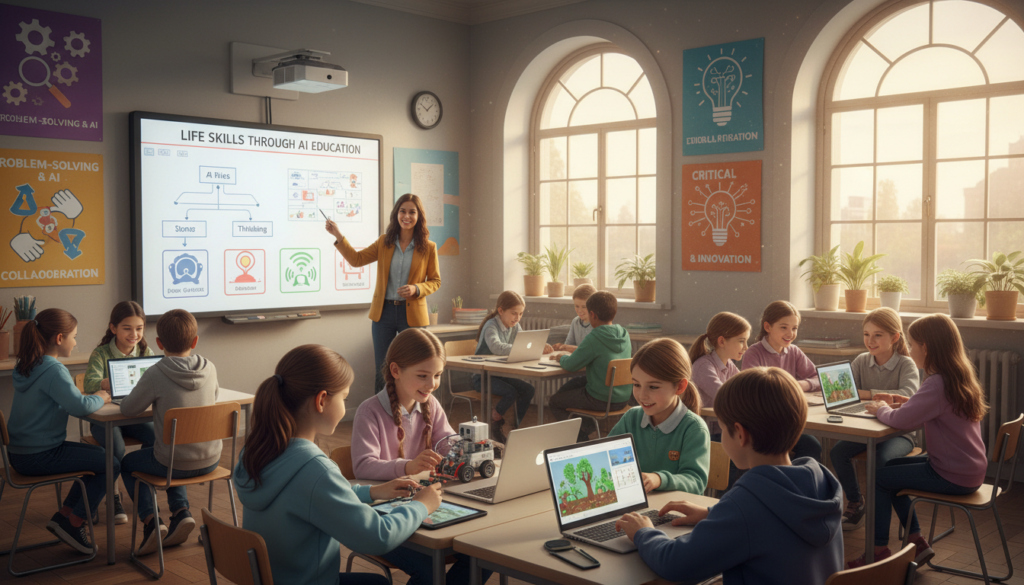
Beyond Technology: AI Education as a Path to Life Skills
Forget circuits and data models. The most profound lesson here has little to do with the tool itself. You are using the technology to build durable skills for life.
These abilities will outlive any specific platform or program. They are the foundation for clear communication and systematic thinking. This is the core of true education.
Clear Communication: The Foundation of Effective AI Use
When your child learns to command a smart system, they are really learning to command their own ideas. The machine mirrors the clarity of their request. Vague questions get vague answers.
This practice directly translates to human interactions. Explaining needs to a teacher. Collaborating on group projects. Presenting ideas with confidence. It all starts with precise language.
Consider the difference between these prompts:
| Vague Prompt | Specific, Effective Prompt | The Skill Being Practiced |
|---|---|---|
| “Write about dolphins.” | “Write a short, exciting paragraph for a 3rd-grade science report about how dolphins use echolocation to find food.” | Defining audience, purpose, and key details. |
| “Make a schedule.” | “Create a weekday after-school schedule for a 10-year-old that includes 1 hour for homework, 30 minutes for reading, and time for a creative activity before dinner.” | Breaking down complex things into actionable steps. |
| “Draw a robot.” | “Design a friendly robot helper for a library. It should have one arm to hold books, wheels to move quietly, and a screen to show reading recommendations.” | Using vivid descriptions and functional specifications. |
This table shows how specific speech yields useful results. It is a direct example for your young one. They learn that quality information in gets quality output out.
Critical Thinking and Problem-Solving
Critical thinking ignites the moment the system gives an answer. Your child must learn to evaluate it, not just accept it. Is the information correct? Does it make sense for their project?
This is how we help students move from consumers to analysts. They question the output. They cross-check facts. This habit protects them in a digital world.
Problem-solving becomes a structured process. Define the goal first. Break it into smaller assignments. Try a prompt, review the feedback, and iterate. This cycle teaches resilience.
You are not teaching them to use a tool. You are using the tool to teach them how to think. This mindset shift is everything. It prepares people of any age for a future of constant change.
Educators and adults see the same benefit. The step-by-step approach builds confidence. It turns confusion into a clear process. Your child learns to see patterns and adjust their ideas.
That is the ultimate goal. To raise a generation that can partner with technology thoughtfully. They will command it with precision and question it with wisdom.
How to Start Teaching Kids About AI: A Practical Guide
Begin with what they already know, not with what intimidates you. This is your practical blueprint. We move from theory to action with clear, age-respectful steps.
The goal is not instant expertise. It is building a foundation of familiarity and confidence. You will use simple examples from daily life.
Your role is guide and supervisor. This education happens through conversation and shared discovery. Let’s start.
Age-Appropriate Introductions
Match the introduction to your child’s age and curiosity. A five-year-old needs a different example than a fifteen-year-old. This is the first rule.
For young children, use simple analogies. Explain that this technology is like a very smart helper. It has read many books and can answer questions. Keep it concrete and friendly.
With tweens, introduce the concept of training data. Explain that the tool learns from information, just like they do from school and experience. This builds a basic mental model.
For teenagers, the conversation deepens. Discuss ethical implications and potential bias. Show how these programs can support complex research projects. They are ready for more abstract ideas.
The constant rule is supervision. Always be present to discuss the outputs. Talk about the process, not just the answers. This turns use into a learning dialogue.
Start with free, reputable tools like Khanmigo or Google Read Along. Maximize privacy settings from day one. Your aim is demystification—creating a sense of control, not awe.
Using Everyday Examples to Explain AI
Point to the technology already in your home. The voice assistant that plays music is a perfect example. So is the photo app that sorts pictures by face.
Streaming service recommendations are another clear example. Ask your child why a new show appears. This starts a conversation about patterns and predictions.
Demonstrate with a simple, supervised task. Ask a smart helper to explain a homework concept. Or use it to brainstorm story ideas for a creative project. Show the input and output cycle.
For young people who learn and think differently, this tool can be a powerful ally. It improves accessibility in real time.
AI programs can quickly turn complex texts into short summaries. They can also read any text out loud in a clear, natural voice. This is text-to-speech technology.
These functions provide crucial support. They help students engage with information on their own terms. This builds academic confidence.
Your daily world is full of these examples. Use them as teachable moments. This method makes the idea of artificial intelligence tangible and less abstract.
You are not just explaining a tool. You are showing how it fits into their life. This practical approach builds the skills they need for the future.
The Art of Prompting: Teaching Kids to Communicate with AI
The command you type is the single most powerful tool you hand your child in this digital age. This is not about coding. It is about clear speech made permanent.
Prompting is the new handwriting—a fundamental skill for interacting with the world. Your young one must master it to command the tools around them.
Think of any smart program as a literal-minded assistant. It only knows what you tell it. Vague questions yield useless answers.
The process of crafting the prompt is where the real learning happens. It forces clarity of thought. This is the achievement.
From Vague to Specific: Crafting Effective Prompts
Teach your child that quality information in gets quality output out. Walk them through the “who, what, why, where, when” of their request.
A bad prompt is vague and lazy. “Make something cool” gives the system nothing to work with. It reflects unfocused ideas.
A good prompt is specific and thoughtful. It provides context, desired format, tone, and length. This step builds systematic thinking.
Encourage them to start with the end in mind. What is the goal? Who is the audience? This method turns confusion into a clear process.
You are not just teaching them to use a tool. You are using the tool to teach them how to think. That mindset shift prepares people for a future of constant change.
Examples of Good vs. Bad Prompts
Concrete examples make the idea tangible. Compare these prompts. Notice how specificity unlocks useful results.
| Vague, Ineffective Prompt | Specific, Effective Prompt | The Skill & Thinking Practiced |
|---|---|---|
| “Write about dolphins.” | “Write a short, exciting paragraph for a 3rd-grade science report about how dolphins use echolocation to find food.” | Defining audience, purpose, and key details. Turning thoughts into precise words. |
| “Make a poster.” | “Create a poster about space exploration for my 5th-grade science class. It should show the solar system with fun facts about each planet. Use colors that will print well.” | Starting with the end in mind. Breaking a complex project into actionable assignments. Considering practical things like printing. |
| “Write a short story.” | “Write a 300-word adventure story for a 10-year-old. The story is about a robot who learns to garden. It must have a funny ending.” | Including length, audience, genre, and key plot patterns. Structuring creative ideas. |
| “Help with my essay.” | “I am a middle school student. Give me three examples of strong thesis statements for an essay on climate change support.” | Providing context and a clear request for feedback. This is how students learn to ask for support. |
This skill transfers directly to real world tasks. Writing clear emails. Giving project instructions. Stating needs with confidence.
Praise the quality of their prompt, not just the program’s output. The thinking is the true victory. This builds their language and problem-solving skills for life.
Building Vocabulary and Language Skills with AI
Think of vocabulary not as a list to memorize, but as a collection of tools for building ideas. Each new term is a lever for clearer thoughts and more powerful commands.
One child started collecting words like prized trading cards. “What’s a better word for ‘very big’?” she would ask. Enormous, massive, colossal—each term made her more powerful. This is the new frontier of language education.
Artificial intelligence is the ultimate partner in this quest. It transforms a dry chore into a game of superpower acquisition. Your child’s verbal toolkit expands in real time.
Using AI as a Tool for Word Exploration
When a young person needs a better word, a smart tool becomes an instant thesaurus. It provides definitions, synonyms, and usage examples on demand.
This active exploration builds confidence. Encourage them to ask direct questions. “Give me five more descriptive words for ‘happy.’” Or, “What’s a more precise term than ‘thing’ for this object?”
The system’s answers are immediate feedback. This process turns passive reading into active discovery. It directly improves their prompting power for all future projects.
For educators and adults, this is a paradigm shift. You are not just giving information. You are providing a dynamic support system for lifelong learning.
Encouraging Precise and Vivid Descriptions
Precise language leads to precise results—from machines and from people. This is the core skill.
Teach your child to paint pictures with words. Language is their paintbrush. The more colors they have, the more beautiful and detailed their creations become.
Compare these approaches. A vague request like “draw a cat” gives the system little to work with. A vivid description changes everything.
“Draw a fluffy orange tabby cat sitting in a sunny window, with one paw raised.” This specific speech yields a specific, useful result. The thinking behind the prompt is the true victory.
This practice enriches every subject. Creative writing, storytelling, even science reports gain clarity. A child with a rich vocabulary can articulate nuanced thoughts and emotions.
That ability is a key to emotional intelligence. They learn to express exactly what they mean and feel.
Frame each new word as a new tool added to their lifelong kit. Their influence in the world grows with their word hoard. This is how you build communicators, not just consumers.
Developing Systematic Thinking Through AI Interactions
The most powerful lesson a smart machine teaches is how to think in a straight line. It demands logic and sequence. This interaction builds a crucial skill for the modern world.
Your child learns to move from a fuzzy idea to a clear result. The technology acts as a mirror for their thoughts. Chaotic ideas yield chaotic answers.
Ordered instructions yield useful outcomes. This is the foundation of systematic thinking.
Starting with the End in Mind
Every effective command begins with a clear vision. What is the final product? Your young person must define it before typing a single word.
This habit transforms vague wishes into concrete goals. “I need a science poster” becomes “I need a poster for my 5th-grade class that explains the water cycle with diagrams.”
The machine forces this clarity. It is the ultimate trainer for focused intention.
This step is thinking before acting. It builds confidence and reduces wasted time. Your child learns that success is planned, not accidental.
Breaking Down Complex Tasks into Steps
A large project can feel like a mountain. The systematic mind sees a path. It breaks the climb into a series of small, manageable steps.
This is where tools offer incredible support, especially for young people. They can ask for help deconstructing a complex assignment.
Show them how to instruct the system logically. “First, help me brainstorm ideas for my history report. Second, outline the main points. Third, find three reliable sources.”
This approach is an antidote to overwhelm. It turns procrastination into a process. The table below contrasts a vague request with a systematic one.
| Vague, Overwhelming Request | Systematic, Manageable Plan | Thinking Skill Developed |
|---|---|---|
| “Help me with my big science project.” | “1. Generate five possible experiment ideas on plant growth. 2. Create a list of materials for the chosen experiment. 3. Draft a week-by-week timeline to complete it.” |
Task decomposition and sequential planning. |
| “I need to study for my test.” | “1. Make a quiz from my notes on chapters 4-6. 2. Generate a one-page summary of key dates. 3. Create a 30-minute study schedule for tonight.” |
Externalizing and structuring review assignments. |
| “Plan my book report.” | “1. Give me a template for a character analysis. 2. Suggest three main themes to discuss. 3. Help me write a strong opening sentence.” |
Using frameworks to organize thoughts. |
For students who struggle with executive function, this is a supportive scaffold. It externalizes planning skills. The tool provides the structure they are building internally.
Using these programs to generate checklists or calendars reinforces organization. It is not a crutch. It is training wheels for the mind.
The process of instructing the machine in a logical sequence strengthens their own sequential thinking. They are learning project management fundamentals.
Educators and adults see the value. This method provides clear examples. It gives feedback on the child’s plan.
Large goals are just a series of small steps. This is a lesson for life, not just school. You are building a systematic thinker, one clear instruction at a time.
Learning from Failure: The Power of Iteration with AI
A confusing or incorrect answer from an intelligent tool is the best data you can get for learning. This moment is not a breakdown. It is a breakthrough.
Your child’s first attempt with any new program will rarely be perfect. That is the perfect teaching moment. You must seize it.
When the system gives them something they did not want, do not let them quit. Ask one simple question: “How can you ask differently?” This single step changes everything.
It teaches a fundamental truth. First attempts are drafts. Feedback is information, not defeat. Each revision brings you closer. Mastery is a process, not a single event.
Treating Feedback as Data, Not Defeat
Reframe every “failure” as useful data. The machine’s weird or wrong answer is a signal. It tells you exactly what to clarify next.
This mindset shift is crucial for young students. In a world that often rewards quick, right answers, this teaches the value of the journey.
They learn that feedback is not personal criticism. It is a guide for their next move. This builds incredible confidence.
You are not protecting them from wrong results. You are arming them with a method to fix anything.
Encourage them to analyze the output. What parts are useful? What parts missed the mark? This critical thinking turns a dead end into a detour.
For educators and adults, this provides a clear example. It shows how real projects in coding, science, and art actually work. Success comes through adjustment.
The Iterative Process for Continuous Improvement
Teach your child the iterative loop. It has four clear phases: Prompt, Evaluate, Refine, Repeat. This cycle is the engine of improvement.
Start with a clear command. Then, honestly assess the result. Next, make one specific change to your speech. Finally, try again.
This builds resilience and a growth mindset. They see that mastery comes through deliberate change, not magical first tries.
Show them how to change one variable at a time. Adjust the tone, the audience, or the format of their request. Watch how the output shifts.
This methodical approach reveals patterns. They learn how their ideas directly influence the machine’s thoughts.
Consider this process for common assignments:
- Writing: A vague story prompt gets a generic tale. A refined prompt with character details and a setting yields a rich narrative.
- Research: A broad question gives surface-level information. A focused, step-by-step inquiry uncovers deeper support.
- Design: Asking for “a poster” creates chaos. Requesting a poster with specific sections and colors produces a usable tool.
This iterative process is how problems are solved in the real world. It is a core skill for any future career or creative pursuit.
Your child learns to embrace the cycle. They stop fearing wrong turns. They start collecting data from every result. This lesson in iteration will set them apart.
It transforms them from passive users into active commanders of technology. They gain the confidence to try, assess, and improve—continuously.
Ethical AI Use: Teaching Kids Responsibility and Honesty
Ethics in technology use is not a sidebar discussion—it’s the core of every interaction. Your child’s character is built in these moments. It happens when they decide how to use a powerful tool for their school work.
This is about more than rules. It’s about shaping a young person’s integrity in a digital world. Your guidance here is the bedrock.
Using these programs ethically means being honest, safe, and fair. You must be clear about when help comes from a machine. The line between assistance and substitution is crucial.
Your role is to illuminate that line. This education builds trustworthy digital citizens who value authentic effort.
Understanding Academic Integrity and AI
Academic integrity is clear and non-negotiable. Using a smart tool to understand a complex idea is learning. Using it to generate and submit a final essay is cheating.
The difference is in the thinking and effort. Your child must do the heavy lifting. The machine provides support, not the finished product.
Work with your child and their educators. Establish consistent rules for assignments at home and in class. This collaboration removes confusion.
Transparency is a strength, not a weakness. Teach your young one to say, “I used this technology to brainstorm ideas and check my grammar.” That statement shows ownership and honesty.
This approach protects their academic record. It also builds confidence in their own abilities. They learn to trust their thoughts first.
When and How to Credit AI Assistance
Crediting help is a fundamental skill. It applies to books, websites, and now, intelligent tools. Show your child how to do it simply.
They can add a brief note at the end of a project. For example: “I used an AI program to help outline this report.” It’s that straightforward.
The original prompt they craft is their intellectual work. That’s where their thinking shines. The words they choose, the questions they ask—that is their contribution.
This practice turns every interaction into a lesson in citation. It reinforces that taking credit for others’ work is wrong. This is true even if the “other” is a machine.
For different age groups, adapt the step. Young students can verbally acknowledge help. Older students should use a formal citation style their school approves.
Your guidance here shapes them into people who value authenticity. They see tools as partners for empowerment, not shortcuts for deception.
This foundation of honesty extends far beyond technology. It prepares them for a world where integrity is the most valuable currency.
Adults and educators must model this behavior. Discuss your own use of these programs. Show how you cite information and seek feedback.
Your child learns by watching you. Your actions teach more than any lecture ever could.
Safety First: Protecting Privacy and Personal Information
Before your young one types a single word into a smart program, establish one non-negotiable boundary. Their personal information is their most valuable asset in the digital world. Protecting it is not an advanced skill—it is the first step.
This education builds a shield of confidence. Your child learns to explore with power, not fear. Your vigilance sets the standard.
What Information Should Never Be Shared with AI
Drill this rule into every interaction. Never share personally identifiable details with a public tool. Treat every chat like a conversation with a stranger in a crowded square.
Be helpful but guarded. The list is clear and absolute.
- Full names, nicknames, or family member names.
- Home addresses, school names, or locations.
- Personal photos, birthdates, or phone numbers.
- Any information about daily routines or schedules.
Explain this in simple language. “This technology learns from data. Our private talks are not for its lessons.” This idea sticks with young students.
For educators and adults, model this behavior. Show how you guard your own data. Your examples teach more than any lecture.
Checking Privacy Settings and Policies
Make this the first step with any new program. Open the settings before the first prompt is typed. This habit instills lifelong scrutiny.
Most tools allow you to limit how your conversations train models. Disable data sharing for model training where possible. Look for clear privacy policies.
Use kid-focused programs with strong protections when possible. Platforms like Khanmigo are designed for younger people. They build safer environments for learning.
Walk through the settings with your child. Explain each option in simple terms. “This setting keeps our ideas private.” This turns a chore into a lesson in ownership.
Your support here is crucial. It teaches them that technology serves them, not the other way around. Their privacy is worth protecting every time.
A safe child is an empowered child. They gain the confidence to explore within strong boundaries. This is how you raise thoughtful digital citizens.
Combating AI Bias: Encouraging Critical Evaluation
The most dangerous assumption your young one can make is that a machine’s answer is neutral truth. It is not. Every output carries the fingerprints of its human creators—and their flaws.
This intelligence learns from the vast ocean of information we put online. That data pool is not pure. It holds our brilliance and our prejudice.
Your child’s critical eye is the essential filter. You must build it now. This is not an optional skill.
It is the core of responsible education in a digital world. You are raising a thinker, not a passive receiver.
How AI Can Perpetuate Stereotypes
These programs are mirrors. They reflect the patterns in their training data. If that information is skewed, the reflection is distorted.
Unfair ideas about gender, race, or profession get baked into the models. The machine then replicates them, often without context or correction.
Consider a simple test. Ask a common image generator to “draw a doctor.” If the results show only men, the bias is visible. It is a powerful example for a conversation.
This happens because the tools train models on historical data. Past imbalances become present suggestions. Your child might see these answers as fact.
Your role is to illuminate the flaw. Show them that the tool is not presenting objective reality. It is presenting a statistically common, but often limited, viewpoint.
Teaching Young People to Question and Challenge Outputs
Empower your student to become an active critic. Teach them to interrogate the machine’s logic. This builds confidence and intellectual courage.
The first step is simple. Encourage them to question anything that seems unfair or wrong. Their gut feeling is a powerful feedback signal.
Then, give them the language to challenge. Show them how to make the system defend its answers.
- Ask for opposing viewpoints: “That seems biased. Show me examples of women doctors throughout history.”
- Double-check facts: Cross-reference AI information against trusted textbooks or reputable sites. This is a mandatory habit.
- Compare different tools: Run the same question through two different programs. Inconsistencies reveal hidden assumptions.
This practice transforms them. They move from passive consumers to engaged analysts. They learn that authority—human or machine—must earn trust.
For educators and adults, this is a vital support strategy. Provide clear examples in assignments. Discuss the thoughts behind a biased result.
You are not just teaching them to use a tool. You are forging a mindset. A healthy skepticism that serves them in any domain.
You are raising a person who won’t blindly accept information without thinking for themselves. That is the ultimate goal. It shapes a more equitable world, one critical question at a time.
Balancing Screen Time: AI and Human Connection
Balance is not a luxury; it’s the discipline that turns powerful tools into allies for growth. Your child’s mind needs both the digital frontier and the physical world. One without the other creates an incomplete person.
This technology is a launchpad, not a destination. Its true value is realized when it propels your young one back into lived experience. Human touch, unstructured play, face-to-face conversation—these are irreplaceable.
Your role is to architect this harmony. It demands clear rules and your own example. The goal is a child who commands intelligence with confidence, then confidently engages with people.
Setting Boundaries for AI Use
Boundaries are acts of love, not punishment. They create a safe container for exploration. Start with clear, consistent rules everyone follows.
Set firm time limits for using these programs. A kitchen timer works perfectly. Designate specific purposes—homework help or creative projects only. This prevents mindless wandering.
Establish tech-free zones in your home. The dinner table and bedrooms are sacred spaces for human connection. This step reminds everyone of what matters most.
You must model this balance yourself. Show your child you can put your phone down to be fully present. Your action is their most powerful lesson.
For young people who hyperfocus, use timers as gentle transitions. Signal the move from an AI task to physical activity. This builds self-regulation skills for life.
The tool is powerful, but it is not a replacement. It cannot replicate the messy joy of play or the warmth of a real conversation. Your boundaries protect that truth.
Integrating Offline Activities and Real-World Learning
Use intelligence to enhance the real world, not escape from it. The skills practiced online must find expression offline. This is where learning becomes wisdom.
Actively seek activities that build the same core skills. Play board games for strategy and patience. Encourage journaling for reflection and organizing thoughts. Host family debates to practice argumentation and clear speech.
Connect digital projects to tangible results. Use a smart program to research a garden plan—then go outside and plant the seeds. This cycle gives information meaning and purpose.
Build in movement and time with friends. Physical experience is the context that makes knowledge stick. Empathy is learned through shared laughter and solved conflicts, not through screens.
For educators and adults, this integration is key. Provide examples where assignments start with digital support and end with a handmade product or presentation.
Your child’s ability to connect with others is their greatest advantage. Artificial intelligence should support that connection, never supplant it. This balance prepares them not just for a technological future, but for a fully human one.
That is the ultimate goal. A young person who can gather answers from a machine, then use them to build something beautiful with their own hands and heart.
Conclusion: Raising Thoughtful and Empowered Digital Citizens
The real achievement is not in mastering a tool, but in forging a future-ready mindset.
You have done the essential work. Your guidance moved beyond the technology itself. The focus was always on the human skills it demands.
Clear communication, critical thinking, and ethical grounding are now part of your child’s toolkit. These abilities will help them adapt, no matter how the world changes.
You have shifted from concern to active preparation. Your young person now approaches information with confidence and agency. They are thoughtful digital citizens.
This step is not an end. Stay engaged. Keep conversations open with educators. Model the balanced, critical use of programs you encourage.
Your child’s future will be shaped by their choices and ideas. You have given them the ability to navigate uncertainty. Their future-ready mind is your lasting legacy.