
How Can AI Affect Children? 7 Critical Things Every African Parent Must Know

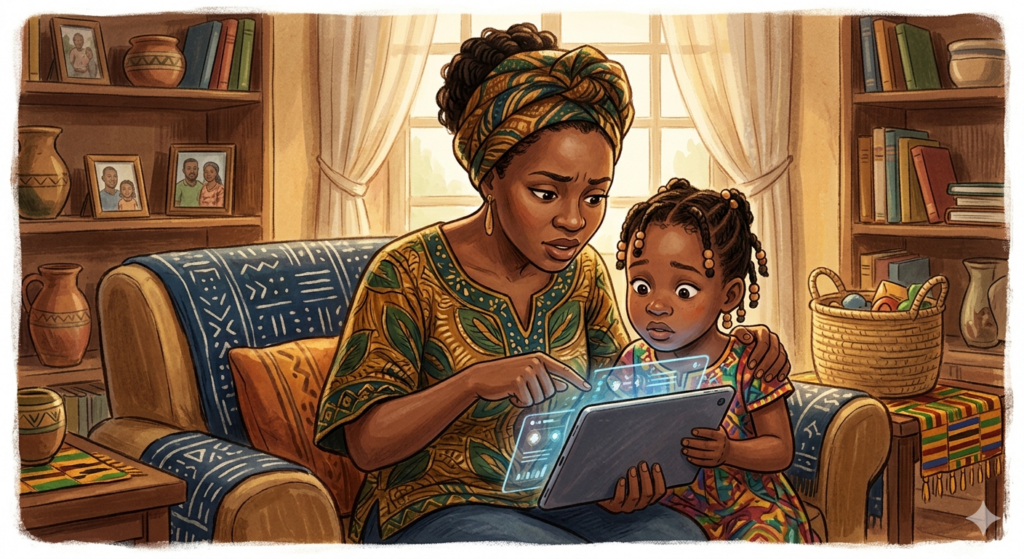
How can AI affect children? It is the question every serious African parent should be asking right now — and very few are.
Artificial intelligence is no longer a distant technology. It is inside the phones your children use, the YouTube videos they watch, the games they play, and increasingly the classrooms they sit in. AI is already shaping your child’s world whether you have given it permission to or not.
How can AI affect children? The question is not whether AI will affect your child. It already is. The question is whether you understand how — and whether you are prepared to guide your child through it intelligently.
This post breaks down exactly how AI can affect children, both positively and negatively, so you can make informed decisions as a parent rather than reactive ones driven by fear or ignorance.
1. AI Is Reshaping What Skills Your Child Actually Needs
How can AI affect children? The most fundamental way AI affects children is not through a screen. It is through the job market they are growing into.
The World Economic Forum projects that by 2030 over 85 million jobs will be displaced by automation and AI globally. At the same time 97 million new roles will emerge — roles that require humans to work alongside AI systems rather than compete against them.
For African children this shift is both an opportunity and a threat. The skills Nigerian schools are currently prioritizing — memorization, routine calculation, passive knowledge reproduction — are precisely the skills AI performs better than any human. The skills AI cannot replace — critical thinking, creativity, emotional intelligence, complex problem solving — are the ones African schools spend the least time developing.
How can AI affect children in Africa? It can make an entire generation’s education irrelevant overnight if parents and educators do not pay attention now.
Visit our For Parents page to understand how you can bridge this gap at home before the school system catches up.
2. AI Can Accelerate Your Child’s Learning Dramatically
Not everything about AI’s effect on children is a warning. The opportunity side is equally real.
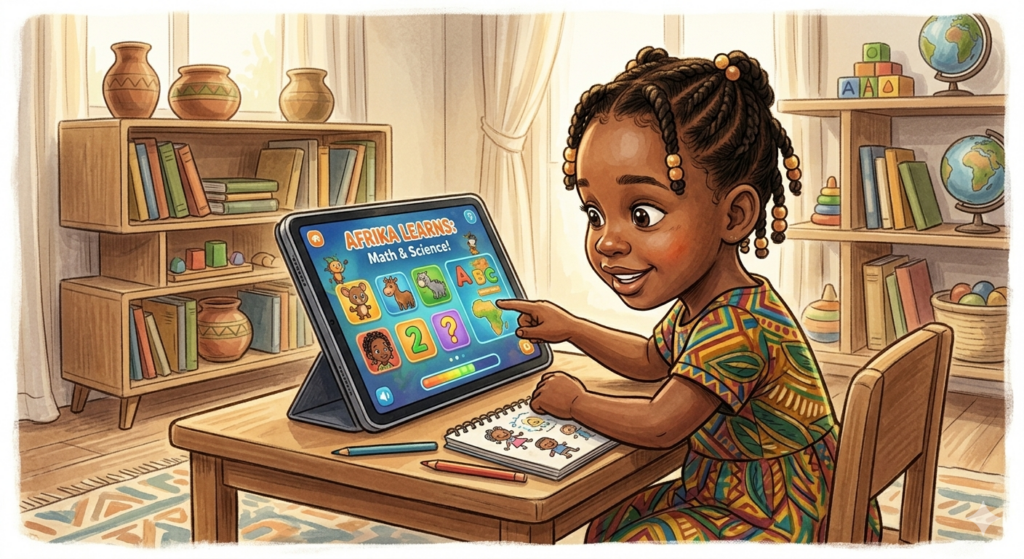
AI powered learning tools are transforming what is possible for children who have access to them. Platforms that adapt to a child’s individual learning pace, identify knowledge gaps in real time, and provide personalized feedback are now accessible on a basic smartphone.
A child in Lagos with a ₦50,000 Android phone and the right AI learning tools has access to a quality of personalized education that wealthy parents paid private tutors thousands of dollars for a decade ago.
This is one of the most powerful AI prospects for children in Africa — the democratization of quality learning. The child whose parent introduces them to these tools early builds a compounding learning advantage that separates them from peers within months.
3. AI Affects Children’s Attention Spans and Patience
Here is where the conversation gets uncomfortable for many parents.
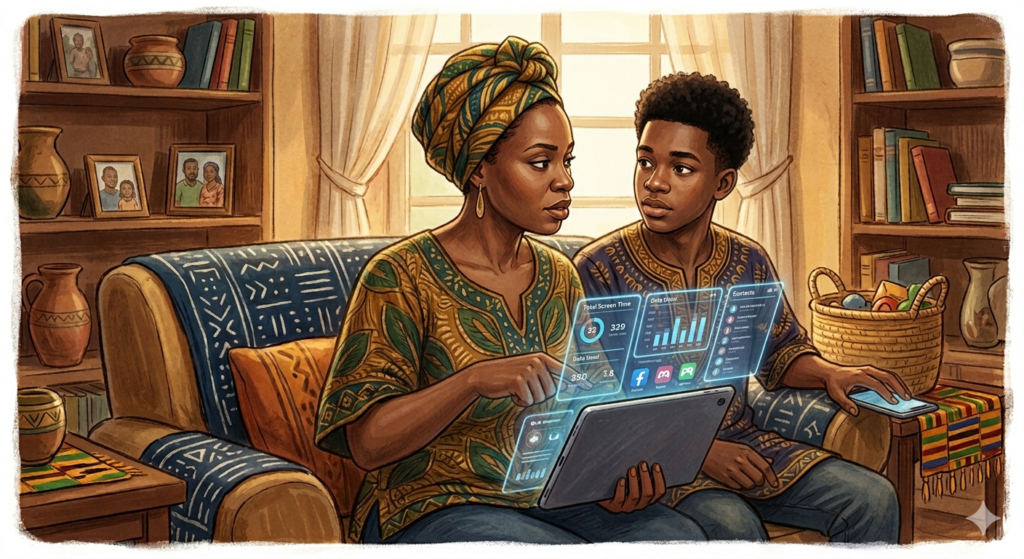
AI driven platforms — YouTube, TikTok, Instagram, gaming apps — are designed by some of the most sophisticated engineering teams on earth with one goal: keep your child’s attention as long as possible.
These platforms use AI recommendation algorithms that learn your child’s preferences faster than you do and serve content specifically engineered to trigger dopamine responses. The result is a child who struggles to focus on anything that does not deliver instant stimulation.
Research from the American Psychological Association shows that children who spend significant time on algorithmically driven platforms demonstrate reduced patience, shorter attention spans, and greater difficulty with tasks that require sustained concentration.
For African children already navigating under resourced schools this attention erosion is a serious developmental risk that parents cannot afford to ignore.
The answer is not banning technology. It is teaching children to use it with intention — a skill that starts at home, not at school.
4. AI Can Affect Your Child’s Ability to Think Independently
How can AI affect children’s thinking? More directly than most parents realize.
When a child reaches for an AI tool every time they encounter a difficult question they gradually lose the muscle of independent reasoning. The struggle of not knowing — sitting with a problem, turning it over, working through it — is where genuine intelligence develops.
AI tools that provide instant answers to every question are extraordinary resources when used correctly. They become intellectual crutches when used as a replacement for thinking rather than a complement to it.
The prepared child is not the one who knows how to get AI to answer questions. It is the one who knows how to ask the right questions in the first place — and who has developed enough independent reasoning to evaluate whether the AI’s answer is actually correct.
This distinction is everything. And it is a distinction that only intentional parenting can build.
Learn more about how The Prepared Child approaches this balance between AI use and independent thinking.
5. AI Exposes Children to Content and Risks Beyond Their Age
One of the most immediate ways AI affects children is through content exposure.
AI recommendation algorithms do not have a conscience. They optimize for engagement. A child who watches one mildly inappropriate video can find themselves served increasingly extreme content within minutes because the algorithm detected engagement and doubled down.
Beyond content there are more serious risks. AI generated deepfakes, AI driven online grooming, and AI powered misinformation are documented and growing threats to children globally. African children are not exempt from these risks simply because the continent’s internet penetration is lower than the West.
As access grows so does exposure. The parent who waits until their child has already encountered these risks to have the conversation has waited too long.
6. AI Affects How Children Understand Truth and Reality
This is one of the least discussed but most serious ways AI can affect children.
AI generated images, videos, and text have reached a quality level where children — and many adults — cannot reliably distinguish them from real content. A generation growing up without the ability to critically evaluate what is real and what is AI generated is a generation uniquely vulnerable to manipulation.
Media literacy — the ability to question sources, verify information, and think critically about content — has always been important. In the age of AI it is a survival skill.
African children need to be taught explicitly that not everything they see online is real, that AI can generate convincing lies, and that the habit of questioning and verifying is more valuable than the habit of consuming and believing.
This is not a school subject yet in most African countries. It is a parenting responsibility right now.
Visit About House of Chrys to understand why we built this brand around exactly this mission.
7. How AI Affects Children Depends Almost Entirely on Parental Involvement
This is the most important point in this entire post.
How can AI affect children? AI is not inherently good or bad for children. It is a tool. Like every powerful tool in history its effect depends entirely on how it is introduced, guided, and governed.
The children who will thrive in an AI world are not the ones whose parents kept them away from technology out of fear. They are not the ones whose parents gave them unlimited unsupervised access out of convenience either.
They are the children whose parents understood what was at stake, made deliberate decisions, introduced AI literacy early, maintained ongoing conversations about technology, and treated preparation as a responsibility rather than an option.
How can AI affect children? In every direction — accelerating the prepared and leaving the unprepared further behind with every passing year.
The gap between those two groups is not determined by school fees, geography, or access to expensive technology. It is determined by parental intentionality.
The Bottom Line — How AI Can Affect Children Is Your Responsibility to Understand
How can AI affect children? In more ways than most African parents currently recognize — and in more directions than fear alone can navigate.
AI can affect children’s learning speed, attention span, independent thinking, exposure to risk, understanding of truth, and long term career prospects. It can accelerate the prepared child and silently sideline the unprepared one. It can democratize quality education for a child in Kano or Kumasi or Kisumu — or it can quietly erode their ability to think, focus, and reason if left completely unguided.
Understanding how AI can affect children is not optional for the modern African parent. It is the baseline of responsible parenting in this decade.
The parents who grasp how AI can affect children early enough to act are giving their children something no school curriculum currently offers — a guide through the most consequential technological shift of their lifetime.
How AI can affect children positively or negatively is not decided by the technology itself. It is decided by you. By the conversations you start. By the boundaries you set. By the resources you introduce and the questions you encourage your child to ask.
That is why The Prepared Child was written. Not to frighten African parents about how AI can affect children. But to give them the starting point — a resource their child can hold, read, and grow from — so that the answer to how can AI affect children in your home is always: positively, intentionally, and under the guidance of a parent who knew what was at stake.
Get The Prepared Child today — the picture book introducing African children to artificial intelligence in language they understand and a world they recognize. Visit The Prepared Child page to order your copy now.