7 Smart Ways to Teach Kids About AI Technology for Kids Without Making It Boring

The robot was lying.
Hector knew it.
He stared at the little plastic machine on the dining table, then looked at Chrys.
“Uncle Chrys,” he said slowly, “if the computer can learn things, can it learn something wrong?”
Chrys stopped moving.
That was not the question he had expected.
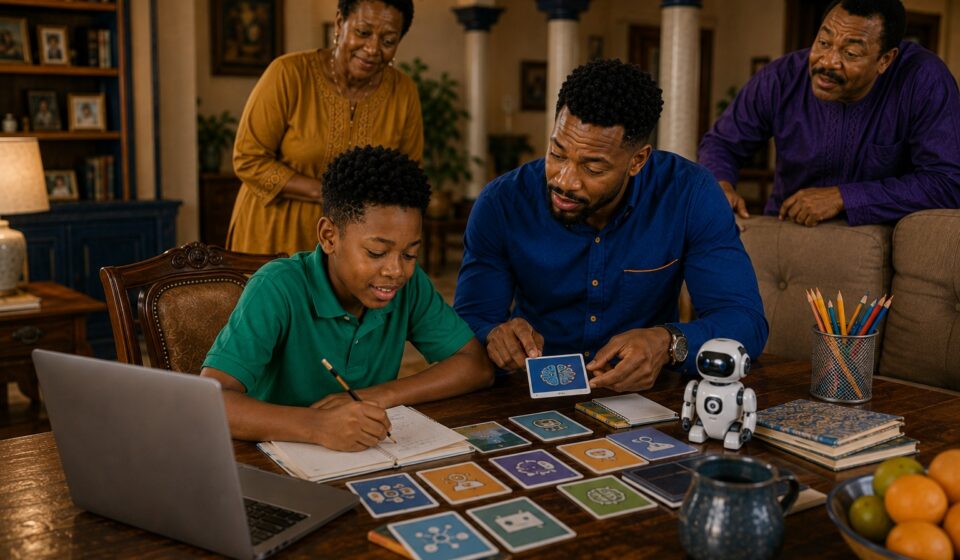
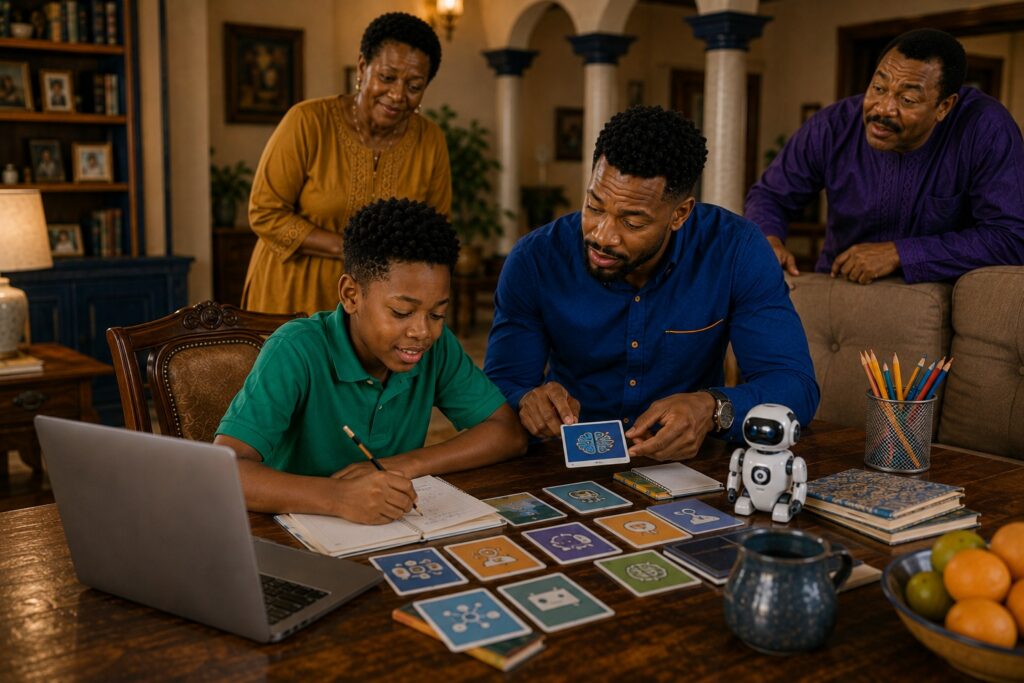
A few minutes earlier, he had been trying to explain AI technology for kids using nothing more complicated than coloured cards, pencils and a toy robot.
Now Hector had accidentally walked straight into one of the biggest questions about artificial intelligence.
Can a machine learn the wrong thing?
Chrys pulled out a chair.
“That’s exactly the kind of question I wanted you to ask.”
Hector opened his notebook.
Across the room, Mummy Chrys was arranging oranges in a bowl when she heard this.
“Please,” she called out, “make sure this lesson doesn’t end with the computer teaching my child nonsense.”
Uncle Emeka, who had just entered the dining room, laughed.
“Too late. Computers have been teaching adults nonsense for years.”
Mummy Chrys turned around.
“And you are the strongest evidence.”
Hector burst out laughing.
Chrys smiled.
“Come on, Hector. Let’s start again.”
He placed three coloured cards on the table.
“This,” he said, “is where understanding AI begins.”
What Is AI Technology for Kids?
Chrys picked up one of the coloured cards.
“Imagine I showed you hundreds of pictures of dogs.”
Hector nodded.
“And every time you saw a dog, I told you, ‘That’s a dog.’ Eventually, you would start noticing patterns.”
“Four legs,” Hector said.
“Usually.”
“Fur.”
“Usually.”
“Two ears.”
“Usually.”
Hector looked at the toy robot.
“So the robot learns?”
“Not exactly like you do,” Chrys said. “But artificial intelligence can be designed to find patterns in information and use those patterns to produce an answer, prediction or action.”
Hector thought about it.
“So AI isn’t just robots?”
“No.”
“It’s also inside computers?”
“Yes.”
“Phones?”
“Yes.”
“Apps?”
“Yes.”
“The things that recommend videos?”
“Exactly.”
Hector’s eyes widened.
“So AI is already everywhere?”
“More than you probably realise.”
That is one of the most important ideas when teaching AI technology for kids.
Children do not need to begin with complicated mathematics, programming languages or technical definitions.
They need a mental model.
AI is technology designed to perform tasks that can involve things such as recognising patterns, generating content, making predictions, understanding language or responding to information.
And children should understand that AI is technology created by people, not a magical brain living inside a computer.
UNESCO’s AI Competency Framework for Students similarly places emphasis on helping students understand AI, use it, create with it and develop the ethical judgement needed to become responsible users and co-creators.
1. Teach Kids That AI Learns From Information
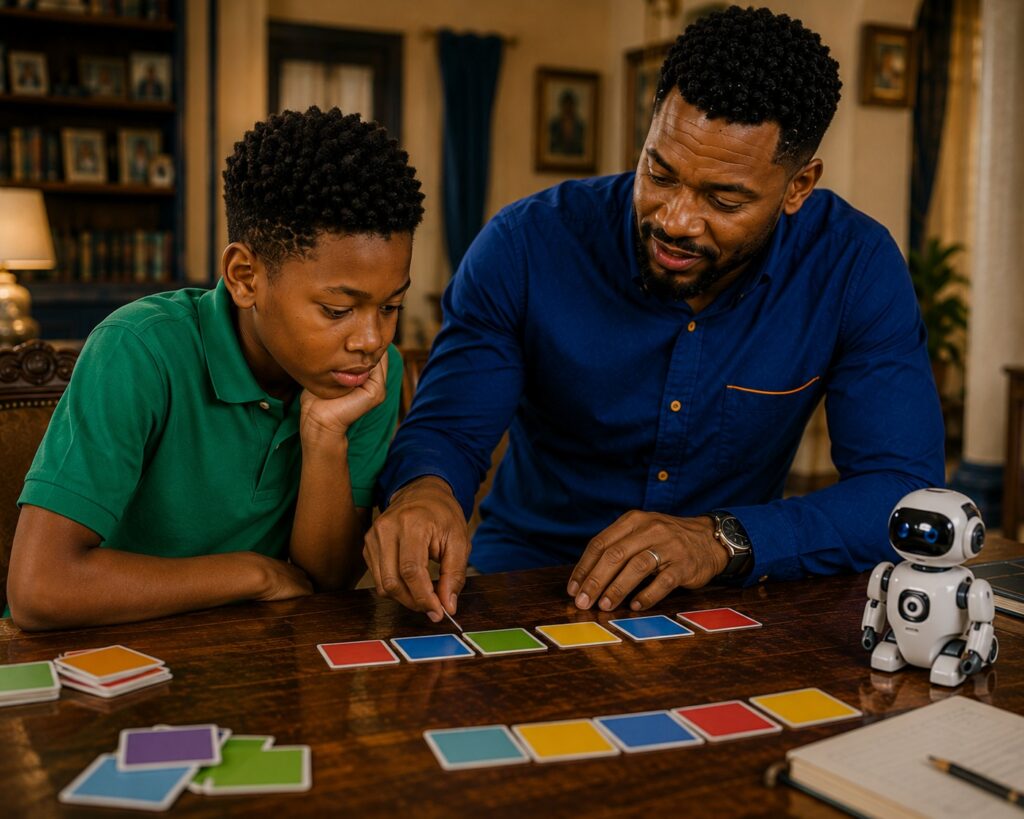
Chrys placed five cards on the table.
Three were blue.
Two were yellow.
“What colour do you think comes next?” he asked.
“Blue,” Hector answered.
“Why?”
“Because there are more blue ones.”
“Good.”
“But what if you showed the computer ten thousand cards and most of them were blue?”
“It might learn that blue is more common.”
“And then it could guess blue.”
“Exactly.”
Hector leaned closer.
“But what if the next card was yellow?”
“Then the guess would be wrong.”
Hector smiled.
“So AI can be wrong.”
“Very wrong.”
This was the moment Chrys wanted him to understand.
One of the biggest mistakes children can make with AI is assuming that because a computer sounds confident, it must be correct.
AI systems can produce useful answers, but an AI-generated answer is not automatically a verified fact.
That means AI technology for kids should always include a lesson about checking information.
If a child uses AI to learn about history, science, geography or current events, they should learn to ask:
How do I know this is true?
That question may be more valuable than knowing how to type a perfect prompt.
2. Let Children Experiment With AI
“Can I ask it anything?” Hector asked.
“Almost anything appropriate,” Chrys replied.
“Can I ask it to write a story?”
“Yes.”
“Draw a picture?”
“Yes.”
“Explain mathematics?”
“Yes.”
“Make a song?”
“Yes.”
“Do my homework?”
Chrys paused.
“That’s where we need to have a conversation.”
Uncle Emeka immediately pulled up a chair.
“I have been waiting for this conversation.”
Mummy Chrys looked at him suspiciously.
“You have been waiting to avoid homework?”
“Madam, I prefer to call it technological efficiency.”
Hector laughed.
The problem isn’t that children use AI.
The problem is when AI becomes a replacement for thinking.
A child can use AI as a tutor, brainstorming partner, explanation tool or creative assistant without handing over the entire learning process.
For example, instead of asking:
“Give me the answer to this mathematics question.”
A child could ask:
“Explain how I should solve this problem without giving me the final answer.”
That small difference changes everything.
The child still has to think.
AI becomes a guide rather than a shortcut.
This is one reason practical experimentation can be so valuable when teaching AI technology for kids.
Children should experience what AI can do.
But they should also experience its limitations.
3. Teach Kids How to Give Better Instructions
Chrys took out a pencil.
“Imagine I told you to draw a house.”
Hector grabbed a pencil.
“What kind of house?”
“Any house.”
“How big?”
“Any size.”
“What colour?”
“Any colour.”
Hector looked at him.
“You’re giving me bad instructions.”
“Exactly.”
Uncle Emeka nodded solemnly.
“For once, the boy understands management.”
Chrys laughed.
“AI works with instructions too. When you give an AI system a clear instruction, you’re more likely to get something useful.”
Hector wrote something in his notebook.
“So that’s called prompting?”
“Correct.”
A simple prompt might be:
“Explain volcanoes.”
A more useful one might be:
“Explain volcanoes to a 10-year-old using a simple example and no complicated scientific words.”
The second instruction gives the AI more context.
Children can learn this through games.
Ask them to give an AI system the same task three different ways.
Then compare the results.
Which instruction produced the clearest answer?
Which produced the funniest answer?
Which produced the most useful answer?
Which one produced something completely unexpected?
Suddenly, prompting becomes an experiment.
And experiments are much more interesting than lectures.
4. Teach Children That AI Is Not a Person
Hector stared at the screen.
“But it talks like a person.”
“Yes.”
“It answers questions.”
“Yes.”
“It can remember things sometimes.”
“Yes.”
“So…”
He pointed at the computer.
“Is it alive?”
Chrys smiled.
“No.”
“Are you sure?”
“Yes.”
“Because it sounds very smart.”
“That doesn’t make it human.”
This distinction matters.
Modern AI systems can produce remarkably human-like conversations. Children may naturally begin treating them as if they have feelings, intentions or personal experiences.
That can become particularly important when children use conversational AI regularly.
UNICEF has highlighted concerns around children relying on AI chatbots not only for information and creativity, but also for advice, emotional support and relationships.
So children should learn a simple rule:
AI can sound human without being human.
It doesn’t mean children cannot enjoy interacting with technology.
It means they should understand what they are interacting with.
Mummy Chrys walked over and looked at Hector’s notebook.
“What did you write?”
Hector read it aloud.
“AI can talk like a person, but that doesn’t mean it is a person.”
Mummy Chrys nodded.
“Good. Keep that one.”
5. Make Privacy Part of AI Education
Chrys reached for another card.
“This one is important.”
He wrote a fictional name on the card.
Then he added a school name.
Then a home address.
Then a phone number.
“Would you put all of this information into a random AI tool?”
Hector shook his head.
“No.”
“Why?”
“Because they’re private.”
“Exactly.”
Children may not always recognise that seemingly harmless information can become personal data when combined with other details.
A child’s name, school, routines, friendships, feelings or location can reveal far more than the child realises.
UNICEF’s current guidance specifically calls for children’s data and privacy to be protected and recommends privacy-by-design approaches. UNICEF’s parenting guidance also encourages families to talk with children about what information is safe to share and what should remain private.
That means a basic AI lesson for children should include questions like:
- Should I tell an AI my home address?
- Should I share my phone number?
- Should I upload somebody else’s private photograph?
- Should I tell an AI everything about my family?
- Should I share my school timetable?
- Should I paste private conversations into an AI tool?
The answer will depend on the particular service and situation, but the habit should be simple:
Pause before sharing personal information.

6. Show Children How AI Can Be Creative
“Now,” Chrys said, “we’re going to do something fun.”
Hector immediately closed his notebook.
“Finally.”
Chrys opened an AI tool.
“We’re going to invent a creature.”
Hector’s eyes lit up.
“What kind?”
“You decide.”
Hector thought for a few seconds.
“A flying lion.”
Uncle Emeka objected.
“Too ordinary.”
Hector looked at him.
“What do you suggest?”
“A talking goat that owns a bank.”
Everyone stared at him.
“Why?” Mummy Chrys asked.
“Because goats have financial ambitions.”
Nobody could explain what that meant.
But Hector was already laughing.
Creative AI can give children a new way to explore ideas.
They can create stories.
Design imaginary worlds.
Develop characters.
Brainstorm inventions.
Generate questions.
Turn rough ideas into projects.
But the most valuable part isn’t simply pressing a button and receiving something beautiful.
It is deciding what to create.
A child who tells AI exactly what to make, examines the result, changes the instructions and improves the outcome is learning something much deeper than how to generate an image.
They are learning creative direction.
They are learning iteration.
They are learning communication.
They are learning that technology responds to human decisions.
That is an important part of becoming AI-literate.
7. Challenge Children to Catch AI Getting Something Wrong
Chrys placed his phone on the table.
“Final challenge.”
Hector leaned forward.
“What challenge?”
“I’m going to ask the AI a question.”
“Okay.”
“And your job is to find out whether its answer is correct.”
Hector smiled.
“I like this.”
Chrys typed a question.
The AI responded confidently.
Hector read the answer.
Then he frowned.
“Wait.”
“What?”
“That doesn’t sound right.”
Uncle Emeka looked offended.
“Never question the machine.”
Hector ignored him.
He checked another source.
Then another.
Finally, he looked at Chrys.
“The AI made a mistake.”
Chrys nodded.
“And you caught it.”
Hector smiled.
That may have been the most important lesson of the afternoon.
Children growing up around AI technology for kids shouldn’t be trained to obey machines.
They should be trained to question them intelligently.
UNESCO’s student framework explicitly emphasises critical judgement of AI solutions alongside foundational AI knowledge and responsible citizenship.
The goal isn’t to make children suspicious of every AI answer.
It is to make them thoughtful enough to verify important information.
What Should Kids Actually Learn About AI?
By now, Hector’s notebook was almost full.
Chrys looked at the pages.
“Let’s see what you’ve learned.”
Hector read from his notes.
“AI can recognise patterns.”
“Good.”
“AI can make predictions.”
“Good.”
“AI can generate things.”
“Good.”
“AI can make mistakes.”
“Very good.”
“We shouldn’t share private information carelessly.”
“Excellent.”
“We shouldn’t assume AI is human.”
“Exactly.”
“And we should check important information.”
Chrys nodded.
“That is a good beginning.”
The important thing is that children don’t need to master everything about artificial intelligence at once.
A strong foundation can include:
| AI skill | What children can learn |
|---|---|
| AI basics | What artificial intelligence is and isn’t |
| Pattern recognition | How machines can learn from examples |
| Prompting | How clear instructions produce better results |
| Critical thinking | How to question and verify AI answers |
| Creativity | How AI can support stories, art and ideas |
| Privacy | What personal information should be protected |
| Ethics | Why AI should be used responsibly |
| Human judgement | Why people remain responsible for decisions |
This approach also aligns with UNESCO’s broader framework, which organises student AI competencies around a human-centred mindset, AI ethics, AI techniques and applications, and AI system design.
How Parents Can Teach AI Technology for Kids at Home
You don’t need an expensive robotics laboratory.
You don’t need to be a programmer.
You don’t even need to understand every technical detail of artificial intelligence.
Start with ordinary things.
Use playing cards to demonstrate patterns.
Use a toy robot to start conversations about machines.
Ask children why recommendation systems might suggest certain videos.
Give them an AI-generated answer and ask them to verify it.
Ask them to improve a weak prompt.
Create a short story together.
Discuss what information should remain private.
And sometimes, deliberately allow the AI to be wrong so the child can practise catching the mistake.
The objective isn’t to raise children who blindly know how to use every new AI application.
It is to raise children who can walk into a future full of AI and still think for themselves.
One More Lesson From the House of Chrys
The afternoon was almost over when Hector closed his notebook.
“Uncle Chrys?”
“Yes?”
“Can I ask you one more question?”
“Of course.”
Hector looked at the toy robot.
“If AI is going to become smarter and smarter…”
Chrys waited.
“Who is supposed to make sure people use it properly?”
The room became quiet.
Even Uncle Emeka didn’t make a joke.
Chrys leaned back in his chair.
“People.”
“Which people?”
“All of us.”
Hector frowned.
“Even kids?”
“Especially kids. Because you are growing up with technology that we didn’t have when we were your age.”
Hector looked down at his notebook.
“So learning about AI isn’t just learning how computers work.”
“No.”
“It’s learning how we should behave around computers.”
Chrys smiled.
“Now you’ve got it.”
Mummy Chrys picked up the bowl of oranges.
“Good. Since everybody has learned something, everybody can now learn how to peel an orange.”
Uncle Emeka stood up.
“I have extensive experience in that field.”
Mummy Chrys handed him an orange.
“Then demonstrate.”
He stared at it.
Hector burst out laughing.
The robot remained silent.
For once, it had nothing to say.
Why AI Education for Children Matters Now
AI is no longer a distant technology that children will encounter only when they become adults.
It is already appearing in the platforms, apps, search tools, educational products and digital experiences surrounding them.
UNICEF’s current work on AI and children points to both the opportunities and risks: AI can support learning and accessibility, but children also face risks involving misinformation, deepfakes, privacy, harmful content and exclusion.
That means waiting until children are teenagers—or adults—to teach them about AI may be too late.
But teaching children about AI does not mean turning every child into a software engineer.
It means giving them the mental tools to navigate an AI-shaped world.
They need curiosity.
They need critical thinking.
They need creativity.
They need digital judgement.
They need privacy awareness.
And above all, they need to understand that human beings remain responsible for how technology is used.
That is the real lesson behind AI technology for kids.
Not simply how to make a computer answer a question.
But how to make sure the child asking the question remains smarter than the answer.
Frequently Asked Questions About AI Technology for Kids
What is AI technology for kids?
AI technology for kids refers to age-appropriate ways of teaching children what artificial intelligence is, how it works at a basic level, how they can use AI creatively and safely, and how to recognise its limitations.
What age should children start learning about AI?
There is no single perfect starting age. Young children can begin with simple concepts such as patterns, instructions, machines and digital safety, while older children can explore prompting, machine learning concepts, verification and responsible AI use.
Is AI safe for children?
AI can be useful for children, but safety depends on the specific tool, the child’s age, how the system is designed and how it is used. Parents should pay particular attention to privacy, inappropriate content, accuracy and the possibility of children becoming overly dependent on conversational systems. UNICEF’s guidance emphasises safety, privacy, fairness, transparency and children’s well-being.
Should children use AI for homework?
AI can be used as a learning assistant, but children should not simply copy AI-generated answers. A better approach is to use AI to explain difficult concepts, generate practice questions, provide feedback or guide a child through a problem while preserving the child’s own thinking.
What is the most important AI skill for a child?
There isn’t just one, but critical thinking is foundational. A child who knows how to question, verify and evaluate AI-generated information is better prepared to use many different AI systems responsibly.
Final Thought
Hector had started the afternoon thinking artificial intelligence was about robots.
He ended it understanding something much bigger.
AI was about patterns.
It was about information.
It was about instructions.
It was about creativity.
It was about mistakes.
It was about privacy.
And, most importantly, it was about people.
The toy robot was still sitting on the table.
Hector picked it up.
“Good lesson,” he said.
Chrys smiled.
“Ready for the next one?”
Hector shook his head.
“No.”
“Why?”
“I need to teach the robot first.”
And before Chrys could respond, Hector placed the robot in front of the notebook.
Uncle Emeka leaned over.
“Ask it whether it knows how to peel oranges.”
Mummy Chrys immediately shouted from the kitchen.
“EMEKA!”
The entire House of Chrys erupted in laughter.