

Why Roger Penrose Wants to Rename AI — And Why Every African Parent Should Pay Attention

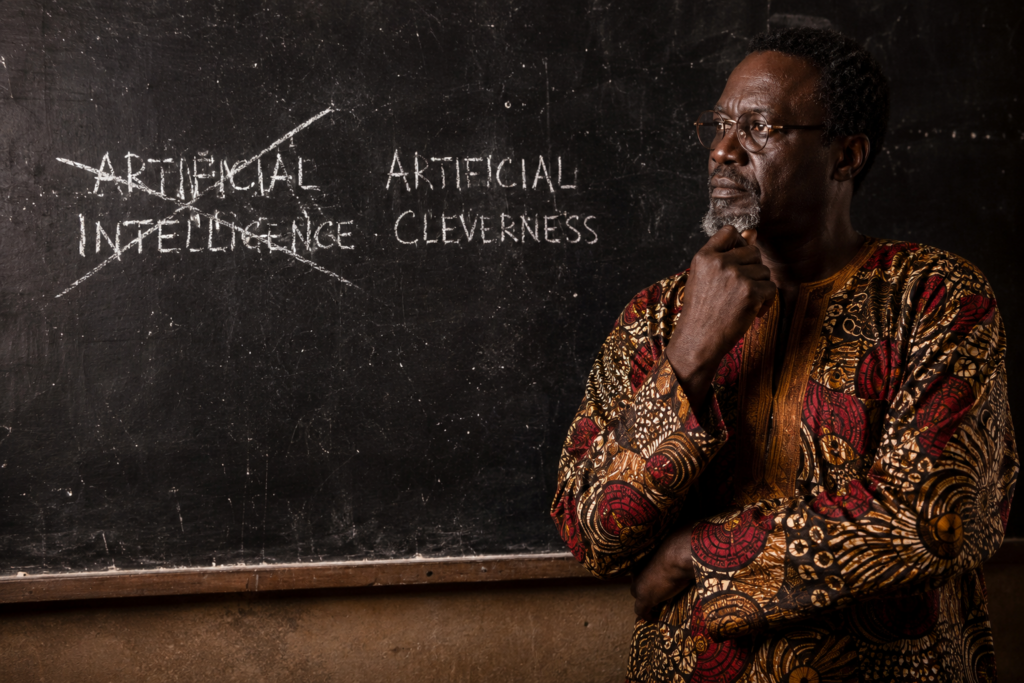
Roger Penrose is not someone you dismiss easily. Read up on why Roger Penrose wants to rename AI.
Nobel Prize in Physics. Decades at the absolute frontier of human understanding about consciousness, mathematics, and the nature of reality. The kind of mind that does not make careless claims about things that matter.
And he thinks we have made a serious error. An error so embedded in how we talk about technology that most people cannot see it anymore. An error whose consequences are quietly shaping how an entire generation relates to the most powerful tools ever built.
The error is in what we call it.
Not artificial intelligence. Artificial cleverness.
His argument is precise and worth taking seriously. Intelligence involves consciousness. Machines are not conscious. Therefore what machines do — however extraordinary, however useful, however apparently sophisticated — is not intelligence. It is cleverness. Unprecedented, world altering, genuinely impressive cleverness. But cleverness is categorically different from intelligence and treating them as the same thing has consequences that reach further than most people have thought through.
For African parents specifically this distinction is not philosophical background. It is one of the most practically important ideas in the entire conversation about AI and children — and almost nobody raising African children is engaging with it seriously.
The Mathematics Classroom That Explains Everything
Penrose illustrates his argument with an example that every African parent who has watched a child prepare for examinations will recognize with uncomfortable familiarity.
In a mathematics classroom there are two kinds of students.
The first kind understands what they are doing. They can encounter a problem they have never seen before and navigate it through genuine comprehension — feeling their way through the underlying structure, making connections across different areas of knowledge, arriving somewhere true because they understand why the path leads there.
The second kind is clever. Sometimes extraordinarily clever. They have memorized the methods, internalized the patterns, and can reproduce the correct answer to any problem that resembles something they have practiced before. Their speed is impressive. Their accuracy is reliable. Their results on familiar problems are indistinguishable from those of the first student.
The difference only becomes visible when something genuinely new appears. Something outside every pattern they have stored. Something that requires not just applying a learned method but understanding why the method works and what to do when it does not.
The clever student stalls. The intelligent student navigates.
Current AI systems — every single one regardless of how sophisticated the name attached to it sounds — are the clever student. Extraordinarily, almost incomprehensibly clever. Processing more information, identifying more patterns, producing more accurate outputs across more domains simultaneously than any human being who has ever lived.
But at the edge of genuine understanding — where consciousness, meaning, and the kind of intelligence that emerges from actually living in the world becomes necessary — the machine reaches a limit that no amount of additional computing power moves.
Penrose’s concern is that calling this intelligence has hypnotized people into forgetting that limit exists. Am I the only one still curious about why Roger Penrose wants to rename AI?

Why the Hypnosis Is Particularly Dangerous Here
The confusion Penrose describes produces a specific and damaging response in how people think about what children need in an AI world.
If AI is genuinely intelligent — if it possesses the same quality of mind that human beings possess, only faster and more capable — then the logical conclusion is that human intelligence is being made redundant. That the things human minds do are being superseded by machines that do those things better. That the appropriate response is to find whatever narrow set of distinctly human capabilities remain after AI has claimed everything else and retreat into them.
That conclusion produces educational anxiety. The desperate search for what humans can still do that machines cannot. Curriculum reform that tries to preserve human relevance at the margins of machine capability rather than building on what makes human consciousness genuinely irreplaceable.
But if Penrose is right — if what AI actually has is cleverness rather than intelligence — then the entire framing shifts completely.
The question stops being what can humans do that machines cannot. It becomes what can conscious, understanding, meaning making human beings accomplish when they have access to the most powerful cleverness engine ever built?
That is a fundamentally different question. It produces a fundamentally different educational response. And it produces a fundamentally different relationship between a child and the AI tools they are growing up alongside.
The child who understands they are working with artificial cleverness rather than artificial intelligence does not compete with the machine. They direct it. They evaluate it. They bring to the collaboration the one thing no machine can supply — genuine understanding of what matters and why.
What African Education Has Been Getting Wrong on Both Sides
The painful truth in the African education context is that the system has spent decades producing the wrong kind of cleverness while simultaneously failing to develop genuine intelligence — and AI has arrived to make both failures simultaneously more visible and more consequential.
African examination systems reward precisely what Penrose describes in his clever mathematics student. The ability to reproduce learned patterns accurately under pressure. Memorization over comprehension. Method application over genuine problem solving. The student who has stored the most retrievable responses to predictable stimuli performs best — not because they understand the most but because they have practiced the patterns most thoroughly.
This is the educational equivalent of training children to compete with machines at exactly what machines do best. And now that AI performs this kind of pattern reproduction faster, more accurately, and across more domains than any human student the bankruptcy of this approach is impossible to ignore any longer.
The solution is not simply to add AI tools to the existing curriculum and describe that addition as preparation. The solution is to understand what Penrose is pointing at — that consciousness, genuine understanding, and the intelligence that emerges from being a living experiencing human being is not something AI has and not something AI will acquire simply by becoming more powerful.
That is what African children need to develop. Not just digital skills. Not just tool literacy. Genuine intelligence in Penrose’s sense — the capacity for understanding rather than calculation, for meaning rather than pattern recognition, for the kind of consciousness that makes human beings irreplaceable at everything that actually matters.
The Name Change and What to Do With It
Penrose’s proposed rename will not happen at the industry level. The term AI is too embedded in culture, commerce, and public conversation to be displaced by a more accurate alternative regardless of how correct that alternative is.
But at the individual level — at the level of an African parent talking to their child about technology, an African teacher introducing students to these tools, an African educator thinking about what genuine preparation requires — the rename is both possible and valuable.
Consider the difference between telling a child that AI is intelligent and telling a child that AI is extraordinarily clever but not conscious, not understanding, and not capable of the meaning making that makes human beings irreplaceable at the things that matter most.
The first framing produces awe that slides toward passivity. The machine is intelligent therefore I should defer to it and hope it does not make me obsolete.
The second framing produces something more useful — accurate confidence. The machine is clever therefore I should direct it, evaluate its outputs with my own judgment, and bring to our collaboration the understanding it cannot supply from within itself.
That accurate confidence is what House of Chrys is built to produce in African children. And it is why The Prepared Child matters as an entry point — because the child who first encounters AI as a remarkable tool made by people to solve specific problems grows up with an accurate mental model rather than a hypnotized one.
Visit For Parents to understand how to build this foundational accuracy at home before your child’s relationship with AI is shaped entirely by platforms designed to maximize engagement rather than understanding.

The Question Penrose Leaves Behind
He ends his argument with a question that deserves to travel far beyond the physics lecture where he first asked it.
When we call a system intelligent are we describing what it does or quietly assuming something about what it is?
For African parents the practical version of that question is this — are you preparing your child to compete with artificial cleverness or to bring genuine intelligence to bear on a world where artificial cleverness is abundantly available?
Those are not the same preparation. They do not look the same in practice. They do not produce the same child.
The child prepared to compete with AI cleverness is trying to out-pattern-match a machine that processes billions of patterns per second. That competition is already lost before it begins.
The child prepared to bring genuine intelligence — consciousness, understanding, meaning, judgment — to a world full of artificial cleverness is not competing at all. They are operating in a different category entirely. The category that Penrose insists cannot be manufactured. The category that remains distinctly, irreducibly human regardless of how clever the machines become.
Africa’s children belong in that category. Getting them there — building the genuine intelligence that complements rather than competes with artificial cleverness — is the preparation that actually matters for the world they are inheriting.
The Prepared Child begins that work at the age when foundations are most durably laid. Visit The Prepared Child page to start. Visit For Schools to bring this thinking into your child’s classroom through House of Chrys workshops. Visit About House of Chrys to understand the full vision behind what we are building for African children.
Cleverness can be manufactured. Consciousness cannot. Africa’s children have the one thing no machine will ever replicate.
The work is making sure they know it.
In all things, prepare.