
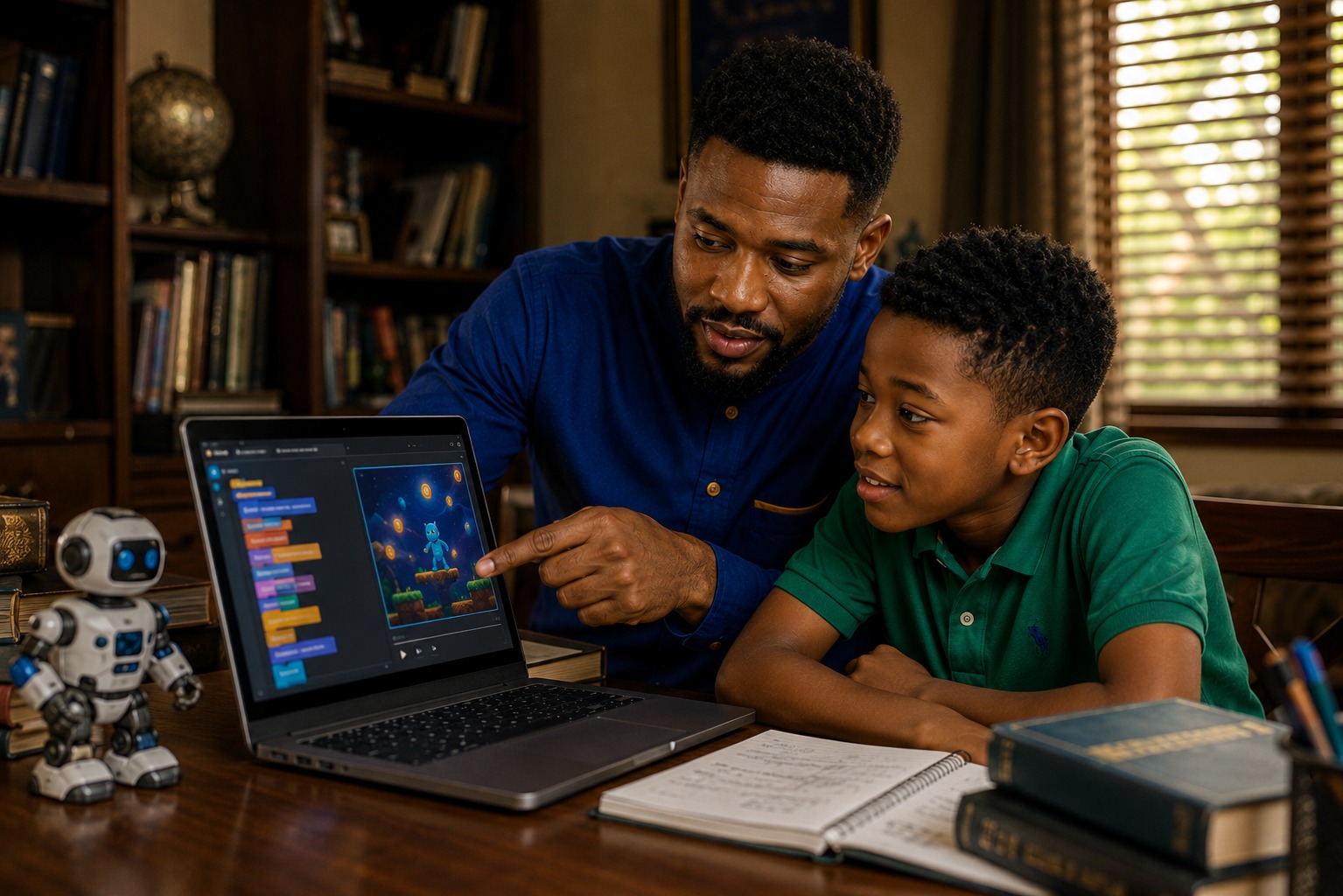

“Coding for kids Nigeria.”
Hector read the words slowly from Chrys’s laptop.
Then he looked up.
“Uncle Chrys, what does that mean?”
Chrys turned around from his desk.
“What does what mean?”
“This.”
Hector pointed at the screen.
“Coding for kids Nigeria.”
Uncle Emeka, who had been lying on the sofa in the living room, immediately sat up.
“Ah.”
Everyone looked at him.
Uncle Emeka adjusted his glasses.
“This is how they start.”
“How they start what?” Ada asked.
“Programming children.”
Hector frowned.
“Programming?”
“Yes,” Uncle Emeka said confidently. “Today they teach them coding. Tomorrow they will teach them how to become robots.”
Ada laughed.
“You don’t even know what coding is.”
“I know enough.”
“What does it mean?”
Uncle Emeka paused.
“It’s…”
He looked at Chrys.
Then at Ada.
Then back at Hector.
“It’s computer mathematics.”
Ada burst out laughing.
Mummy Chrys, who had been arranging vegetables in the kitchen, called from the doorway.
“Emeka, if you don’t know something, why don’t you simply say you don’t know?”
Uncle Emeka looked offended.
“I was simplifying it.”
Chrys smiled.
“No. You were inventing it.”
Hector started laughing.
And that was how the House of Chrys began talking about coding for kids in Nigeria.
What Is Coding for Kids?
Coding is essentially the process of giving a computer instructions that it can execute.
But when we’re talking about coding for kids in Nigeria, the objective shouldn’t be to sit a six-year-old in front of hundreds of lines of complicated code and tell them to memorize programming syntax.
Children can begin with concepts such as:
- sequences
- instructions
- patterns
- conditions
- loops
- problem-solving
- logic
- debugging
- experimentation
For younger children, visual block-based programming can make these concepts easier to understand. Scratch, for example, allows children to create interactive stories, games and animations using visual programming blocks. Other learning pathways can gradually introduce children to HTML, Python, JavaScript and application development as their abilities develop. Current Nigerian-focused coding programs reflect this progression, with offerings ranging from Scratch and basic coding through Python, web development, AI and app development. (earlySTEMer)
The important thing is that coding should be something children do, not merely something they study.
Hector didn’t understand that yet.
He was about to.
“So What Does Coding Actually Do?”
That evening, Hector found Chrys in his study.
“Uncle Chrys?”
“Yes?”
“If I learn coding, what happens?”
“You can build things.”
Hector looked at the laptop.
“Like what?”
“Games.”
Hector’s eyes widened.
“Apps.”
His eyes widened further.
“Websites.”
Now Hector was interested.
“Robots?”
“Eventually.”
“Artificial intelligence?”
“Eventually.”
“Can I build a machine that makes Mummy Chrys stop telling me to clean my room?”
Chrys laughed.
“No programming language has been invented for that.”
From the hallway came Mummy Chrys’s voice.
“I heard that.”
Hector immediately became quiet.
Chrys smiled.
“See? You have discovered the most advanced technology.”
“What?”
“Your mother’s hearing.”
Hector laughed.
But then Chrys became serious.
“There’s something more important than learning how to write code.”
“What?”
“Learning how to think like a builder.”
Why Coding for Kids in Nigeria Matters
Nigeria is already home to a growing ecosystem of organizations teaching children programming, web development, Python, artificial intelligence and other technology skills. Current programs cater to children across different age groups, including beginners with no previous coding experience. (earlySTEMer)
That matters because the future Nigerian economy will not only need people who can use technology.
It will increasingly need people who can create with technology.
And that distinction is enormous.
A child who learns to use an application learns how to operate somebody else’s creation.
A child who learns to code begins to understand:
“I can make the machine do something.”
That psychological shift can be powerful.
The child stops seeing technology as magic.
The child begins seeing technology as something that can be understood, questioned, modified and built.
But Does Every Nigerian Child Need to Become a Programmer?
“No.”
Mummy Chrys answered before Chrys could.
The family was back at the dining table.
Hector had asked the question again.
“So everyone needs to become a programmer?”
“No,” Mummy Chrys said.
“Why not?”
“Because everyone has different gifts.”
She looked at Chrys.
“Your uncle may understand computers.”
She paused.
“Your aunt may understand people.”
She looked toward Ada.
“Someone else may understand agriculture.”
“Someone else may understand medicine.”
“Someone else may understand business.”
“Someone else may understand art.”
She picked up her cup.
“The purpose of education isn’t to make everyone the same.”
Chrys nodded.
“Exactly.”
Coding doesn’t have to be the final career destination.
It can instead become a tool for developing transferable skills.
Coding education providers commonly emphasize problem-solving, creativity, logical thinking and critical thinking alongside technical skills.
Those skills can matter even if a child eventually becomes:
- a doctor
- architect
- entrepreneur
- scientist
- teacher
- economist
- designer
- journalist
- lawyer
- artist
The question isn’t:
“Will my child become a software engineer?”
The better question is:
“Will learning to code help my child become a better problem-solver?”
Hector Makes His First Program
On Saturday morning, Hector sat in Chrys’s study.
He had been given a simple challenge.
Create something that asks a person their name and then greets them.
Hector stared at the screen.
“That’s easy.”
“Go ahead,” Chrys said.
Five minutes later, Hector was frustrated.
“It’s not working!”
“What did you do?”
“I told the computer to say hello.”
“Did you tell it what name to use?”
“Yes.”
“Show me.”
Hector turned the laptop around.
Chrys looked at the program.
There was a small mistake.
“You forgot something.”
“What?”
“This instruction tells the computer to ask for the person’s name.”
“Okay.”
“But you haven’t told it what to do with the answer.”
Hector stared at the screen.
Then suddenly his eyes widened.
“Oh!”
He changed the instruction.
The program ran.
The screen displayed a greeting.
Hector jumped out of his chair.
“I DID IT!”
Chrys smiled.
“Yes.”
Hector looked at the screen.
Then he looked at Chrys.
“But I made a mistake.”
“You did.”
“And it worked after I fixed it.”
“Exactly.”
Hector smiled.
“So coding is making mistakes until the computer works?”
Chrys laughed.
“That’s one way of putting it.”
The Hidden Skill Children Learn When They Code
That little moment contains something more important than the program itself.
Debugging.
A child writes something.
It doesn’t work.
The child investigates.
The child finds the problem.
The child changes something.
The child tries again.
The child eventually succeeds.
That cycle can teach persistence and structured problem-solving.
This is one reason Nigerian coding programs often emphasize practical, project-based learning rather than simply presenting programming theory. For example, Nigerian providers currently describe children building games, websites, apps and other projects as part of their learning pathways. (earlySTEMer)
The child isn’t merely learning:
if
or:
for
or:
function
The child is learning:
“When something doesn’t work, I can investigate why.”
That lesson travels far beyond a computer.
What Should Children Learn First?
One mistake parents can make is becoming obsessed with the programming language.
“Should my child learn Python?”
“Should my child learn JavaScript?”
“Should they learn Scratch?”
“Should they learn HTML?”
These are useful questions.
But they aren’t the first questions.
The first question should be:
“What is appropriate for this child’s age, interests and current ability?”
For younger beginners, visual programming environments can provide a gentler introduction to programming concepts. As children become more comfortable with computational thinking, they can move toward text-based languages and more complex projects. Nigerian programs currently offer pathways involving Scratch, HTML/CSS, Python, JavaScript, app development and AI, often organized by age or skill level. (earlySTEMer)
A sensible progression might look something like this:
Ages 6–8
Focus on:
- sequencing
- patterns
- simple instructions
- visual programming
- animations
- storytelling
- games
Ages 8–12
Introduce:
- more complex Scratch projects
- computational thinking
- simple web concepts
- beginner Python
- problem-solving challenges
Ages 12+
Children who are interested can explore:
- Python
- JavaScript
- web development
- app development
- AI
- robotics
- more advanced programming concepts
The exact progression should depend on the individual child.
Don’t Give a Child Coding Lessons. Give Them Problems to Solve.
This was where Ada disagreed with Chrys.
“You’re teaching him syntax.”
“No,” Chrys said.
“That’s what you’re doing.”
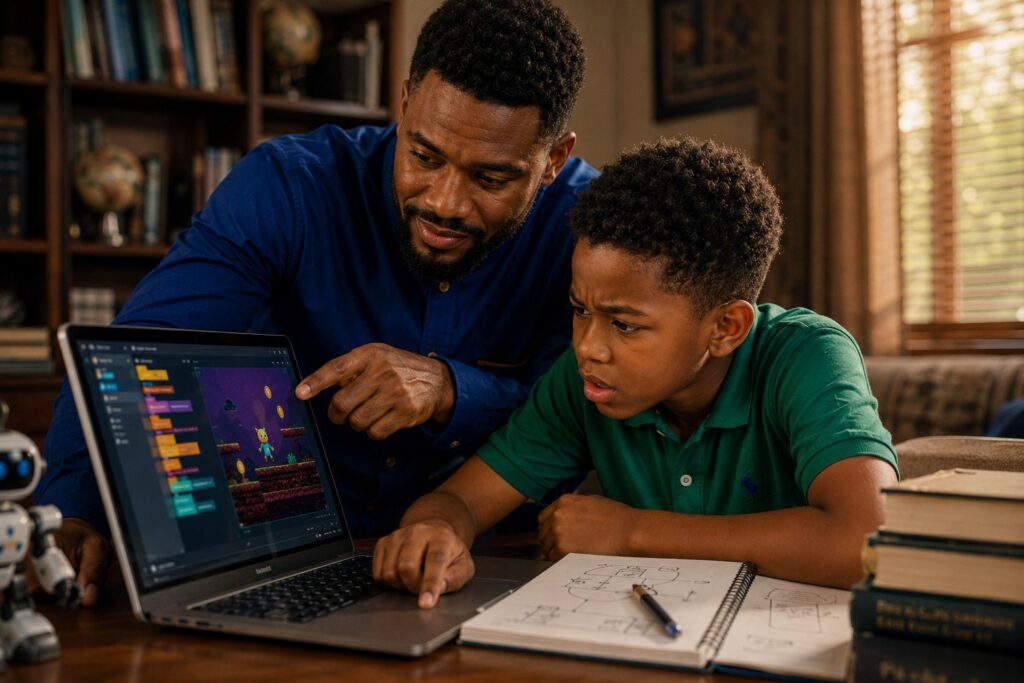
“No. I’m giving him problems.”
Ada folded her arms.
“What problem did he solve?”
Chrys pointed toward Hector.
“He wanted the computer to greet someone by name.”
“And?”
“He had to figure out how to make the machine understand the sequence.”
Ada nodded slowly.
“Fair.”
Chrys smiled.
“This is the difference between teaching a child coding and teaching a child to code.”
The first can become memorization.
The second becomes creation.
That’s why projects matter.
Instead of:
“Today we’re learning loops.”
Try:
“Can you make a game where the character keeps moving until it reaches the treasure?”
Instead of:
“Today we’re learning variables.”
Try:
“Can you make the program remember the player’s score?”
Instead of:
“Today we’re learning conditional statements.”
Try:
“Can you make the game respond differently when the player wins?”
The technical concept is still being taught.
But now there is a reason to learn it.
What Can Nigerian Children Build?
Hector had a new question.
“What should I build?”
Chrys turned the question around.
“What problem do you see?”
Hector thought.
“There are lots of things.”
“Good.”
“Sometimes people don’t know when the school bus is coming.”
“Interesting.”
“Sometimes people forget homework.”
“Good.”
“Sometimes Mummy can’t find her phone.”
Mummy Chrys shouted from the kitchen.
“I don’t need a computer for that!”
Hector laughed.
The possibilities are enormous.
A Nigerian child could eventually build projects around:
- school organization
- transport
- agriculture
- local commerce
- environmental problems
- education
- games
- storytelling
- budgeting
- community information
- accessibility
- entertainment
The point isn’t that every child’s first project needs to solve a national problem.
A game is enough.
A calculator is enough.
A quiz is enough.
A digital story is enough.
The child needs to experience creation.
Coding + AI: The New Question
Mr. Okoro had been quiet.
That was unusual.
Finally, he spoke.
“So now children are learning coding.”
“Yes,” Chrys said.
“And AI can already write code.”
“Yes.”
Mr. Okoro leaned back.
“Then why should they learn coding?”
The room became quiet.
It was a much better question than Uncle Emeka expected.
Chrys thought about it.
“Because knowing how to use AI to generate code isn’t the same as understanding what the code is doing.”
That distinction is becoming increasingly important.
AI-assisted coding can help people produce software faster, but children still benefit from understanding fundamental concepts such as logic, structure, debugging and computational thinking.
A child who blindly copies AI-generated code may have a working program.
A child who understands the code can modify it, troubleshoot it, improve it and eventually build something new.
And that is the direction we should want.
Not:
AI instead of coding.
But:
Coding + AI + human reasoning.

How Parents Can Start Coding for Kids in Nigeria
Parents don’t necessarily need to turn their homes into computer laboratories.
Start small.
1. Give the child access to a computer when possible
A laptop or desktop is generally more practical for serious coding than a phone.
Some beginner activities can work on tablets, but more advanced coding typically benefits from a computer with a keyboard. Nigerian coding providers similarly recommend a computer and internet connection for many of their programs. (earlySTEMer)
2. Start with something the child actually likes
If your child loves:
- football → build a football quiz
- music → create an interactive music project
- stories → make a digital story
- games → build a simple game
- drawing → create an animation
Interest creates motivation.
3. Don’t rush into difficult programming languages
A six-year-old doesn’t need to start by memorizing Python syntax.
The goal is understanding, not impressing the parent.
4. Let the child struggle
Don’t immediately fix every error.
Ask:
“What do you think went wrong?”
That question may teach more than giving them the answer.
5. Introduce AI carefully
AI can help children brainstorm projects, explain concepts and debug code, but parents should encourage children to understand and verify what the AI produces.
The objective is not to create children who cannot code without AI.
The objective is to create children who can use AI while still understanding what they’re building.
The Cost Question
Mummy Chrys eventually asked the question every Nigerian parent eventually asks.
“How much will this cost?”
There is no single answer.
Coding education for children in Nigeria ranges from free resources and competitions to paid online classes, tutoring and structured programs.
For example, current Nigerian offerings include free coding resources and programs as well as paid live and self-paced courses. Some providers list group classes, personal tutoring and structured curricula spanning Scratch, Python, web development and AI. (earlySTEMer)
So parents shouldn’t assume that expensive automatically means better.
Instead, look for:
- age-appropriate teaching
- practical projects
- qualified instruction
- opportunities to build
- feedback from instructors
- a clear curriculum
- progression from beginner to advanced
- safe online learning practices
A child doesn’t need the most expensive coding school in Nigeria to begin learning how computers work.
Sometimes they need a computer, a project and an adult willing to let them experiment.
Hector Has an Idea
That night, Hector walked into Chrys’s room.
“Uncle Chrys?”
“Yes?”
“I know what I want to build.”
Chrys turned around.
“What?”
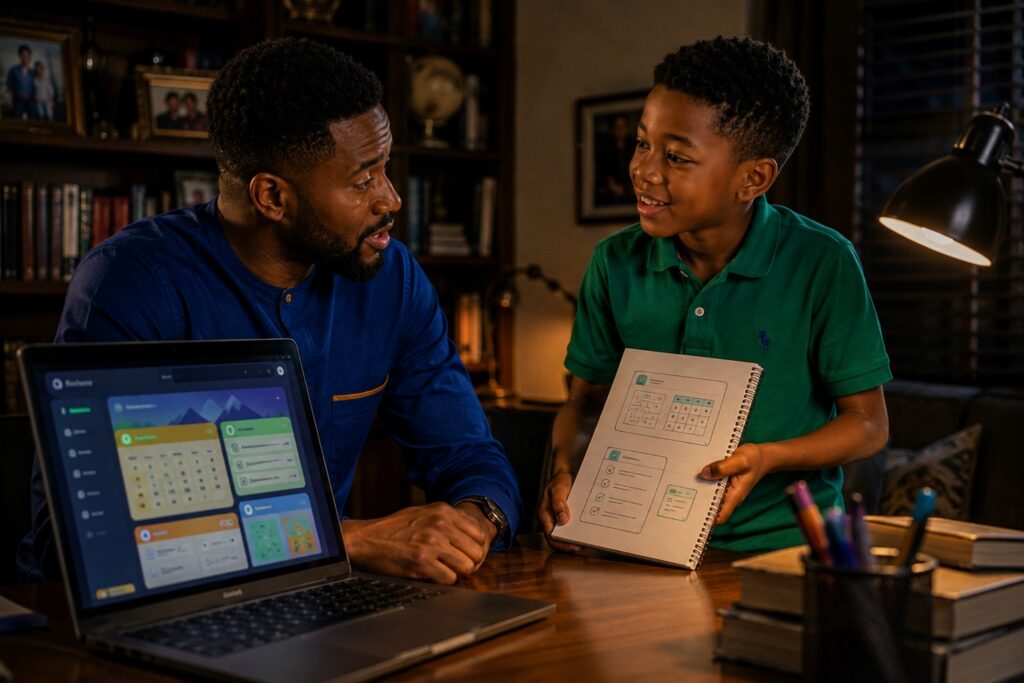
“A homework machine.”
Chrys smiled.
“What does it do?”
“It reminds children what homework they have.”
“Good.”
“And tells them when it’s due.”
“Good.”
“And…”
Hector hesitated.
“What?”
“It doesn’t do the homework.”
Chrys smiled.
“Why?”
“Because then they won’t learn anything.”
There was silence.
Chrys looked at him.
That was the moment he realized something.
Hector hadn’t merely learned to code.
He had started thinking like a creator.
The Real Goal of Coding for Kids in Nigeria
The goal isn’t to make every Nigerian child a software engineer.
It isn’t even to make every child love programming.
The deeper goal is to give children an opportunity to discover something extraordinarily important:
They can create things that did not exist before.
That realization can change a child’s relationship with technology.
Instead of seeing the phone as something that only provides entertainment, the child can begin to see it as the product of someone’s imagination.
Instead of seeing an app as magic, the child can ask:
“How did someone make this?”
Instead of saying:
“I wish someone would build this.”
the child might eventually say:
“I’ll build it.”
That is the mindset Africa needs.
Because the future won’t belong exclusively to the people who consume the technologies that others create.
It will increasingly belong to the people who can understand problems, imagine solutions and build them.
And that is why coding for kids in Nigeria matters.
The Question Mummy Chrys Asked
The following morning, Mummy Chrys found Hector at the dining table.
He was drawing something.
“What are you doing?”
“My app.”
“What does it do?”
“It helps children remember their homework.”
Mummy Chrys looked at the drawing.
Then she looked at Hector.
“Who told you to build that?”
“Nobody.”
“Then why are you building it?”
Hector smiled.
“Because I thought of it.”
Mummy Chrys nodded.
Then she said something that made Hector stop drawing.
“Good.”
She walked away.
Hector looked toward Chrys.
“What does that mean?”
Chrys smiled.
“It means you’ve started.”
Final Thought
Perhaps the most important outcome of coding for kids Nigeria isn’t the programming language a child learns.
It is the moment the child realizes:
“I don’t have to wait for somebody else to build the future for me.”
Hector closed his notebook.
His first program wasn’t impressive.
It wasn’t going to change Nigeria.
It probably wasn’t even going to make his school teacher particularly excited.
But it was his.
And inside the House of Chrys, that was enough for a beginning.
Because every great builder starts with something small.
A question.
An idea.
A mistake.
A failed attempt.
And eventually—
something that works.