
Artificial Intelligence for Kids: Hector Discovers That the Machine Doesn’t Always Know

The principal’s office was very unusually quiet.
Hector sat in one of the two visitor’s chairs, his schoolbag between his feet and his hands folded across his chest.
Across the desk, the principal stared at him.
Then she looked at Chrys.
Then back at Hector.
“I understand what happened,” she said. “But I still want to hear it from him.”
Hector swallowed.
Chrys leaned back in his chair.
“What did you do?”
Hector looked at the principal.
“I used AI.”
The principal raised an eyebrow.
“That is not, by itself, a crime.”
Hector relaxed slightly.
“But,” she continued, “you used it to answer a question you were supposed to research yourself.”
Hector looked down.
“I thought the answer was correct.”
“And how did you know?”
Hector opened his mouth.
Nothing came out.
The principal smiled.
“That,” she said, “is exactly what we need to teach children about artificial intelligence.”
Hector looked at Chrys.
Chrys looked back at him.
And suddenly, what had begun as a small problem with a school assignment became a much bigger conversation.
What Is Artificial Intelligence?
Artificial intelligence can sound like something belonging to the distant future.
For Hector, however, it had already become part of everyday life.
He had encountered AI through chatbots, recommendation systems, image generators, search tools and educational technology without necessarily understanding what was happening behind the screen.
So Chrys decided to start at the beginning.
“Imagine you have a computer that can analyze enormous amounts of information,” he told Hector.
“Okay.”
“And imagine that, using mathematical models and training, it can identify patterns and produce useful outputs.”
“Like answers?”
“Yes. Depending on the system, it might answer questions, recognize images, translate languages, make predictions, generate text or create images.”
“So it’s like a really smart calculator?”
“Not exactly.”
Hector frowned.
“Then what is it?”
Chrys smiled.
“That’s the interesting part.”
For children, a useful starting definition is:
Artificial intelligence is technology that enables computer systems to perform tasks that can involve abilities such as recognizing patterns, processing language, making predictions, or generating content.
Real AI systems are considerably more complicated than this simple explanation.
But when introducing artificial intelligence for kids, the goal isn’t to overwhelm them with technical terminology.
The goal is to give them a mental model they can build on.
The First Experiment
Chrys didn’t take Hector back to the computer.
Instead, he took him to the market.
Mummy Chrys had sent them to buy tomatoes.
Hector thought this was a punishment.
It wasn’t.
As they walked between the stalls, Chrys pointed at a woman sorting tomatoes.
“Look.”
The woman picked up one tomato.
She inspected it.
Then another.
Then another.
“This one is ripe.”
She placed it in one basket.
“This one isn’t.”
She placed it somewhere else.
Hector watched.
“She knows by looking.”
“Exactly.”
“How?”
“She has seen thousands of tomatoes.”
Hector suddenly understood where Chrys was going.
“So she’s recognizing patterns.”
“Exactly.”
Chrys smiled.
“And that gives you a useful starting point for understanding how some AI systems work.”
AI isn’t literally a market woman looking at tomatoes.
The analogy has limits.
But the principle is useful: systems can be trained using examples and mathematical techniques to identify patterns and make predictions or classifications.
That is one of the first ideas children should understand when learning about artificial intelligence for kids.

AI Can Learn From Examples
Later that afternoon, Hector was back at the House.
Chrys placed several objects on the dining table.
An apple.
A football.
A toy car.
A spoon.
A book.
“Let’s play a game.”
Hector smiled.
“What game?”
“I’ll give you examples. You tell me what you notice.”
They began sorting.
Round objects went into one group.
Things used for eating went into another.
Things used for reading went somewhere else.
Hector quickly discovered that the categories depended on what Chrys was asking him to identify.
“Exactly,” Chrys said.
“What?”
“You’re deciding which patterns matter.”
Hector stared at the objects.
“So AI has to figure out which patterns matter too?”
“That’s one way to think about it. Real machine-learning systems are much more sophisticated, but pattern recognition is an important concept.”
This is where artificial intelligence for kids becomes much more understandable.
A child doesn’t have to begin with neural networks.
Start with things they already understand:
examples → patterns → decisions or predictions
Then gradually introduce more sophisticated concepts.
But Artificial Intelligence Can Be Wrong
Hector remembered his school assignment.
“But if AI learns from all those examples, why did it give me the wrong answer?”
“Because learning patterns doesn’t mean knowing everything.”
Chrys opened his laptop.
“Ask it something.”
Hector typed a question.
The AI responded almost immediately.
Hector read the answer.
“It sounds right.”
“Prove it.”
Hector looked at him.
“How?”
“Find another source.”
Hector searched.
Then he stopped.
“The AI got part of it wrong.”
Chrys nodded.
“That is one of the most important things you can learn.”
AI systems can produce incorrect information for many reasons.
They may lack relevant information.
They may misunderstand the question.
They may generate an incorrect response.
Their training or retrieval process may have limitations.
And generative AI can sometimes produce information that sounds plausible without being accurate.
Therefore, one of the most important lessons in artificial intelligence for kids is:
An answer that sounds intelligent is not necessarily an answer that is correct.
Children need to develop the habit of checking important information.
Hector Learns the Difference Between Asking and Thinking
That evening, Hector discovered something else.
He could ask AI almost anything.
So he began asking.
“What is the biggest animal?”
“Why does rain fall?”
“Can a robot become president?”
“Why do cats sleep?”
“Could humans live on Mars?”
Then he typed:
“Do my homework.”
Chrys looked at him.
“No.”
“Why?”
“Because you’re not learning anything.”
“But the answer will be correct.”
“Maybe.”
Hector frowned.
“You just said AI can be wrong.”
“Exactly.”
Chrys closed the laptop.
“AI can help you understand your homework.”
He opened it again.
“But if you make the machine do all the thinking, you are giving away the most valuable part.”
Hector thought about this.
That distinction should sit at the center of artificial intelligence for kids education.
AI can be a tutor.
A brainstorming partner.
A research assistant.
A practice partner.
A creative collaborator.
But children still need to think.
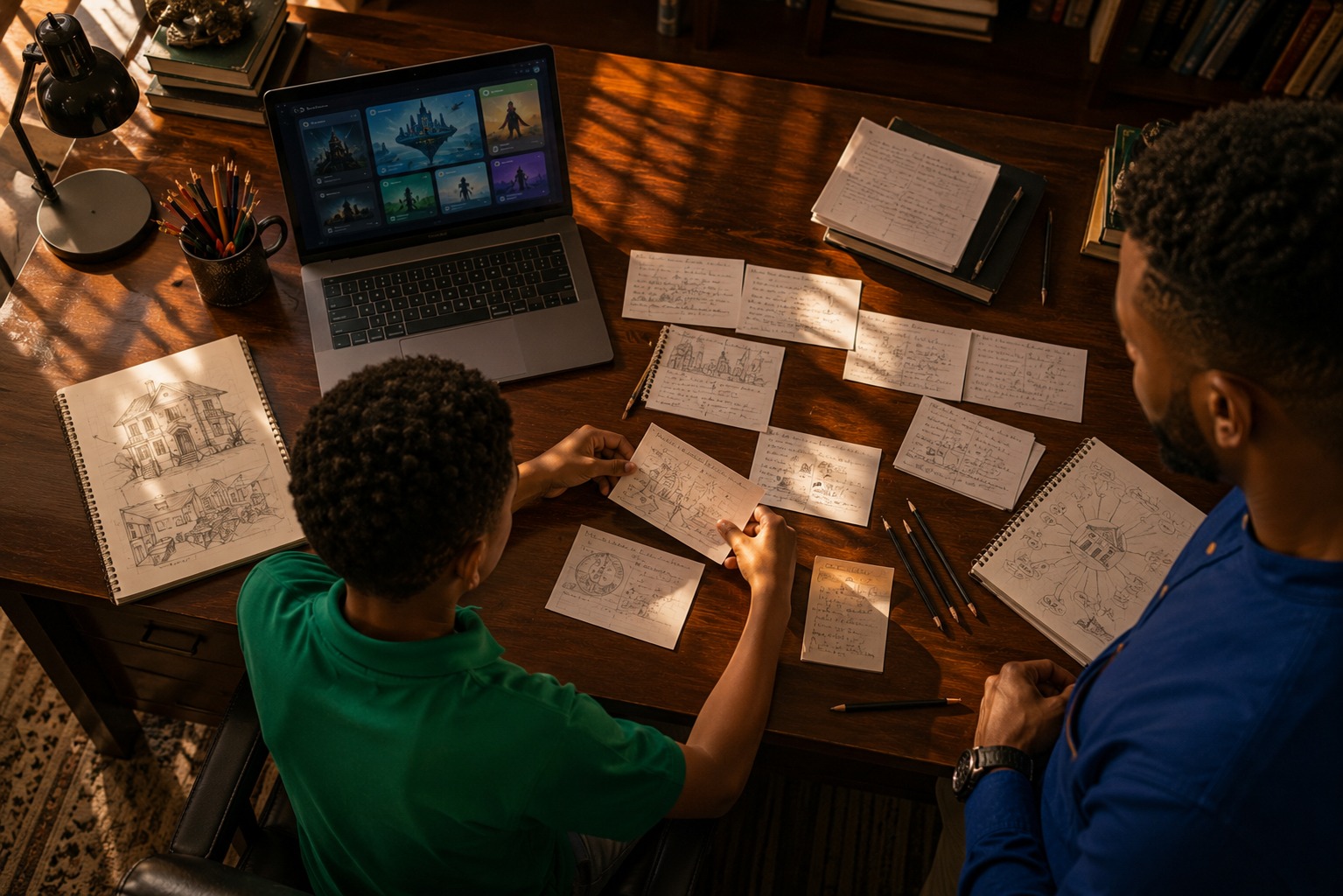
AI Can Help a Child Create
A few days later, Ada found Hector drawing in the school library.
“What are you making?”
“A game.”
“What’s it about?”
“A boy who discovers that his house has a secret room.”
Ada smiled.
“That sounds interesting.”
“I asked AI for ideas.”
“Did you use them?”
“Some.”
“Why not all?”
Hector shrugged.
“Some weren’t good.”
Ada smiled.
“Good.”
“Why?”
“Because you were thinking.”
Hector looked at the drawing.
That distinction is important.
AI can help children brainstorm:
- stories
- characters
- games
- experiments
- illustrations
- questions
- projects
- explanations
- study exercises
But the child should remain an active participant.
When children use artificial intelligence for kids tools creatively, the objective should not be to produce something with the least possible effort.
It should be to expand what the child can imagine and explore.

Children Should Learn to Question AI
The principal’s office had stayed in Hector’s mind.
A week after the incident, he returned to school.
This time, the principal had something different for him.
She placed two printed answers on her desk.
“They are both answers to the same question.”
Hector looked at them.
“They look different.”
“Which one is correct?”
Hector studied them.
“I don’t know.”
The principal smiled.
“Good.”
Hector looked confused.
“Why is that good?”
“Because you didn’t pretend to know.”
She pointed at the papers.
“Your job isn’t to believe whichever answer sounds more impressive.”
She leaned forward.
“Your job is to investigate.”
That is a powerful habit to develop through artificial intelligence for kids education.
Teach children to ask:
Who said this?
What evidence supports it?
Can I verify it?
Could the system be mistaken?
Is there another explanation?
These questions are useful far beyond AI.
They are the foundations of critical thinking.

What About AI and Privacy?
That night, the conversation changed.
Mummy Chrys was sitting at the dining table when Hector showed her an AI application.
“Can I tell it everything about myself?”
Mummy Chrys looked at him.
“Why would you?”
“So it knows me.”
She shook her head.
“That is not necessarily a good thing.”
Chrys joined them.
“Mummy is right.”
Children need to understand that online services can process information according to their design, settings and policies.
Therefore, parents should teach children not to casually enter sensitive personal information into AI systems.
That includes things such as:
- passwords
- financial information
- home addresses
- private family matters
- sensitive photographs
- personal identification information
- another person’s private information
Parents should also check the age requirements and privacy practices of services before allowing children to use them.
This is an essential part of responsible artificial intelligence for kids education.
Children don’t just need to know what AI can do.
They need to know what information they should keep to themselves.
AI Doesn’t Have to Replace Teachers
Hector asked Chrys another question.
“Will AI replace teachers?”
Mummy Chrys answered before Chrys could.
“Can AI punish you when you refuse to do your homework?”
Hector laughed.
“No.”
“Can it know when you are pretending to understand something?”
Hector paused.
“Maybe?”
Mummy Chrys shook her head.
“Your teacher can look at your face.”
Chrys smiled.
This doesn’t mean AI cannot become an important educational tool.
It can explain concepts differently.
Generate practice questions.
Help students explore ideas.
Provide feedback.
Support personalized learning.
But education involves much more than delivering information.
Teachers provide human relationships, context, mentorship, encouragement, discipline and judgment.
That is why the future of artificial intelligence for kids should not necessarily be about replacing the people who teach children.
It can be about giving those people better tools.
The AI Challenge
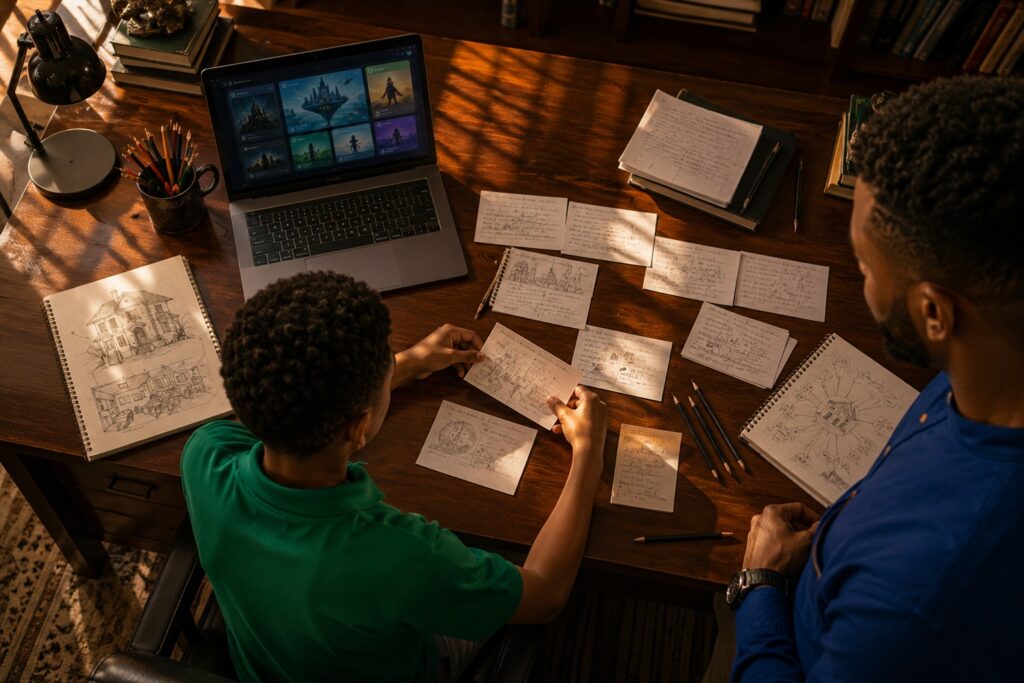
On Saturday, Chrys decided to test everything Hector had learned.
He gave Hector one task:
Use AI to help you create something—but don’t let AI make every decision.
Hector chose to create a simple story.
First, he came up with the character.
Then the setting.
Then the problem.
He asked AI for five possible endings.
He rejected four.
He used the fifth as inspiration.
Then he changed it.
Chrys watched silently.
“Why did you change the ending?”
“Because the AI didn’t understand what I wanted the character to do.”
Chrys smiled.
“And who understood?”
Hector pointed at himself.
“Me.”
Exactly.
That was the point.
Seven Things Parents Can Teach Children About AI
By now, Hector had stopped asking whether AI was “a robot brain.”
He had learned something more useful.
1. AI is technology.
It is built by people and uses computational methods to perform tasks.
2. AI can recognize patterns.
Many AI systems use data and mathematical models to identify patterns and generate outputs.
3. AI can be incredibly useful.
It can help people learn, create, analyze information and solve certain problems.
4. AI can make mistakes.
A confident response is not proof that the response is correct.
5. Better questions produce better interactions.
Children can learn to communicate clearly with AI systems.
6. Privacy matters.
Children should understand what information is appropriate to share online.
7. Human judgment remains essential.
AI can provide information and suggestions, but people remain responsible for deciding what to believe and what to do.
Where Should Parents Begin?
You don’t need to turn your home into a computer laboratory.
You don’t need to teach your child advanced programming.
And you certainly don’t need to know everything about artificial intelligence yourself.
Start with questions.
Ask your child:
“What do you think AI is?”
Then ask:
“Where do you think you’ve encountered it?”
Then:
“What do you think it can do?”
And finally:
“What do you think it cannot do?”
Let the child investigate.
Let them experiment.
Let them discover that some answers are wrong.
Let them create something.
Then ask them to explain what they learned.
That is a far better introduction to artificial intelligence for kids than simply telling them to memorize a definition.
The Conversation Continues
Hector’s school assignment was eventually resubmitted.
This time, he included something different.
At the bottom of the page, he wrote a small note explaining how he had used AI during his research and which information he had independently checked.
The principal read it.
Then she smiled.
“You learned something.”
Hector nodded.
“What?”
“That computers can help me.”
The principal waited.
“And?”
Hector smiled.
“They don’t get to do all my thinking.”
From the doorway, Chrys smiled.
Mummy Chrys folded her arms.
Uncle Emeka, who had somehow come to pick Hector up from school, nodded dramatically.
“Finally.”
Everyone looked at him.
“What?” he said.
“I have always believed this.”
Ada laughed.
“You literally told Hector that AI was smarter than him.”
Uncle Emeka paused.
“That was before my research.”
“What research?”
He pulled out his phone.
“Three TikTok videos.”
Everyone burst out laughing.
Hector shook his head.
Then he looked at Chrys.
“Can we build something now?”
Chrys smiled.
“What do you want to build?”
Hector thought about it.
“I don’t know yet.”
“Good.”
Hector opened his notebook.
“Then let’s find out.”
Artificial Intelligence for Kids Is Really About Preparing Children
The technology will continue to change.
Today’s chatbot will eventually look primitive compared with what comes next.
Today’s image generator will become tomorrow’s ordinary creative tool.
New AI systems will appear in classrooms, workplaces, homes and businesses.
Children growing up now will experience technological changes that are difficult for adults to predict.
That makes artificial intelligence for kids more than a technology lesson.
It is a preparation lesson.
Children need to learn how to use powerful tools without becoming dependent on them.
They need to learn how to question information without becoming cynical.
They need to learn how to experiment without abandoning judgment.
They need to learn how to create with machines while preserving their own imagination.
And they need to understand that being able to ask an AI for an answer is not the same thing as knowing what the answer means.
That may be the most important lesson of all.
Continue Hector’s Story
Hector’s curiosity about technology didn’t end with this lesson.
In fact, it eventually led him into another experiment—one that involved computers, creativity and the question of whether a child could actually build something rather than merely use technology.
That story continues in [Coding for Kids Online].
And if you’re a parent wondering how to introduce AI through practical conversations rather than complicated technical lessons, start with [7 Artificial Intelligence Lessons Every Parent Can Teach Their Child at Home This Weekend].
The House of Chrys is only getting started.
The House of Chrys Takeaway
Artificial intelligence for kids shouldn’t begin with fear.
It should begin with curiosity.
A child should be able to look at an AI system and ask:
How does this work?
Where did this answer come from?
Could it be wrong?
What information should I keep private?
How can I use this to create something?
And perhaps most importantly:
What still requires me to think?
Hector had started with a simple question:
“Is AI smarter than me?”
He eventually discovered that it wasn’t the best question.
The better question was:
“How can I become smarter by learning how to use it?”
That was a question worth taking home.