
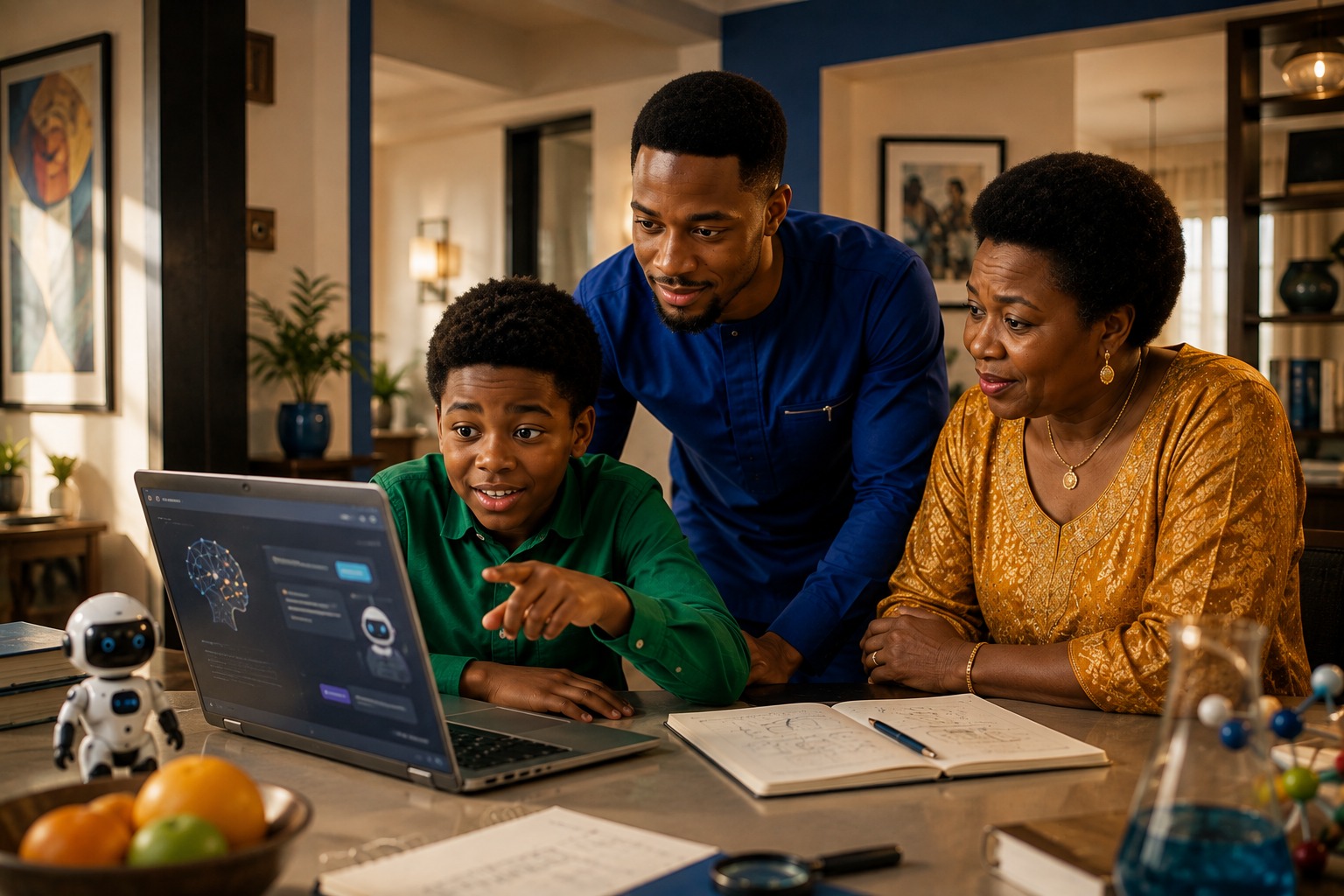
7 Artificial Intelligence Lessons Every Parent Must Teach Their Child at Home Now

At 8:17 on Saturday morning, Hector walked into the kitchen carrying a question instead of his usual breakfast plate.
“Uncle Chrys?”
Chrys looked up.
“Yes?”
“Is AI smarter than me?”
Mummy Chrys stopped stirring her tea.
Uncle Emeka, who had somehow appeared in the kitchen before everyone else, immediately joined the conversation.
“Of course it is.”
Hector frowned.
“How do you know?”
“Because it is artificial intelligence.”
Uncle Emeka said the words as though that settled the matter.
Ada, sitting at the other end of the table, laughed.
“That doesn’t mean anything.”
“It literally has intelligence in its name.”
Chrys smiled.
Hector looked from one adult to another.
“So… is it smarter than me or not?”
Chrys put down his cup.
“That,” he said, “is exactly what we’re going to talk about this weekend.”
And that was how the House of Chrys accidentally created a seven-lesson AI curriculum before breakfast.
Why Parents Should Teach Children About AI at Home
Artificial intelligence is already becoming part of the world children inhabit.
They encounter recommendation systems, voice assistants, search engines, image generators, chatbots, educational software, games and other technologies influenced by AI.
That means children don’t necessarily need to wait until university—or even secondary school—to begin understanding what artificial intelligence is.
But teaching children about AI doesn’t mean sitting them down for a three-hour lecture about machine learning algorithms.
For a child, the first lessons can be much simpler.
They can learn:
- what AI is
- what AI is not
- how machines learn from examples
- why AI sometimes gets things wrong
- how to ask better questions
- why human judgment still matters
- how AI can be used creatively and responsibly
These artificial intelligence lessons for children don’t require a sophisticated laboratory.
They can begin at the dining table.
Lesson 1: AI Is a Tool, Not a Magic Brain
Hector’s first question was still bothering him.
“Is AI smarter than me?”
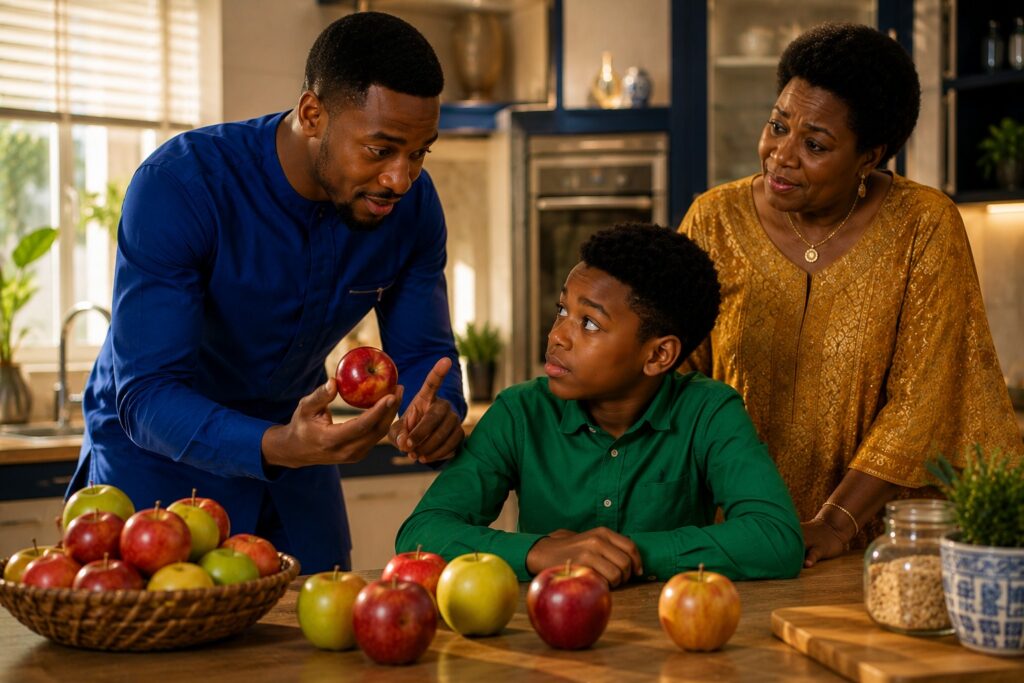
Chrys picked up an apple from the kitchen table.
“Do you know what this is?”
“An apple.”
“How?”
“I’ve seen apples before.”
“Exactly.”
Chrys put the apple down.
“Imagine I show you one hundred different apples.”
Hector nodded.
“Red ones. Green ones. Big ones. Small ones.”
“Okay.”
“After seeing enough examples, you might become very good at recognizing an apple.”
Hector understood.
“So AI learns from examples?”
“That’s one simplified way of thinking about it.”
This is one of the most useful artificial intelligence lessons for children because it begins to remove the mystery surrounding AI.
Children don’t need to understand neural-network architectures immediately.
They can first understand a basic principle:
AI systems can process patterns in information and produce outputs based on what they have been trained or designed to recognize.
This is different from saying that AI possesses a human mind.
And that distinction matters.
A child should understand that an AI system can produce an impressive answer without necessarily understanding the world in the same way a human does.
Lesson 2: Teach Your Child That AI Can Be Wrong
This lesson came immediately after the apple experiment.
Hector was excited.
“So if AI sees enough examples, it knows things?”
“Not exactly,” Chrys said.
“Why?”
“Because AI can make mistakes.”
Hector looked confused.
“But you said it learns.”
“Yes.”
“Then why does it make mistakes?”
Chrys smiled.
“Because learning from information doesn’t guarantee perfect knowledge.”
That afternoon, Chrys gave Hector a challenge.
He asked an AI system a simple question.
Hector read the answer.
Then he looked at Chrys.
“That sounds right.”
“Do you know that it’s right?”
Hector paused.
“No.”
That was the lesson.
One of the most important artificial intelligence lessons for children is that an AI-generated answer should not automatically be treated as truth.
Children should learn to ask:
How do we know this is correct?
That question becomes increasingly valuable as AI systems become more capable.
A child using AI for schoolwork should therefore develop the habit of checking important information against reliable sources, books, teachers or other trusted references.
The goal isn’t to make children afraid of AI.
It’s to prevent blind trust.
Lesson 3: Teach Your Child How to Ask Better Questions
By lunchtime, Hector had discovered something else.
AI could answer questions.
So naturally, he started asking it everything.
“What is the biggest animal?”
“Why is the sky blue?”
“Can ants see humans?”
“Who invented football?”
“What would happen if the Moon disappeared?”
Then Hector typed:
“Tell me everything about dinosaurs.”
The response was enormous.
Hector stared at the screen.
“I’m tired.”
Chrys laughed.
“You asked a terrible question.”
Hector looked offended.
“It was a good question.”
“No. It was a huge question.”
This became the third lesson.
The quality of an AI interaction can depend heavily on the quality of the instructions or questions a person gives the system.
Parents can turn this into a game.
Give the child a simple objective:
“Ask the AI to explain gravity to a ten-year-old.”
Then:
“Now ask it to explain gravity using a football.”
Then:
“Now ask it to create an experiment you can perform at home.”
The child begins discovering that the same technology can produce very different results depending on how the request is framed.
These artificial intelligence lessons for children therefore become lessons in communication as well.
Lesson 4: Show Your Child How AI Can Be Creative
Ada walked into the room while Hector was drawing.
“What are you drawing?”
“A dragon.”
“That’s a strange-looking dragon.”
Hector looked at the drawing.
“It lives in Nigeria.”
Ada smiled.
“What does it eat?”
“Jollof rice.”
Uncle Emeka overheard.
“Finally. An intelligent dragon.”
Hector laughed.
Chrys had another idea.
“Why don’t you ask AI to help you develop the story?”
Hector’s eyes lit up.
The next thirty minutes became chaotic.
Hector invented a dragon.
AI helped him brainstorm names.
Hector rejected three of them.
He invented a village.
He changed the ending.
He asked for ideas.
Then he decided the AI’s ending wasn’t good enough.
“Why didn’t you use the ending it gave you?” Chrys asked.
“Because it’s my story.”
Chrys smiled.
Exactly.
One of the most valuable artificial intelligence lessons for children is learning that AI can be a creative assistant without becoming the creator of everything.
A child can use AI to:
- brainstorm characters
- develop story ideas
- generate questions
- explore concepts
- create variations
- develop games
- organize ideas
- practice writing
But the child should still contribute imagination, judgment and decisions.
The objective isn’t:
“Let AI create everything.”
It’s:
“Use AI to help me create better things.”

Lesson 5: Teach Your Child About AI Bias
This was the lesson that made Mummy Chrys put down her cup.
“Wait,” she said.
“So AI can be wrong.”
“Yes.”
“And AI learns from information.”
“Yes.”
“And information can contain mistakes?”
“Yes.”
She looked at Hector.
“Then the machine can learn some of those mistakes too?”
Chrys nodded.
“Exactly.”
This is where an age-appropriate discussion of AI bias can begin.
Children don’t need an advanced lecture on algorithmic fairness.
They can understand a simple principle:
If the information used to develop a system is incomplete, unbalanced or contains patterns of human bias, the system’s outputs can also reflect problems in that information.
Parents can demonstrate this without making the lesson complicated.
Ask a child:
“If I teach you that every bird is black by showing you only black birds, what happens when you meet a white bird?”
The child will immediately understand.
“You taught me the wrong thing.”
Exactly.
AI systems can face more complicated versions of the same fundamental problem.
This is why children should learn not to assume that a computer’s answer is automatically neutral simply because it came from a computer.
Lesson 6: Teach Your Child What Information Should Stay Private
By evening, Mummy Chrys had a new concern.
“Hector.”
“Yes?”
“What information are you giving these machines?”
Hector stopped.
“Information?”
“Yes.”
He started listing things.
“My name.”
“Anything else?”
“Sometimes my school.”
Mummy Chrys frowned.
This lesson is crucial.
Children should understand that not every piece of personal information belongs in an AI chatbot or online platform.
Parents can teach children to be cautious about sharing information such as:
- passwords
- home addresses
- private family information
- financial information
- private photographs
- sensitive school information
- other people’s personal information
The exact privacy risks depend on the AI service and how it handles data, so parents should also review the privacy settings and policies of services their children use.
The broader principle is simple:
Before putting information into an AI system, stop and think about whether you should be sharing it.
This may be one of the most practically important artificial intelligence lessons for children a parent can teach.

Lesson 7: Teach Your Child That Humans Still Matter
Sunday morning arrived.
Hector had learned six lessons.
He knew that AI could recognize patterns.
He knew that AI could make mistakes.
He knew that better questions could produce better responses.
He knew that AI could help with creativity.
He knew that AI could reflect problems in the information it learned from.
And he knew that he shouldn’t casually hand over private information.
But Chrys had one final lesson.
He placed a blank sheet of paper in front of Hector.
“Draw something.”
“What?”
“Anything.”
Hector drew a house.
“Now ask AI to improve it.”
Hector did.
The AI suggested several possibilities.
Hector looked at them.
“I don’t like these.”
“Why?”
“They don’t look like our house.”
Chrys smiled.
“So what will you do?”
“I’ll change them.”
That was the final lesson.
AI can assist human intelligence. It doesn’t eliminate the need for human judgment.
Children need to develop the ability to:
- question
- compare
- decide
- imagine
- empathize
- reason
- take responsibility
AI can generate possibilities.
Humans still decide what those possibilities mean and what should actually be done.
A Weekend AI Challenge for Parents and Children
By Sunday afternoon, Chrys had an idea.
“Let’s put everything together.”
He gave Hector a challenge:
Build something with AI.
It could be:
- a short story
- a quiz
- a simple game
- a fictional character
- a study guide
- a drawing concept
- a science experiment
- a business idea
But there were rules.
Rule 1: Hector must provide the original idea.
Rule 2: AI can help develop the idea.
Rule 3: Hector must question at least one AI answer.
Rule 4: Hector must verify at least one important fact.
Rule 5: No unnecessary personal information goes into the AI system.
Rule 6: Hector must explain what AI contributed.
Rule 7: Hector makes the final decisions.
Now the lesson wasn’t theoretical anymore.
It was a project.
And that’s where artificial intelligence lessons for children become much more powerful.
Children remember what they do.
Seven Lessons. One Bigger Idea.
That evening, Hector sat quietly in Chrys’s study.
“Uncle Chrys?”
“Yes?”
“I thought AI was a brain.”
Chrys smiled.
“What do you think now?”
Hector considered the question.
“I think it’s a tool.”
“Good.”
“And sometimes it’s useful.”
“Very good.”
“And sometimes it can be wrong.”
“Exactly.”
“And I shouldn’t believe everything it says.”
“Yes.”
“And I can use it to make things.”
Chrys nodded.
Hector looked at his notebook.
“But I still have to think.”
Chrys smiled.
“That is the most important lesson.”
The Seven Artificial Intelligence Lessons
If you only have a weekend, you don’t need to turn your home into an AI academy.
Start with these seven conversations:
| Lesson | What the child should understand |
|---|---|
| 1. What AI is | AI is technology that can process information and produce useful outputs; it isn’t simply a magical human brain. |
| 2. AI can be wrong | An impressive answer isn’t automatically a correct answer. |
| 3. Better questions matter | Clear instructions and questions can improve AI interactions. |
| 4. AI can assist creativity | AI can help brainstorm and create, while the child remains the decision-maker. |
| 5. AI can reflect bias | Systems can produce problematic results when their information or design has limitations and biases. |
| 6. Privacy matters | Children should think carefully before sharing personal or sensitive information. |
| 7. Human judgment matters | AI can assist people, but humans remain responsible for decisions and how technology is used. |
These are not meant to be the final artificial intelligence lessons for children a child ever receives.
They’re the beginning.
Don’t Wait for School to Teach Your Child About AI
Mummy Chrys was washing dishes when Hector walked into the kitchen.
“Mummy?”
“Yes?”
“I think I want to build something.”
She turned around.
“What?”
“I don’t know yet.”
Mummy Chrys smiled.
“Good.”
Hector looked confused.
“Why is that good?”
“Because if you already knew exactly what you wanted to build, you wouldn’t have anything left to discover.”
Hector thought about it.
Then he walked away.
Chrys watched him go.
The boy had started the weekend asking whether artificial intelligence was smarter than him.
He was ending it with a much better question:
“What can I build with it?”
And perhaps that is where parents should begin.
Not by teaching children to fear AI.
Not by teaching them to worship it.
And certainly not by teaching them to depend on it for every answer.
Instead, teach them to understand it, question it, use it and think beyond it.
Because the children growing up with artificial intelligence won’t simply be users of the technology.
Some of them will become its builders.
Some will become the people who decide how it is used.
Some will discover problems that today’s adults haven’t even imagined.
And some, like Hector, will simply sit down one Saturday morning and ask:
“What can I make?”
That is a question worth teaching a child to ask.
The House of Chrys Takeaway
Artificial intelligence lessons for children don’t have to begin with complicated technology.
They can begin with an apple.
A question.
A story.
A mistake.
A drawing.
A conversation about privacy.
Or a simple weekend project.
The objective isn’t to make children experts in AI overnight.
It is to give them something more valuable:
the confidence to understand the technology shaping their world without surrendering their ability to think for themselves.



[…] And if you’re a parent wondering how to introduce AI through practical conversations rather than complicated technical lessons, start with [7 Artificial Intelligence Lessons Every Parent Can Teach Their Child at Home This Weekend]. […]
[…] And if you’re following the family’s earlier attempt to introduce AI through practical activities at home, continue with [7 Artificial Intelligence Lessons Every Parent Can Teach Their Child at Home This Weekend]. […]