

7 Practical Ways to Teach Kids About AI: What Happened When Hector Became the Teacher

Hector was standing in front of the blackboard.
Chrys was sitting at the back of the classroom.
Mummy Chrys had her arms folded.
Ada was trying not to laugh.
Mr. Okoro looked completely confused.
And Uncle Emeka was holding a piece of chalk like he had been appointed professor of artificial intelligence.
Hector cleared his throat.
“Good afternoon, everyone.”
Uncle Emeka raised his hand.
“Yes?”
“Can we leave?”
“No.”
“Why?”
“Because I’m teaching you.”
Uncle Emeka lowered his hand.
“I don’t remember registering for this course.”
Hector smiled.
“You don’t have to.”
“Then why am I here?”
“Because you said yesterday that you understand AI better than everyone in this house.”
The room went silent.
Uncle Emeka looked at Chrys.
Chrys smiled.
Mummy Chrys shook her head.
Ada finally laughed.
“I knew this would happen.”
Uncle Emeka stood up.
“That statement has been taken out of context.”
Hector pointed toward the board.
“Sit down, Uncle Emeka.”
And that was how the House of Chrys discovered that sometimes the best way to learn something is to teach it to somebody else.
1. Start With What Children Already Know
The first mistake adults make when thinking about how to teach kids about AI is assuming that they need to begin with a complicated definition.
Hector’s teacher had done the opposite.
She had started with a question:
“Where do you think you’ve already encountered artificial intelligence?”
The children began guessing.
“Phones.”
“Games.”
“YouTube.”
“Google.”
“Chatbots.”
“Maps.”
“Pictures.”
Exactly.
Children may already be interacting with AI-powered systems without realizing it.
Recommendation systems can determine what content appears next.
Voice technologies can process speech.
Image systems can identify objects.
Generative AI can produce text, images, audio and other forms of content.
So instead of beginning with:
“Artificial intelligence is a branch of computer science…”
Try asking:
“Where have you seen a computer behave in a way that surprised you?”
That gives the child something familiar to investigate.

2. Explain AI Through Everyday Examples
When Hector returned home, Chrys gave him a challenge.
“Explain AI without using the word AI.”
Hector frowned.
“That’s difficult.”
“Exactly.”
He thought.
“Okay.”
He pointed toward Chrys’s phone.
“Sometimes your phone knows what you’re trying to type.”
“Good.”
He pointed at the television.
“Sometimes the television recommends something you might like.”
“Good.”
He pointed at a navigation application.
“Sometimes a map can suggest a route.”
“Good.”
Then he looked at Mummy Chrys.
“And sometimes Grandma knows when I’m lying.”
Mummy Chrys immediately looked at him.
“That’s not artificial intelligence.”
“I’m just saying.”
Everyone laughed.
This is a powerful technique when learning how to teach kids about AI:
Use familiar experiences before technical terminology.
Instead of beginning with machine learning, neural networks and algorithms, begin with:
“Have you ever wondered how your phone does that?”
Then explain the technology behind it.
The child already understands the problem.
Now you’re giving them the explanation.
3. Teach Children That AI Learns From Data
Mummy Chrys had an idea.
She brought a basket of fruit into the living room.
“Come.”
Hector looked suspicious.
“What are you doing?”
“Teaching you.”
She placed apples, oranges and mangoes on the table.
“Separate them.”
Hector did.
“Now explain how you knew.”
“The shapes.”
“The colours.”
“The texture.”
“Good.”
Mummy Chrys pointed at Hector.
“You have seen many fruits before.”
Hector nodded.
“So your brain has experience.”
“Yes.”
“Now imagine a computer system being given enormous amounts of examples and trained using mathematical methods to identify patterns.”
Hector smiled.
“That’s how I should explain machine learning?”
“As a beginning.”
This doesn’t give children the complete technical picture.
It isn’t supposed to.
When thinking about how to teach kids about AI, the objective is to construct understanding progressively.
Start with:
examples
Then:
patterns
Then:
predictions or outputs
Later, children can learn about:
- algorithms
- models
- training
- datasets
- neural networks
- evaluation
- bias
- machine learning
The sophistication can increase as the child becomes ready.

4. Let Children Experiment With AI
After the fruit exercise, Hector wanted to use a real AI system.
Chrys agreed.
But he established one rule.
“Don’t just ask it questions.”
“Why?”
“Experiment.”
Hector opened the laptop.
He asked:
“Explain gravity.”
The AI answered.
Then Hector changed the request:
“Explain gravity to a ten-year-old.”
The answer changed.
Then:
“Explain gravity using football.”
Hector laughed.
Then:
“Explain gravity as a story.”
Now the answer changed again.
Hector stared at the screen.
“So the way I ask changes the answer.”
“Exactly.”
This is one of the most practical approaches to how to teach kids about AI.
Don’t make the child a passive consumer.
Let them experiment.
Give them a question and ask them to change:
- the wording
- the audience
- the context
- the desired format
- the amount of detail
Then compare the results.
Children begin to discover that communicating with AI requires thought.
5. Teach Them That AI Can Be Wrong
This lesson came from Uncle Emeka.
Unfortunately.
Uncle Emeka had discovered an AI chatbot and immediately became convinced that he had become a technology expert.
“I asked it a question yesterday.”
“And?”
“It answered immediately.”
Hector looked at him.
“Was the answer correct?”
Uncle Emeka paused.
“I didn’t check.”
Mummy Chrys sighed.
“Then you learned nothing.”
That afternoon, Hector deliberately gave an AI system a question whose answer could easily be verified.
The system produced a confident response.
Hector checked another source.
It was wrong.
“See?”
Chrys nodded.
“That’s why how to teach kids about AI isn’t simply about teaching children how to obtain answers.”
It is about teaching them how to evaluate answers.
Teach children to ask:
“How do I know this is true?”
“Can I verify it?”
“Where did the information come from?”
“Could the AI have misunderstood the question?”
“Is there another source?”
The ability to question an AI response may become more important than the ability to generate one.

6. Teach Children About Privacy Before They Become Comfortable
Mummy Chrys had been waiting for this lesson.
She sat Hector down.
“Suppose an AI asks you where you live.”
Hector thought.
“Should I tell it?”
“No.”
“Why?”
“Because not everything belongs on the internet.”
Children should understand that AI systems are online technologies and that the information they provide may be processed according to the service’s design, settings and policies.
UNICEF’s guidance specifically identifies children’s data and privacy as a core requirement for child-centred AI.
Parents should teach children to be cautious with:
- passwords
- financial information
- personal identification information
- private family information
- precise location information
- private photographs
- sensitive information about themselves or others
This is an essential part of how to teach kids about AI because technological literacy without privacy literacy is incomplete.
A child should know how to use a powerful tool and where to draw the boundary.
7. Make the Child the Creator
The final lesson changed everything.
Chrys asked Hector:
“If AI disappeared tomorrow, could you still create something?”
Hector thought.
“Yes.”
“Good.”
“Why?”
“Because that’s the point.”
Hector opened his notebook.
He designed a game.
He created the characters.
He invented the problem.
Then he used AI to help brainstorm.
He rejected several suggestions.
He changed others.
He wrote some parts himself.
He tested the ideas.
Then he built a rough prototype.
Ada watched him.
“You’re not letting AI do everything.”
Hector shook his head.
“No.”
“Why?”
Hector smiled.
“Because it’s supposed to help me.”
“Not replace you?”
“Exactly.”
And there it was.
Perhaps the most important principle in how to teach kids about AI:
Teach children to use AI as a tool for creating, not merely as a machine for producing answers.
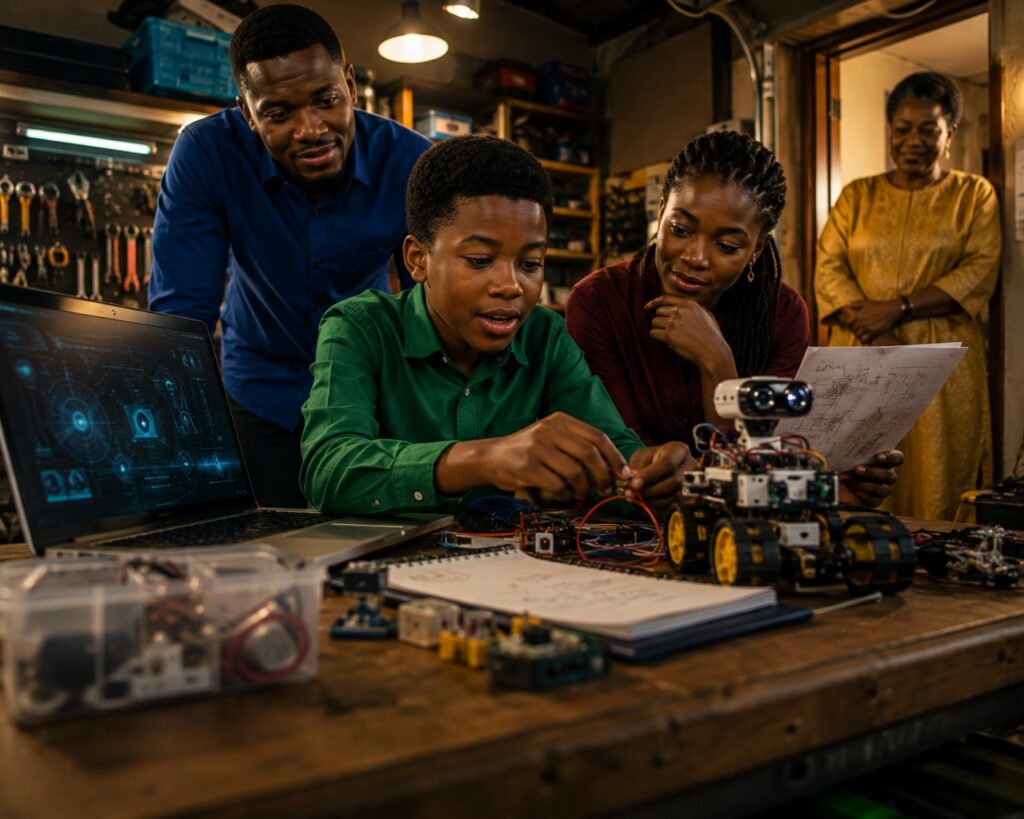
How to Teach Kids About AI Without Turning It Into Another School Subject
Hector eventually realized something.
Learning about AI didn’t have to mean sitting at a desk for three hours.
His family had already taught him through:
- fruit
- school assignments
- conversations
- games
- creative projects
- mistakes
- arguments
- experiments
That’s the secret.
When parents ask how to teach kids about AI, the answer doesn’t have to be:
“Find an AI textbook.”
Start with ordinary life.
Ask questions.
Let children investigate.
Give them problems.
Let them make mistakes.
Then discuss what happened.
A Simple Weekend AI Lesson for Parents
Here’s an experiment any parent can adapt.
Step 1 — Ask the child what AI means.
Don’t correct them immediately.
Listen.
Step 2 — Find three examples of AI around them.
A phone.
A game.
A recommendation system.
A chatbot.
Anything relevant.
Step 3 — Choose one example.
Ask:
“How do you think this works?”
Step 4 — Experiment.
Use an AI system together.
Change the question several times.
Compare the results.
Step 5 — Verify something.
Find an answer that can be checked independently.
Step 6 — Discuss privacy.
Ask:
“What information should we never casually share?”
Step 7 — Create something.
Make a story.
A game.
A drawing.
A quiz.
A presentation.
A simple program.
The child should finish the exercise having made something, not merely consumed information.
The Moment Hector Turned the Lesson Around
The following Monday, Hector returned to school.
His teacher asked him:
“So, Hector. What did you learn about AI?”
Hector smiled.
“I learned that AI can help me.”
“Anything else?”
“It can make mistakes.”
“Good.”
“People need to check its answers.”
“Good.”
“People shouldn’t give it private information.”
“Very good.”
His teacher smiled.
“And what is the most important thing?”
Hector thought.
Then he answered:
“AI should make me more capable, not more dependent.”
The teacher stared at him for a moment.
“Who taught you that?”
Hector smiled.
“Everybody.”
The House of Chrys Takeaway
Teaching children about AI doesn’t require parents to become computer scientists.
It requires them to become good guides.
The best lessons can begin with very simple questions:
What do you think AI is?
Where have you encountered it?
How do you think it works?
Could it be wrong?
How can we check?
What shouldn’t we share?
What can we create with it?
And finally:
“What can you do that AI cannot decide for you?”
That last question may be the most important one.
Because the goal of teaching children about artificial intelligence isn’t to raise a generation that knows how to ask machines for everything.
It is to raise a generation that can think, create, question and decide while powerful machines are around them.
Continue the House of Chrys Story
Hector’s experiment with AI soon leads him to another question: if AI can help him create, can he learn to build technology himself?
See Hector’s coding journey here [Coding for Kids Online].
And if you’re following the family’s earlier attempt to introduce AI through practical activities at home, continue with [7 Artificial Intelligence Lessons Every Parent Can Teach Their Child at Home This Weekend].
The House of Chrys is becoming a place where technology isn’t simply consumed.
It is questioned.
Experimented with.
Argued about.
And eventually—
created.