

7 AI for Children Lessons Hector Learned When His Teacher Asked Him to Stop Using AI

The problem wasn’t that Hector was using artificial intelligence.
The problem was that he had become very good at it.
And his teacher was beginning to worry.
It started with a science assignment.
By lunchtime, Hector had finished it.
By the end of the school day, his teacher had read it three times.
Then she called him to the front of the classroom.
“Hector.”
“Yes, ma’am?”
“Did you write this?”
Hector hesitated.
“Yes.”
The teacher looked at him.
“Entirely?”
Hector looked at the floor.
“No.”
There was silence.
The teacher put the paper down.
“What did you use?”
Hector whispered:
“AI.”
A few students laughed.
His teacher didn’t.
Instead, she asked the question that Hector wasn’t expecting.
“Then tell me something.”
She held up his assignment.
“What did you learn?”
Hector opened his mouth.
And realized he didn’t know.
The Machine Had Done Everything
That afternoon, Hector arrived at the House of Chrys unusually quiet.
Chrys noticed immediately.
“You look like someone who has lost money.”
“I didn’t lose money.”
“Then someone has embarrassed you.”
Hector dropped his schoolbag.
“My teacher said I shouldn’t use AI.”
Mummy Chrys, who was arranging groceries in the kitchen, immediately turned around.
“She said what?”
“She said I shouldn’t use it for my assignment.”
Uncle Emeka appeared from nowhere.
“I agree with the teacher.”
Everyone looked at him.
“You?”
“Yes.”
“Why?”
Uncle Emeka folded his arms.
“Because if machines start doing children’s homework, what will children do?”
Ada answered from the sofa.
“Learn?”
Uncle Emeka frowned.
“That is exactly what I was going to say.”
Hector sighed.
“I thought AI was supposed to help children.”
Chrys pulled out a chair.
“It can.”
“Then why am I in trouble?”
“Because there’s a difference between using AI to learn and using AI instead of learning.”
Hector sat down.
“What difference?”
Chrys smiled.
“That is what we’re going to find out.”
1. AI Should Make Children More Curious, Not Less
Chrys took Hector outside.
They walked down the street toward a small roadside fruit stand.
Hector was confused.
“Why are we here?”
“Look at that.”
A trader was sorting oranges.
Some were large.
Some were small.
Some were ripe.
Others weren’t.
“What do you notice?”
Hector shrugged.
“She knows which ones are good.”
“How?”
“She has experience.”
“Exactly.”
Chrys picked up an orange.
“Now imagine you wanted a computer to perform a similar task.”
Hector thought.
“You’d give it examples.”
“Right.”
This is one of the simplest ways to introduce AI for children.
Children can begin by understanding that many AI systems use data and computational methods to recognize patterns and generate outputs.
They don’t need to start with equations.
They can start with curiosity.
Why does the system make this prediction?
What information did it use?
What could make its answer wrong?
What happens if we change the information?
Those questions are more valuable than simply memorizing the definition of artificial intelligence.
UNICEF’s current guidance on AI and children emphasizes the importance of preparing and skilling children for present and future developments in AI, while also protecting their safety, privacy, rights and well-being. (UNICEF)

2. AI Can Answer You Without Understanding You
Back at home, Hector opened his laptop.
“Let me show you something.”
He typed a question.
The AI answered immediately.
Hector smiled.
“See?”
Chrys looked at the screen.
“It answered.”
“Yes.”
“Did it understand?”
Hector paused.
“What do you mean?”
“There’s a difference between producing an answer and having human understanding.”
Hector stared at the screen.
The distinction matters.
Generative AI can produce fluent language, images, code and other outputs. That fluency can make a system appear more human than it actually is.
Children should therefore learn not to automatically interpret conversational AI as a person.
The system may be useful.
It may be sophisticated.
It may even surprise them.
But children should still understand that AI is a technology, not a replacement for human relationships or human judgment.
That becomes particularly important as children encounter increasingly conversational AI systems.
3. The First Answer Is Not Always the Best Answer
The next day at school, Hector’s teacher gave the class a challenge.
“Ask an AI system a question.”
Everyone became excited.
“Then,” she continued, “find out whether its answer is correct.”
The room became quieter.
Hector smiled.
He knew exactly what she was doing.
He asked a question.
The AI gave him an answer.
Hector checked it against another source.
It was wrong.
Not completely wrong.
Just wrong enough.
His teacher walked over.
“What did you discover?”
Hector smiled.
“AI can be confidently wrong.”
The teacher nodded.
“That is one of the most important things you can learn.”
Children using AI for children tools should develop a verification habit.
When information matters:
- Check another source.
- Look for evidence.
- Ask where the information came from.
- Compare conflicting answers.
- Ask a knowledgeable adult when necessary.
UNESCO’s guidance on generative AI in education stresses a human-centred approach and highlights issues including privacy, ethical use and the need for appropriate educational validation. (UNESCO)
For parents and educators who want a deeper framework, UNESCO’s AI Competency Framework for Students is particularly relevant because it is designed around helping students become responsible and creative users and co-creators of AI. (UNESCO)

4. AI Should Help Children Create, Not Erase Their Creativity
Hector had another problem.
He wanted to make a comic book.
So he asked AI to create everything.
The characters.
The plot.
The dialogue.
The ending.
The illustrations.
When he finished, he looked at it.
“It looks good.”
Ada looked at it.
“Do you like it?”
“Yes.”
“Do you love it?”
Hector hesitated.
“No.”
“Why?”
“I didn’t really make it.”
That sentence stayed with him.
So he started again.
This time Hector designed the main character himself.
He decided where the story would happen.
He created the problem.
He rejected AI suggestions that didn’t fit his idea.
He used AI to brainstorm possibilities.
But Hector remained the author.
That’s a much healthier model for AI for children.
AI can help children:
- brainstorm stories
- generate questions
- explore ideas
- develop characters
- practise difficult concepts
- experiment with coding
- organize projects
- explore different perspectives
But the child’s creative agency should remain intact.
UNICEF’s recent work on AI literacy describes an important transition: children should move from merely using AI toward building, testing and creating with technology. (UNICEF)

5. Children Need to Know What Not to Tell AI
The most serious conversation happened at dinner.
Hector had been experimenting with an AI assistant.
He had told it his name.
Then his school.
Then where he lived.
Then he began typing something else.
Mummy Chrys reached across the table.
“Stop.”
Hector looked up.
“Why?”
“Because you don’t need to tell a machine everything about yourself.”
Chrys nodded.
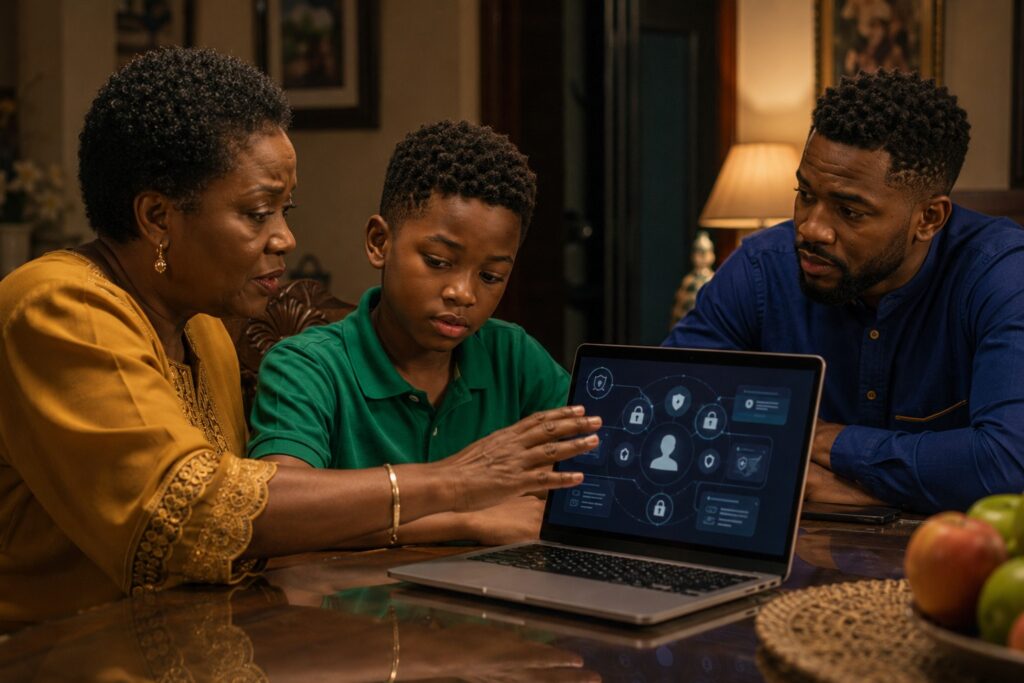
AI literacy isn’t only about prompts and productivity.
It’s also about privacy.
Children should learn to be cautious about sharing:
- passwords
- financial information
- private family information
- precise personal details
- private photographs
- personal identification information
- other people’s private information
UNICEF’s guidance specifically identifies children’s data and privacy as a core requirement for child-centred AI. (UNICEF)
This is one reason parents shouldn’t simply hand children an AI application and say:
“Go ahead.”
The child needs an accompanying framework.
6. AI Should Not Make Children Afraid of Their Future
One Friday afternoon, Hector asked Chrys a question.
“Will AI take my job?”
Chrys didn’t laugh.
“That depends on the job.”
“So should I be scared?”
“No.”
“Why not?”
“Because you’re ten.”
Hector frowned.
“What does that have to do with it?”
“You don’t need to predict your entire career today.”
Chrys sat beside him.
“You need to become the kind of person who can learn.”
That was a different answer.
The future will undoubtedly contain jobs and industries that don’t exist today.
Some tasks will become automated.
Other tasks will change.
New opportunities will emerge.
The most useful response for a child isn’t panic.
It is preparation.
Children should develop skills that remain valuable when technology changes:
- reasoning
- communication
- creativity
- collaboration
- curiosity
- problem-solving
- adaptability
- ethical judgment
UNICEF’s 2026 research on children’s views of an AI-shaped future found a mixture of optimism and concern, including children’s desire to avoid over-reliance on AI and develop transferable skills for an uncertain future. (UNICEF)
7. The Best AI Skill Might Be Knowing When Not to Use AI
This was Hector’s final lesson.
His teacher gave the class one last assignment.
“Write one paragraph about something you learned this week.”
Hector opened his laptop.
Then stopped.
He closed it.
His friend looked at him.
“Why aren’t you using AI?”
Hector smiled.
“Because I don’t need it.”
He picked up his pen.
And began writing.
That was the moment Chrys understood what the entire experiment had been about.
AI literacy isn’t about making children use AI for everything.
It is about making children capable of deciding when AI is useful—and when it isn’t.
Sometimes AI is the right tool.
Sometimes a book is better.
Sometimes a teacher is better.
Sometimes a conversation with your parents is better.
Sometimes the best tool is simply your own brain.
A Simple AI Exercise Parents Can Try This Weekend
You don’t need expensive equipment.
Sit with your child and choose one question.
For example:
Why do some animals sleep during the day?
Ask the child to predict the answer first.
Then ask an AI system.
Then compare the response with a trusted source.
Ask the child:
What did the AI get right?
What did it miss?
What surprised you?
What would you ask next?
Then create something from the lesson.
A drawing.
A story.
A quiz.
A presentation.
A simple experiment.
The goal isn’t to produce an impressive AI output.
The goal is to produce a more capable child.
From AI User to AI Creator
Hector’s teacher eventually returned his original assignment.
She had written one sentence across the top.
“This time, show me what YOU think.”
Hector smiled.
He opened his notebook.
He didn’t ask AI to write the answer.
Instead, he wrote his own answer first.
Then he used AI to challenge it.
“Find the weakest part of my argument.”
The AI responded.
Hector disagreed with one of its criticisms.
He checked another source.
Then he changed his paragraph.
When he handed it back to his teacher, she read it carefully.
“Much better.”
Hector smiled.
“Because I used AI?”
She shook her head.
“No.”
She handed him the paper.
“Because you were thinking while you used it.”
That distinction may become one of the defining lessons of childhood in the AI era.
What Parents Should Really Teach About AI for Children
Children don’t need to become AI engineers at age ten.
They need something more fundamental.
They need AI literacy.
That means being able to:
- understand what AI is at a basic level
- recognize where AI appears in everyday life
- use AI creatively and responsibly
- question AI-generated information
- verify important claims
- protect personal information
- understand that AI has limitations
- maintain their own creative agency
- know when human help is more appropriate
- understand that they remain responsible for their decisions
UNESCO’s student AI competency framework similarly frames AI education around preparing students to become responsible and creative users and co-creators of AI. (UNESCO)
And UNICEF’s current guidance makes an equally important point: children should not simply be protected from AI; they should also be prepared for a world in which AI is increasingly present. (UNICEF)
The House of Chrys Takeaway
That evening, Hector sat outside the House with his notebook.
Chrys joined him.
“So,” Chrys asked, “what did you learn?”
Hector thought.
“That AI is powerful.”
“Good.”
“That it can help me.”
“Good.”
“That it can make mistakes.”
“Very good.”
“That I shouldn’t give it private information.”
“Excellent.”
Hector closed his notebook.
“And I learned something else.”
“What?”
Hector smiled.
“Sometimes I shouldn’t use AI.”
Chrys laughed.
“Now you’re getting it.”
Hector looked toward the road.
“Uncle Emeka still uses it to write his WhatsApp messages.”
From inside the house came a loud voice.
“I HEARD THAT!”
Hector and Chrys burst out laughing.
The House of Chrys went quiet again.
For approximately eleven seconds.
Then Uncle Emeka shouted:
“AND MY MESSAGE WAS EXCELLENT!”
Hector shook his head.
Perhaps there was still some AI education left to do.
Continue the House of Chrys Story
Hector’s fascination with artificial intelligence didn’t end here.
His next question was more dangerous:
“If AI can help me create things, can I actually build something myself?”
That question leads directly into [Coding for Kids Online]—where Hector begins moving from simply using technology toward understanding how things are actually built.
And if you’re following the family’s broader conversation about introducing AI at home, continue with [7 Artificial Intelligence Lessons Every Parent Can Teach Their Child at Home This Weekend].
The House of Chrys is slowly discovering that the biggest question about AI isn’t what machines will become.
It’s what children will become while growing up alongside them.