

This boy called Hector thought he knew what artificial intelligence was.
Then the toaster disagreed.
Well, technically, the toaster didn’t disagree.
But Hector was convinced it was becoming intelligent.
He had been standing in the kitchen staring at the machine when Chrys walked in.
“What are you doing?”
“Watching.”
“Watching what?”
“The toaster.”
Chrys looked at the toaster.
Then at Hector.
“Why?”
“It stopped heating.”
“That’s not intelligence.”
“I didn’t say it was intelligent.”
“You just said you were watching it.”
“Exactly. I’m investigating.”
Mummy Chrys walked into the kitchen carrying a cup of tea.
“What is this investigation about?”
Hector pointed at the toaster.
“Artificial intelligence.”
Mummy Chrys looked at the toaster.
Then she looked at Hector.
“Does that thing have artificial intelligence?”
“I don’t know.”
“Then why are you standing there?”
“Because I want to know what else machines can do.”
Chrys smiled.
“Now that’s a good question.”
So he made Hector a deal.
“Let’s find out.”
And that morning, Hector discovered 10 Artificial Intelligence Facts for Kids that were considerably stranger than anything he had expected.
1. AI Doesn’t Think Exactly Like a Human
Hector’s first question was simple.
“Does AI think?”
Chrys didn’t answer immediately.
Instead, he picked up a chessboard.
“Can you play chess?”
“Yes.”
“Can you explain every thought that happens in your head while you’re deciding your next move?”
“No.”
“Interesting.”
Chrys explained that artificial intelligence systems can process information and produce outputs in sophisticated ways, but that doesn’t mean they have a human mind hiding inside the computer.
An AI system can recognize patterns, generate language, make predictions or perform tasks without possessing human consciousness in the way people do.
That’s one of the most important Artificial Intelligence Facts for Kids:
A machine producing an intelligent-looking answer doesn’t automatically mean the machine thinks like a human being.
AI can be incredibly powerful without being a little person trapped inside a computer.
Hector looked at the laptop.
“So there’s nobody inside?”
“No.”
“Not even a very small person?”
“No, Hector.”
“Okay.”
He looked disappointed.
2. AI Can Learn From Examples
Mummy Chrys had the best demonstration.
She placed three bowls on the table.
One contained apples.
Another contained oranges.
The third contained bananas.
“Sort them,” she told Hector.
“That is easy.”
“Why?”
“Because I know what they look like.”
“Exactly.”
Hector had learned from experience.
Chrys explained that many AI systems are also trained using large amounts of data so they can identify patterns and make predictions.
Give a system many examples of something, and it can learn statistical patterns associated with those examples.
This doesn’t mean it learns exactly like a child does.
But the basic idea is fascinating:
examples can help an AI system recognize patterns.
That is one of the most useful Artificial Intelligence Facts for Kids because children can understand it through things they already know.

3. AI Can Recognize Things in Pictures
Later that afternoon, Hector took a photograph of a football.
He showed it to an AI system.
The system identified it as a football.
Hector became excited.
“It’s seeing!”
Chrys shook his head.
“Not necessarily.”
“What do you mean?”
“An AI system can analyze visual information and identify patterns associated with objects. That’s different from having human eyesight and experiencing the world the way you do.”
That distinction fascinated Hector.
AI-powered computer vision systems can be used to analyze images and video.
They can help identify objects, detect patterns and perform other visual tasks.
This is one reason Artificial Intelligence Facts for Kids can be so fascinating.
AI isn’t only about chatbots.
It can work with:
words.
pictures.
sound.
video.
numbers.
And other forms of data.
4. AI Can Recognize Human Speech
Hector tested this one immediately.
He picked up Chrys’s phone.
“Hello, computer.”
The phone responded.
Hector jumped.
Mummy Chrys laughed.
“You were expecting it not to answer?”
“I wanted to surprise it.”
Voice assistants and speech-recognition systems can process spoken language and convert speech into information that a computer can work with.
But Hector discovered something important.
He deliberately spoke with a strange accent.
The system misunderstood him.
Then he spoke very quietly.
It misunderstood him again.
“See!” Hector shouted.
“It doesn’t understand everything.”
“Correct,” said Chrys.
AI systems can perform remarkable tasks, but they have limitations.
Different accents, languages, background noise, unusual phrasing and other factors can affect how speech systems perform.
One of the most important Artificial Intelligence Facts for Kids is therefore this:
AI can be extremely good at something without being perfect at it.
5. AI Can Create Pictures, Stories and Music
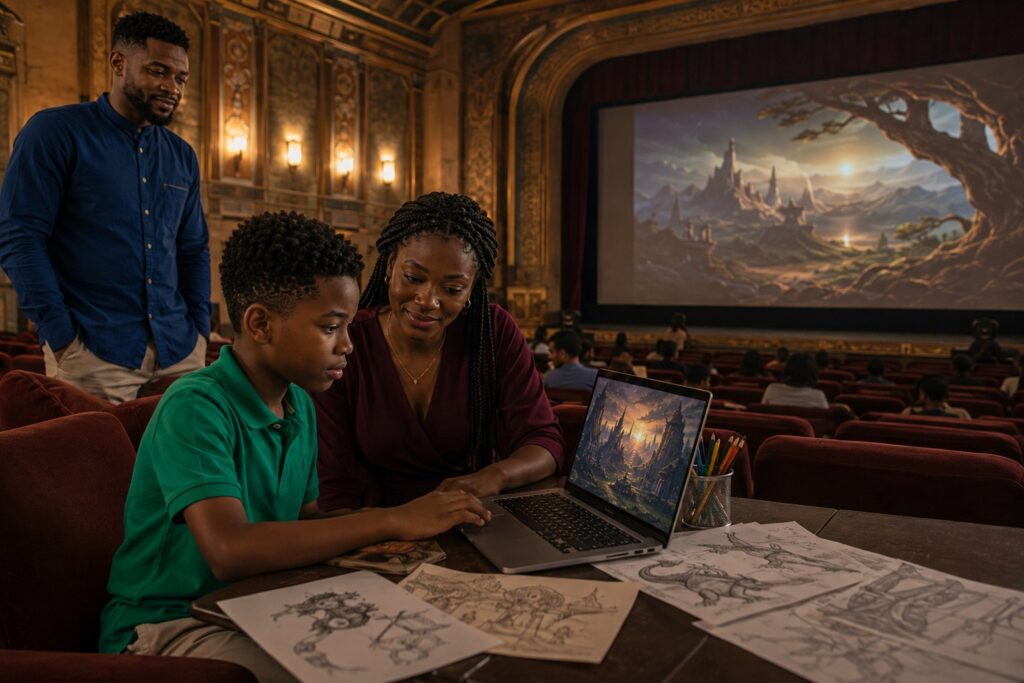
Ada arrived just as Hector was experimenting with generative AI.
“What are you doing?”
“Making a dragon.”
“Where did you get the idea?”
“Me.”
Ada looked at the screen.
“And the picture?”
“AI helped me.”
Hector had discovered generative AI.
Unlike systems designed only to classify or predict things, generative AI can produce new content such as text, images, audio, video or code based on patterns learned during training.
But Ada asked him something important.
“If the machine creates it, is it your idea?”
Hector thought carefully.
“Not necessarily.”
“Good.”
He changed the prompt.
Then changed the character.
Then changed the setting.
Then rejected the result completely.
“I’m still directing it,” he said.
Ada smiled.
“Now you’re thinking.”
This is another important lesson hidden among these Artificial Intelligence Facts for Kids:
AI can be a creative tool, but using a creative tool doesn’t mean giving up your own imagination.
6. AI Can Be Used in Cars
The next fact almost made Hector fall off his chair.
“Cars can use AI?”
“Some vehicles use AI-related technologies,” Chrys explained.
AI and machine-learning technologies can contribute to systems used in advanced driver assistance and autonomous-driving research.
These systems can process information from cameras, radar, lidar and other sensors to help a vehicle understand aspects of its environment.
Hector stared at Chrys.
“So the car can see?”
“Systems in the car can analyze information about its surroundings.”
“And decide?”
“Some systems can make automated decisions within the tasks they are designed to perform.”
Hector looked outside.
“So cars are learning the road?”
“Careful.”
Chrys laughed.
“Don’t start telling your mother that cars have brains.”
Too late.
Mummy Chrys had already heard him.
7. AI Can Help Doctors and Scientists
This one changed Hector’s expression.
“AI can help doctors?”
“Yes.”
AI and machine-learning systems are being researched and used in healthcare for tasks such as analyzing medical images, supporting research, identifying patterns in data and assisting certain clinical workflows.
But Chrys immediately added:
“Does that mean AI should replace doctors?”
“No.”
“Exactly.”
Technology can assist professionals without replacing the human responsibility surrounding important decisions.
This is an especially valuable lesson when teaching children about AI.
The machine may process enormous amounts of information.
The human professional still needs judgment, context, ethics and responsibility.
8. AI Can Make Mistakes Even When It Sounds Confident
Uncle Emeka provided the demonstration.
He walked into the living room holding his phone.
“I have discovered something extraordinary.”
“What?”
“I asked AI who the most intelligent man in this family is.”
Everyone looked at him.
“And?”
“It said me.”
Silence.
Mummy Chrys slowly put down her cup.
Hector burst out laughing.
Uncle Emeka looked offended.
“Why are you laughing?”
“Because that’s obviously wrong.”
Uncle Emeka pointed at the phone.
“The machine said it.”
“So?”
“So it must be true.”
Chrys shook his head.
“No.”
That became one of the funniest Artificial Intelligence Facts for Kids Hector had learned:
AI can give an answer confidently and still be wrong.
AI-generated information should therefore be checked, especially when the information is important.
Children should learn to ask:
How do we know?
Can we verify it?
What is the evidence?
Could the system have made a mistake?

9. AI Doesn’t Always Know Who You Are
Hector tried another experiment.
He asked an AI:
“Who is Hector?”
The answer was wrong.
Hector looked offended.
“It doesn’t know me!”
Chrys laughed.
“Why would it?”
“But it talks to me.”
“That doesn’t mean it knows you like your family does.”
That distinction matters.
A conversational AI can generate responses based on the information and context available to it.
That is different from having a human relationship with someone.
Mummy Chrys pointed at Hector.
“I know when you are hungry.”
Hector smiled.
“And I know when you’re pretending not to be hungry.”
“I am hungry.”
“You ate thirty minutes ago.”
Hector became quiet.
Apparently, some intelligence still couldn’t compete with Mummy Chrys.
This is one of the more important Artificial Intelligence Facts for Kids:
A machine can know information about you without knowing you in the human sense.
10. The Most Powerful Part of AI Might Be What Children Build With It
The final fact was Hector’s favorite.
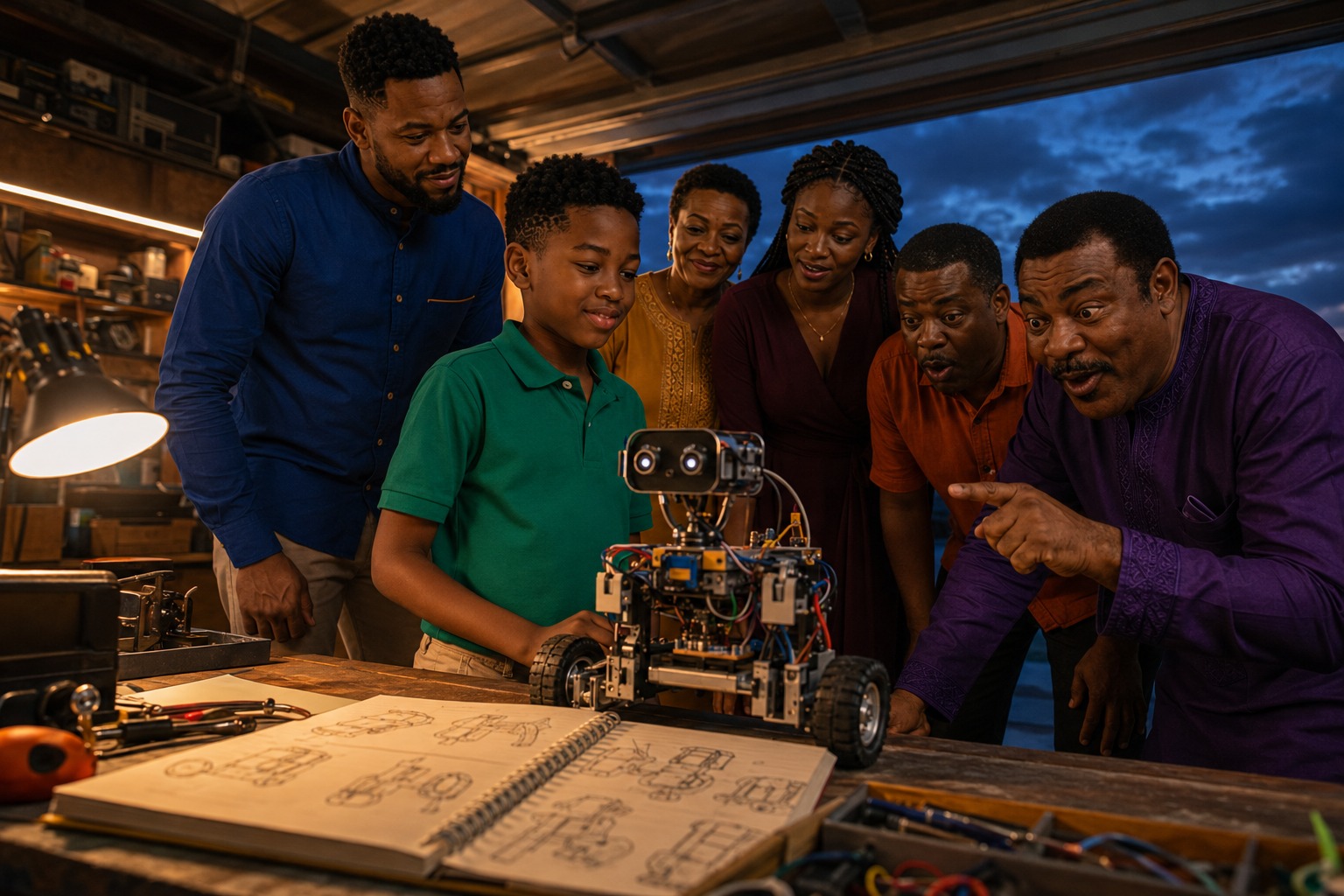
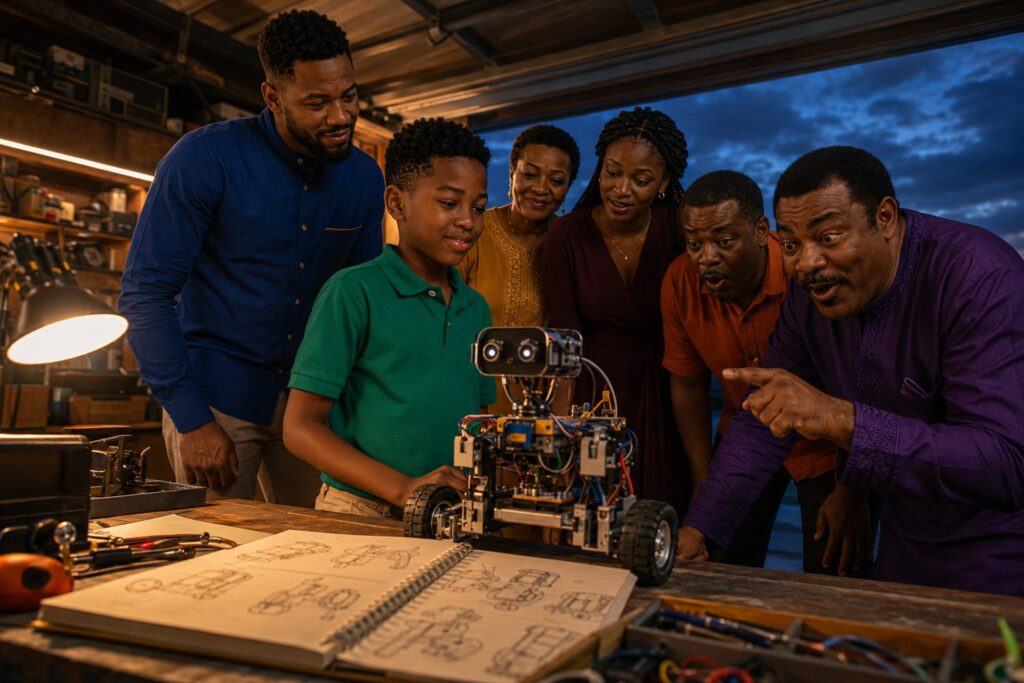
Chrys took him into the garage-workshop.
On the table was a small robot.
Hector’s eyes widened.
“Did you build this?”
“No.”
“Then who did?”
“You.”
Hector stared at him.
“Me?”
“With some help.”
Hector opened his notebook.
He had drawn the robot weeks earlier.
He had designed its shape.
He had imagined what it could do.
Now he had started learning how to turn the idea into something real.
AI could help him understand difficult concepts.
It could help him brainstorm.
It could help him debug code.
It could explain unfamiliar ideas.
But it couldn’t decide what kind of person Hector wanted to become.
That part remained his.
And suddenly the whole list of Artificial Intelligence Facts for Kids made sense.
AI wasn’t simply about machines becoming powerful.
It was also about what people could do with powerful machines.
So, What Exactly Should Kids Know About AI?
By bedtime, Hector had filled almost an entire notebook.
He wrote:
AI can recognize patterns.
AI can process images.
AI can process speech.
AI can generate content.
AI can assist with complicated tasks.
AI can be used in transportation.
AI can assist scientists and healthcare professionals.
AI can make mistakes.
AI doesn’t have human relationships simply because it can talk.
AI can become a powerful tool for human creativity.
Then Hector added one final sentence.
“The machine is powerful. The person using it still matters.”
Chrys read it.
“That’s probably the best thing you’ve written today.”
Mummy Chrys nodded.
“Good.”
Uncle Emeka looked over her shoulder.
“I think I should add something.”
Hector moved the notebook away.
“No.”
“Why?”
“Because you will write that you invented AI.”
Uncle Emeka looked offended.
“I was going to write something philosophical.”
Ada laughed.
“You don’t even know what philosophical means.”
“I know exactly what it means.”
“What does it mean?”
Uncle Emeka paused.
“It means… something intelligent.”
Everyone laughed.
10 Artificial Intelligence Facts for Kids Worth Remembering
If your child remembers nothing else from this article, let them remember these ten ideas:
- AI can produce intelligent-looking results without thinking exactly like a human.
- Many AI systems learn patterns from examples and data.
- AI can analyze images and recognize patterns in visual information.
- AI can process human speech.
- Generative AI can create text, images, audio, video and code.
- AI-related technology is being used in advanced transportation systems.
- AI can assist researchers and healthcare professionals.
- AI can make mistakes—even when it sounds confident.
- An AI system can process information about you without knowing you like a human does.
- AI can become a powerful tool for children who learn to create, question and experiment with it responsibly.
These are more than random Artificial Intelligence Facts for Kids.
They are the beginning of AI literacy.
A Challenge for Parents and Children
Tonight, don’t simply ask your child:
“What did you learn about AI?”
Ask something harder:
“What would you build if you could use AI to help you?”
Give them a notebook.
Let them draw it.
Let them explain it.
Let them ask questions.
Then see where the conversation goes.
Because the most exciting part of artificial intelligence isn’t necessarily what machines can do today.
It is what a curious child might build tomorrow.
Continue the House of Chrys Story
Hector’s fascination with AI didn’t end with ten surprising facts.
He soon discovered that knowing what AI is wasn’t enough.
He wanted to know how to teach other children about it.
That takes us into How to Teach Kids About AI, where Hector unexpectedly ends up teaching the adults in the House of Chrys.
And his earlier experiments had already introduced him to 7 Artificial Intelligence Lessons Every Parent Can Teach Their Child at Home This Weekend, where the family began discovering that AI education was much bigger than simply learning how to use a chatbot.
The House of Chrys was changing.
The family wasn’t merely asking what artificial intelligence could do.
They were beginning to ask the more important question:
What could they do with it?