
AI Workshop for Kids: 7 Lessons Hector Learned When the Machine Got Something Completely Wrong

“Whatever you do,” Hector said, “don’t let the computer answer that question.”
Everyone in the room turned toward him.
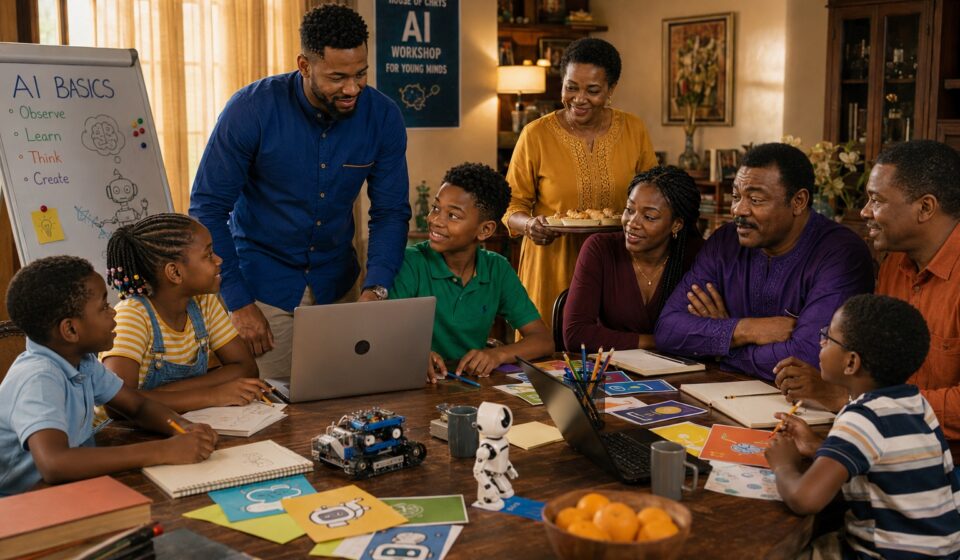
It was Saturday morning at the House of Chrys, and the dining table had disappeared beneath laptops, notebooks, coloured cards, toy robots, pencils and a bowl of oranges that nobody had been invited to eat yet.
On the wall, Chrys had taped a handwritten sign:
TODAY: AI WORKSHOP FOR KIDS
Underneath it, in smaller handwriting, someone had added:
NO BORING LECTURES.
Uncle Emeka had written that part.
He was sitting at the end of the table in his deep-purple traditional outfit, arms folded.
“I still don’t understand why children need a workshop to talk to machines,” he announced.
Mr. Okoro, dressed in his usual burnt-orange shirt, looked up from his phone.
“Because machines are becoming business,” he said. “If the children understand them early, perhaps one of them will become rich and remember me.”
Ada laughed.
Mummy Chrys walked into the room carrying a tray.
“Before anybody becomes rich,” she said, “eat something.”
Hector grinned.
He had been waiting for this day all week.
But Chrys had made one rule.
The workshop would not begin with the question:
“What is artificial intelligence?”
Instead, he placed a laptop in the middle of the table.
“We’re going to let the machine teach us something,” he said.
Hector immediately leaned forward.
“What?”
Chrys smiled.
“That is the first thing we’re going to find out.”
1. An AI Workshop for Kids Should Begin With Curiosity, Not Definitions
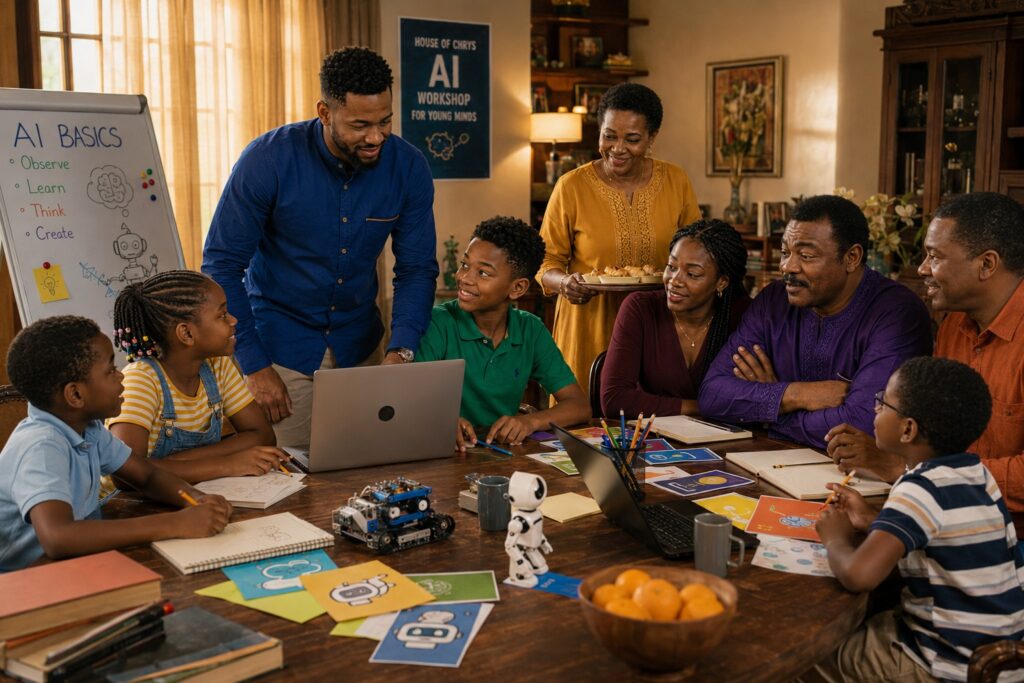
Chrys opened an AI tool on the laptop.
“Imagine you have never heard the words artificial intelligence before,” he told the children. “What would you want to know?”
Hands went up.
Hector was first.
“How does it know things?”
Ada raised an eyebrow.
“Can it think?”
A younger child asked, “Can it become my friend?”
Uncle Emeka raised his hand dramatically.
“Can it wash my car?”
Nobody answered.
“That’s a serious question,” he protested.
Chrys laughed.
“These are better questions than memorising a definition.”
He explained that artificial intelligence refers broadly to computer systems designed to perform tasks that normally require abilities associated with human intelligence, such as recognising patterns, working with language, making predictions or generating content.
“But here’s the important part,” he said. “AI doesn’t magically know everything.”
Hector frowned.
“But it gives answers.”
“So do people who are wrong.”
Mummy Chrys nodded.
“That one is true.”
Chrys continued.
“An AI system learns patterns from data and uses those patterns to produce an output. Depending on the system, that output might be a prediction, a recommendation, an image, a piece of text or something else.”
Hector stared at the screen.
“So if it gives me an answer, I shouldn’t automatically believe it?”
“Exactly.”
Uncle Emeka leaned backwards.
“So the machine can confidently lie?”
Chrys paused.
“It can confidently give you something that is wrong.”
Uncle Emeka pointed at him.
“That’s what I said.”
Hector smiled.
He had just learned something important.
The first rule of the workshop was not believe the machine.
It was:
Be curious about the machine.
For educators who want a broader framework for teaching children about AI, UNESCO’s AI Competency Framework for Students provides a useful reference, including competencies around human-centred thinking, AI ethics, AI techniques and AI system design.
2. Kids Should Learn How to Give AI Better Instructions
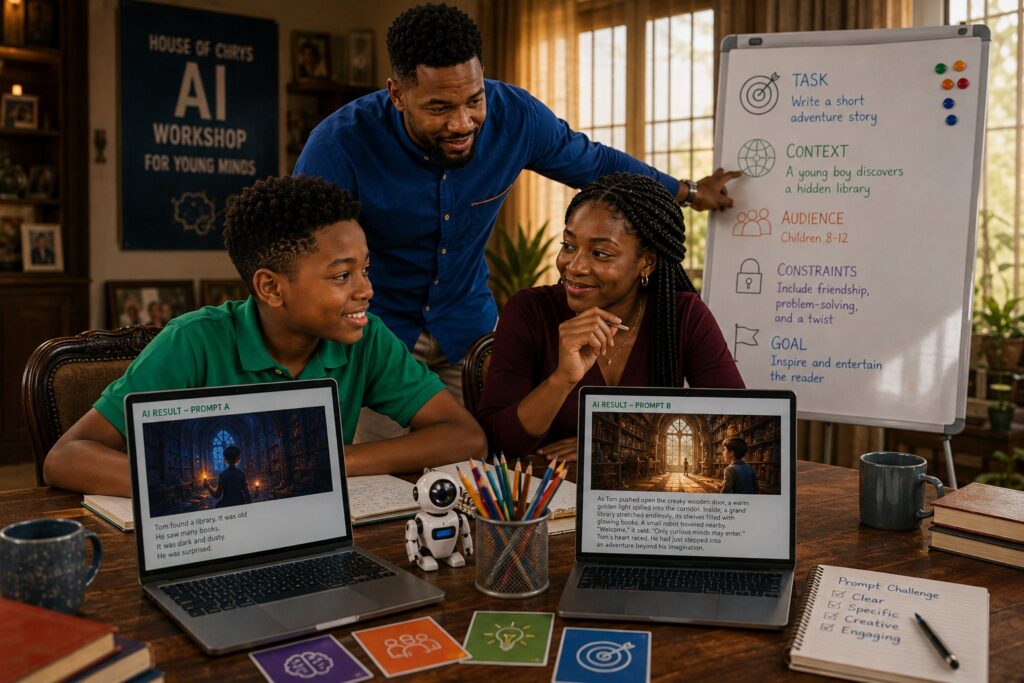
Chrys divided the children into two teams.
Each team received the same challenge:
Ask an AI to create a story about a Nigerian child who discovers a mysterious invention.
The first team typed:
“Write a story about a Nigerian child.”
The second team took a little longer.
Hector typed:
“Write a short adventure story for a 10-year-old Nigerian reader about a curious boy who discovers a strange invention in his grandmother’s old storeroom. Make the story funny, mysterious and exciting, and give the boy a difficult decision at the end.”
The two results appeared on the screen.
The first story was ordinary.
The second had characters, a setting, a problem, a mood and a clear ending.
Hector stared at the difference.
“Why did ours come out better?”
“Because your instruction gave the system more useful information,” Chrys said.
“So that’s prompting?”
“Partly.”
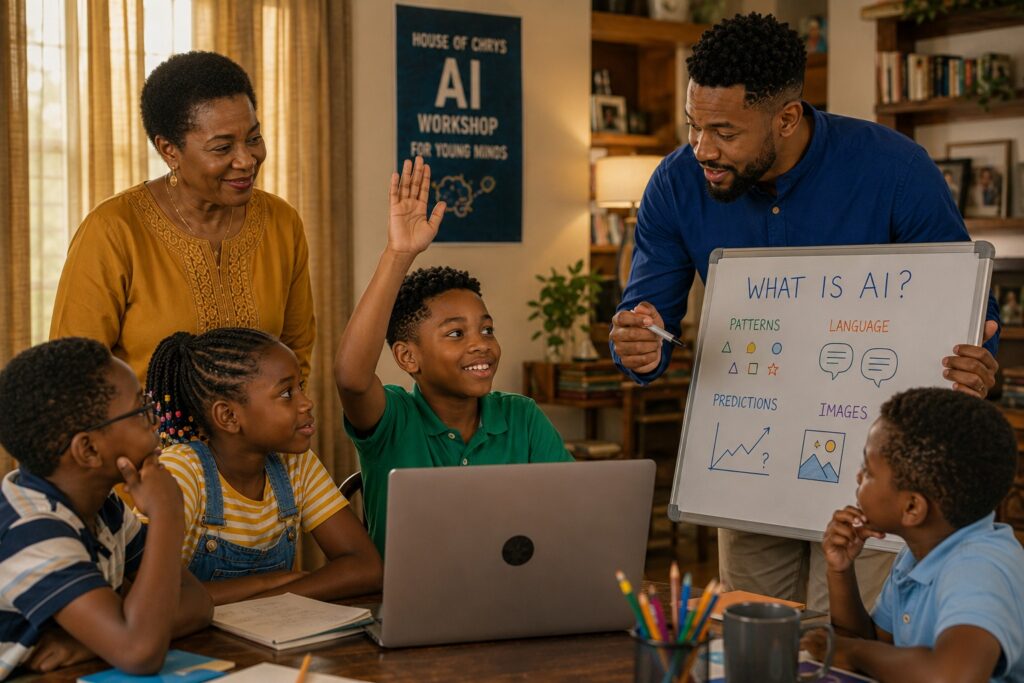
He wrote five words on the board:
TASK
CONTEXT
AUDIENCE
CONSTRAINTS
GOAL
“These aren’t magic words,” Chrys explained. “They’re a way of thinking. When you know exactly what you want, you can give an AI system better instructions.”
Ada nodded.
“And you still have to judge whether the result is actually good.”
“Exactly.”
Hector immediately opened his notebook.
At the top of a fresh page, he wrote:
HOW TO TALK TO A MACHINE WITHOUT TALKING NONSENSE
Mummy Chrys looked over his shoulder.
“That title is already nonsense.”
Hector crossed it out.
3. The Most Important Skill in an AI Workshop for Kids: Check the Answer
This was the moment the workshop changed.
Chrys gave the children a question.
“Which Nigerian city has the largest population?”
The children began arguing.
“Lagos!”
“Abuja!”
“Maybe Kano!”
“Port Harcourt!”
Uncle Emeka slapped the table.
“Obviously Lagos.”
Chrys smiled.
“Ask the AI.”
Hector typed the question.
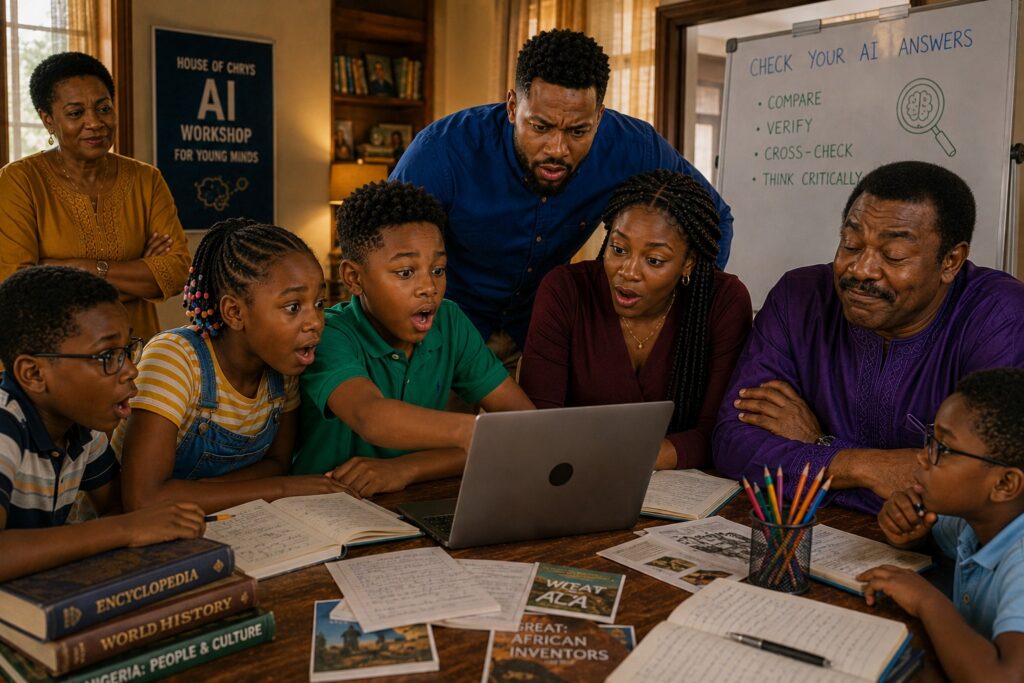
The answer appeared.
Everyone read it.
Then Hector stopped smiling.
“Wait.”
“What?” Ada asked.
“That doesn’t look right.”
Chrys leaned closer.
Hector had noticed that the answer gave a population figure without clearly stating the year or source.
“So what do we do?” Chrys asked.
“Search somewhere else.”
“Why?”
“Because the AI might be wrong.”
Chrys nodded.
That was the point.
The children opened reliable sources and compared the information.
The exercise became unexpectedly competitive.
One child became the “source checker.”
Another became the “question checker.”
Another looked for the date of the information.
Another asked whether the AI had misunderstood the question.
Soon, nobody cared about winning.
They were too busy trying to catch the machine making mistakes.
Mummy Chrys watched from the doorway.
“So this is an AI workshop,” she said.
Chrys nodded.
“No.”
She looked confused.
“It’s an intelligence workshop.”
Hector looked up.
“Because we’re learning to think?”
“Exactly.”
The machine was useful.
But the children were still responsible for the thinking.
This lesson is especially important with generative AI. The U.S. National Institute of Standards and Technology (NIST) describes “confabulation” as AI systems generating and confidently presenting erroneous or false information.
4. AI Should Expand a Child’s Creativity — Not Replace It
After lunch, Chrys placed a strange object on the table.
It looked like a tiny cardboard spaceship.
“Hector made this,” he said.
Hector immediately protested.
“It’s not finished!”
“That’s why we’re going to finish it.”
The children were told to create a fictional Nigerian world.
They could use AI for brainstorming, character ideas, world-building or visual concepts.
But they had one rule:
The final idea had to belong to them.
Hector asked an AI system for ten possible names for his fictional invention.
It produced ten names.
He rejected nine.
“Why?”
“They sound like robot names.”
Uncle Emeka looked offended.
“What is wrong with robot names?”
“They’re boring.”
Uncle Emeka placed a hand over his chest.
“I have been insulted by a ten-year-old.”
Hector eventually chose his own name:
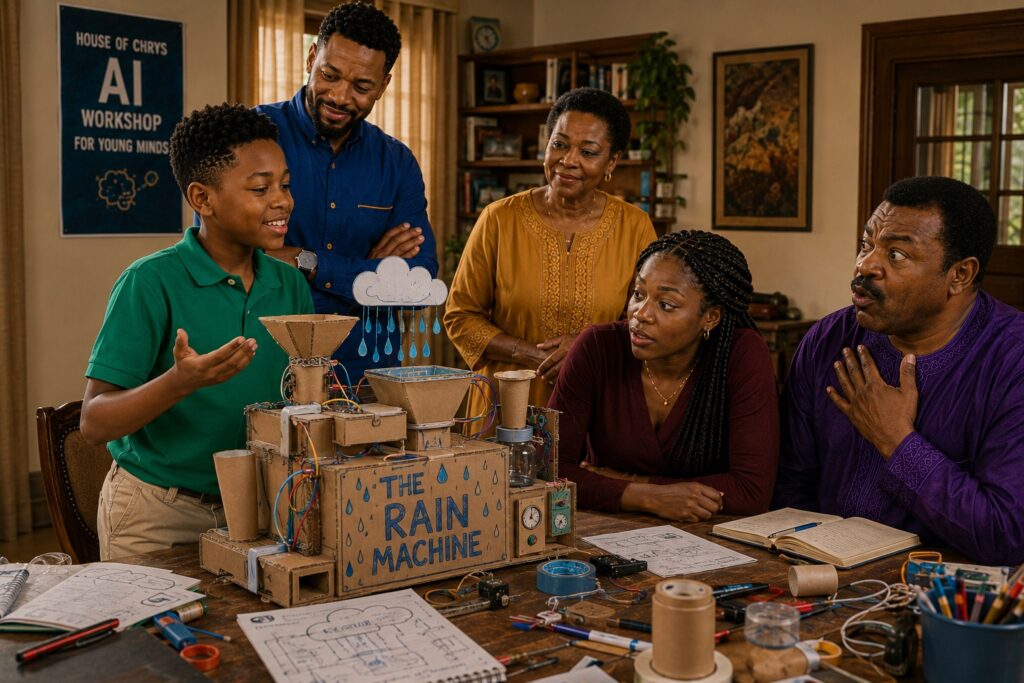
The Rain Machine.
It was a device from his story that could predict when a dangerous storm was coming.
Ada liked the idea.
“But why does it exist?”
Hector thought for a moment.
“To save a village.”
“Then what’s the problem?”
Hector looked at the cardboard machine.
“Maybe the machine is wrong.”
The room went quiet.
Chrys smiled.
There it was.
The story had suddenly become interesting.
The AI hadn’t written that idea for him.
It had helped him explore possibilities.
The child remained the creator.
5. A Good AI Workshop for Kids Must Include Privacy
Later that afternoon, Chrys gave the children another challenge.
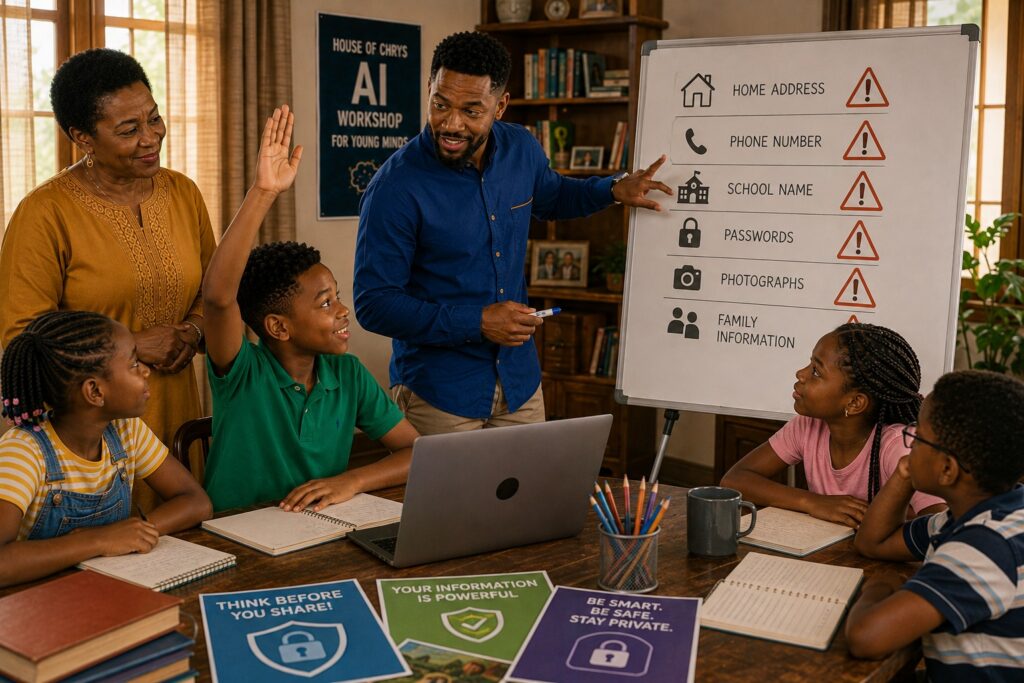
“Imagine an AI assistant asks you for your full name, school, home address, phone number and your family’s daily routine.”
Hector’s hand shot up.
“Don’t give it to them.”
“Why?”
“Because that’s private.”
Mummy Chrys nodded.
“Good.”
Chrys explained that children need to understand that personal information can be sensitive, and AI tools vary in what information they collect and how they use it.
The children began naming things that should make them pause before sharing:
- Home address
- Phone number
- School details
- Passwords
- Private photographs
- Family information
- Information about friends
- Personal problems or sensitive feelings
“Does that mean children should never use AI?” someone asked.
“No,” Chrys said.
“It means children should learn how to use it safely.”
He wrote another sentence on the board:
A useful tool can still require careful boundaries.
Hector copied it into his notebook.
Then he added:
Don’t tell the robot everything.
Mummy Chrys read it.
“Better.”
UNICEF’s current guidance on AI and children specifically highlights children’s safety, data protection and privacy, and recommends teaching children to pause before sharing personal information.
6. Kids Need to Understand That AI Is a Tool, Not a Person
The workshop’s final activity was supposed to be easy.
It wasn’t.
Chrys asked:
“Can an AI be your best friend?”
The room became strangely quiet.
One child said yes.
Another said no.
Hector wasn’t sure.
Uncle Emeka immediately volunteered an opinion.
“Of course it can. My phone understands me better than some human beings.”
Ada laughed.
“That says more about your friends than your phone.”
Chrys didn’t laugh.
Instead, he asked Hector a question.
“If your friend disagrees with you, what happens?”
“We argue.”
“And then?”
“We talk.”
“And if your friend gets upset?”
“I can see it.”
“And if your friend needs help?”
“I can help.”
Chrys nodded.
“Human relationships involve people with feelings, responsibilities, boundaries and real-world consequences. An AI can simulate conversation, but that doesn’t make it a human friend.”
Hector looked at the laptop differently.
“So if it says, ‘I’m sad,’ that doesn’t mean it actually feels sad?”
“Correct.”
The room became silent again.
That distinction mattered.
The children weren’t being told to fear AI.
They were being taught not to confuse a convincing conversation with a human relationship.
UNICEF’s guidance on AI and children also addresses AI companions and recommends that AI systems clearly distinguish themselves from humans when interacting with children.
7. The Workshop Ends With a Challenge: Build Something
By five o’clock, everyone was tired.
Except Hector.
He had been sitting beside the laptop for nearly an hour, drawing something on paper.
“What are you making?” Ada asked.
“A school assistant.”
“For homework?”
“No.”
“For teachers?”
“No.”
“Then what?”
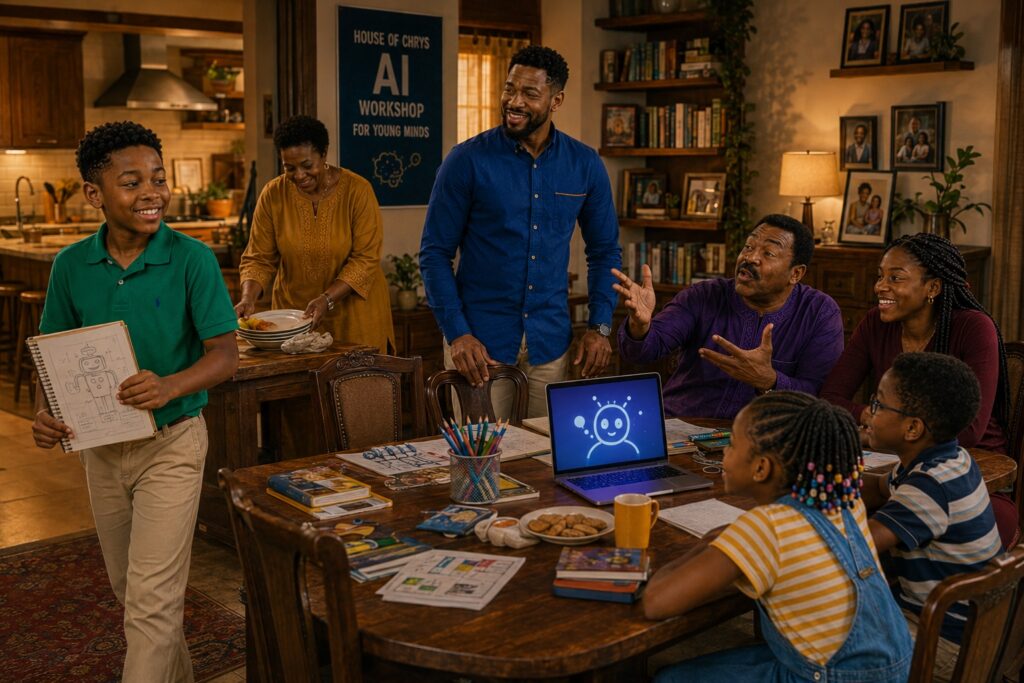
Hector turned the paper around.
It was a rough drawing of an AI-powered learning system designed for children.
It could explain difficult words.
It could create practice questions.
It could help a child brainstorm ideas.
It could tell the child when it was uncertain.
And, most importantly, it had a giant button labelled:
CHECK THIS ANSWER
Chrys stared at the drawing.
“Why did you add that?”
Hector shrugged.
“Because the machine can be wrong.”
Mummy Chrys smiled.
“That is the best thing you learned today.”
Uncle Emeka stood up.
“I have a better idea.”
Everyone looked at him suspiciously.
“We build one that tells me when I’m wrong.”
Ada laughed.
“That machine would never stop.”
Mr. Okoro shook his head.
“Impossible product.”
“Why?”
“Too expensive.”
Everyone laughed.
But Hector wasn’t laughing.
He was looking at his drawing.
He had just realised something.
The workshop hadn’t really been about learning how to use AI.
It had been about learning what not to surrender to AI.
Curiosity.
Judgement.
Creativity.
Privacy.
Responsibility.
Human relationships.
And the ability to say:
“Wait. Let’s check that.”
What Should Kids Actually Learn in an AI Workshop?
The House of Chrys workshop had started with laptops and ended with something much more valuable: a framework for thinking.
Here are the seven lessons parents, teachers and workshop organisers can take from Hector’s experience.
1. Understand what AI actually does
Children should learn that AI systems can recognise patterns, process information, generate content and perform different tasks depending on how they are designed.
They do not need complicated mathematics to begin.
They need a clear mental model.
2. Learn how to prompt
Children can practise giving AI systems instructions that include the task, context, audience, constraints and desired outcome.
The goal isn’t to memorise “perfect prompts.”
The goal is to learn how to communicate clearly.
3. Verify AI-generated information
This may be one of the most important lessons.
AI can produce inaccurate information. Children should learn to question claims, check sources, compare information and recognise uncertainty.
4. Use AI to support creativity
AI can help children brainstorm, explore possibilities, create drafts and experiment with ideas.
But children should still make decisions, develop their own ideas and evaluate what the AI produces.
5. Protect personal information
An AI workshop for kids should include practical conversations about privacy.
Children need to understand that not every question belongs in a chatbot.
6. Understand the difference between AI and people
Children should know that a conversational AI system can produce human-like language without being a human being.
That distinction becomes increasingly important as AI systems become more conversational.
7. Build something
The best workshop should eventually move from:
“What can AI do?”
to:
“What can I create with it?”
Children can design a story, game, educational tool, robot concept, research project, animation idea or simple AI-assisted invention.
The objective is to move children from passive consumers to thoughtful creators.
UNESCO’s framework similarly emphasises progression from Understand to Apply to Create, alongside human-centred thinking, ethics, AI techniques and AI system design.
How to Run Your Own AI Workshop for Kids
You don’t need a futuristic laboratory.
A small classroom, library, community centre, school computer room or even a living room can work.
A simple workshop could look like this:
| Session | Activity | Skill |
|---|---|---|
| 1 | “What do you think AI is?” | Curiosity |
| 2 | AI demonstrations | AI literacy |
| 3 | Prompt challenge | Communication |
| 4 | Find the AI mistake | Critical thinking |
| 5 | Privacy game | Digital safety |
| 6 | Create with AI | Creativity |
| 7 | Build a mini project | Problem-solving |
For younger children, the activities should be visual, conversational and hands-on.
For older children, the workshop can gradually introduce concepts such as datasets, machine learning, algorithms, bias, generative AI, AI ethics and simple AI system design.
The point is not to turn every child into an AI engineer.
The point is to make sure children grow up understanding the technology that increasingly surrounds them.
What Parents Should Look For in an AI Workshop for Kids
Not every workshop deserves the label “AI education.”
A good AI workshop for kids should not simply give children access to a chatbot and tell them to generate pictures.
Look for a programme that includes:
- Age-appropriate explanations
- Hands-on activities
- Critical thinking
- Fact-checking
- Privacy and safety
- Creativity
- Responsible AI use
- Human judgement
- Opportunities to build or create
And there is an important reason for this broader approach.
UNESCO’s AI Competency Framework for Students identifies competencies across four dimensions: a human-centred mindset, ethics of AI, AI techniques and applications, and AI system design. It also describes progression through Understand, Apply and Create.
UNICEF’s Guidance on AI and Children likewise emphasises children’s safety, privacy, transparency, inclusion and preparation for an AI-shaped future.
That is a useful way to think about AI education.
Children shouldn’t merely learn what AI is.
They should gradually learn how to understand it, use it, question it and create with it.
The House of Chrys Rule
By the time the children packed away the laptops, Hector had written one final sentence on the workshop board.
Chrys read it aloud.
“Don’t let artificial intelligence become a substitute for your own intelligence.”
Mummy Chrys nodded.
“Keep that one.”
Hector picked up his notebook.
“Can we have another workshop next Saturday?”
Chrys smiled.
“Perhaps.”
Uncle Emeka immediately stood up.
“I will teach the next one.”
Everyone shouted:
“No!”
He looked offended.
“I know plenty about AI.”
Ada raised an eyebrow.
“You asked it yesterday whether your phone charger was a vegetable.”
Uncle Emeka pointed at her.
“It was a complicated question.”
Hector laughed all the way to the kitchen.
And somewhere on the dining table, the laptop screen was still glowing.
Waiting for the next question.
Final Takeaway
An AI workshop for kids should not be a competition to see which child can make an AI generate the fanciest picture or write the longest essay.
The real achievement is much simpler.
A child sees an AI answer and asks:
“How do we know that’s true?”
A child sees a blank screen and thinks:
“What could I build?”
A child is asked for private information and knows:
“I shouldn’t share that.”
And a child uses AI without forgetting how to think independently.
That is when an AI workshop becomes something worth having.