
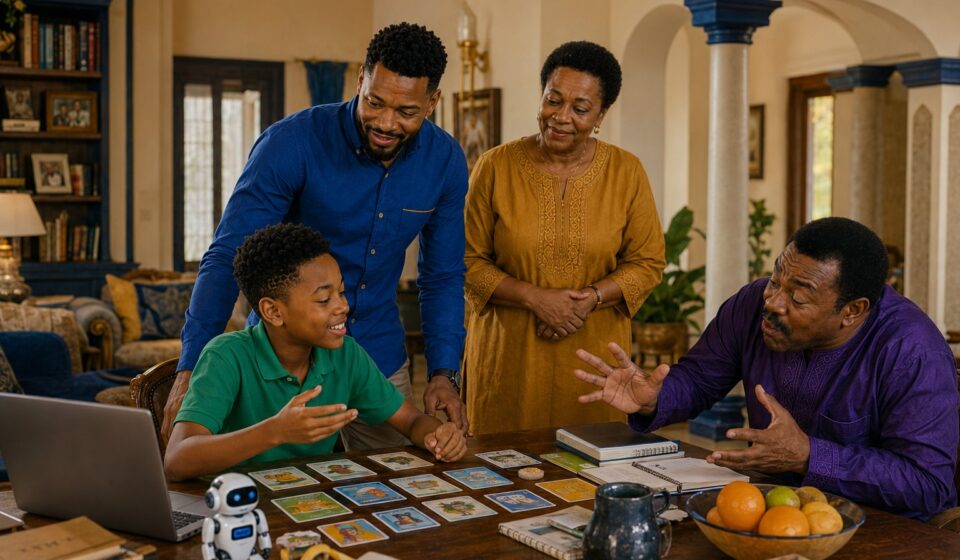

“Don’t press the button.”
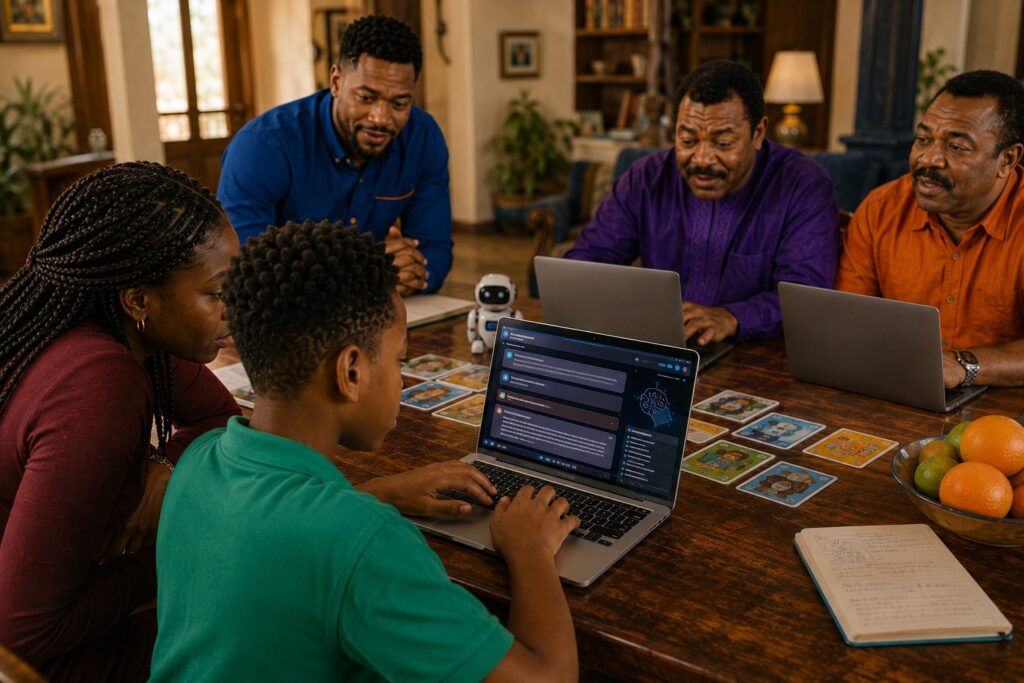
Hector’s finger stopped approximately one centimetre above the laptop.
He looked at Chrys.
“Why?”
“Because you don’t know what it does.”
Uncle Emeka leaned across the table.
“Press it.”
Mummy Chrys immediately turned around.
“Don’t encourage him.”
“But what if the button contains knowledge?”
“What if it contains trouble?”
Uncle Emeka considered this.
“Knowledge sometimes contains trouble.”
Hector grinned.
Saturday had begun quietly at the House of Chrys.
It was no longer quiet.
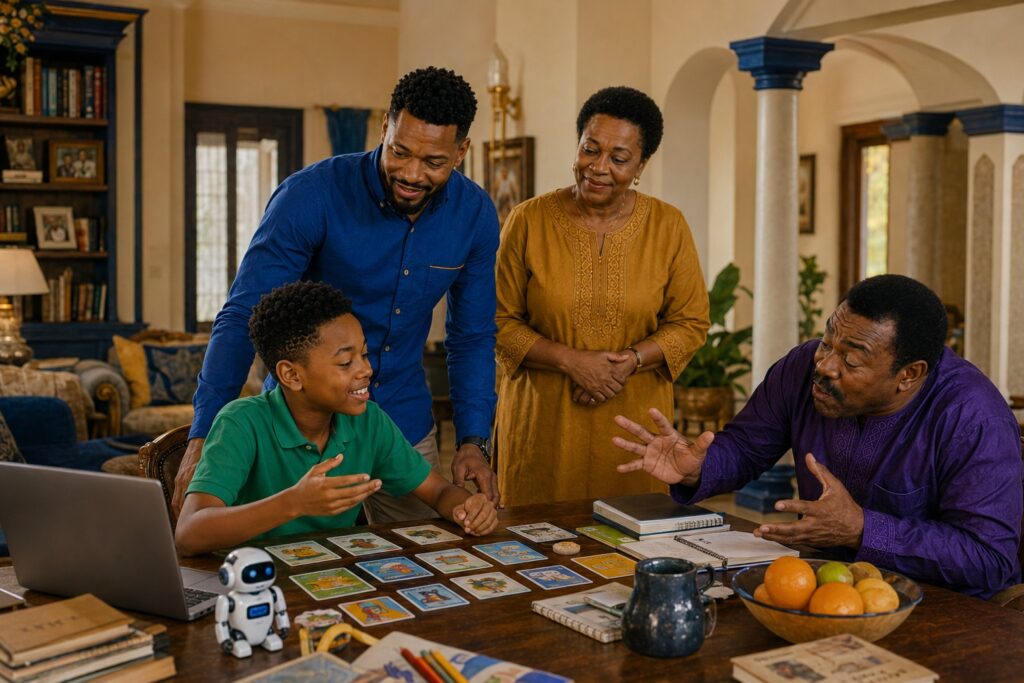
The dining table had become a battlefield of notebooks, coloured cards, toy robots, oranges, pencils and laptops.
And Chrys had announced something that Hector had been waiting to hear all morning.
They were going to play.
Not football.
Not video games.
Not hide-and-seek.
They were going to play AI games.
More specifically, Chrys had promised to show Hector what made an AI game for kids different from simply handing a child a chatbot and telling them to ask questions.
“Today,” Chrys said, “you are not going to learn AI by memorising definitions.”
Hector leaned forward.
“How, then?”
“By trying to beat it.”
Uncle Emeka pulled up a chair.
“Now this is education.”
Why AI Games Can Teach More Than a Lecture
Chrys placed seven coloured cards on the table.
“Here’s the problem,” he said. “When adults hear the words artificial intelligence, they often want to explain everything.”
“What’s wrong with that?” Hector asked.
“Nothing.”
Chrys picked up the first card.
“But children don’t always learn best by listening.”
He placed the card down.
“They learn by doing.”
An AI game for kids can turn abstract ideas such as patterns, prediction, classification, prompting, creativity and verification into something a child can actually experience.
Instead of saying:
“AI systems identify patterns in data.”
You can give a child a collection of pictures and ask:
“Can you figure out the rule?”
Instead of saying:
“AI can make mistakes.”
You can let a child catch the machine making one.
Instead of telling a child:
“You should verify information.”
You can turn verification into a competition.
That was exactly what Chrys had planned.
Game 1: Guess the Pattern
Chrys put three oranges on the table.
Then three bananas.
Then three apples.
Hector looked confused.
“What’s the game?”
“I’m thinking of a rule.”
Hector narrowed his eyes.
“Okay.”
Chrys pointed at the fruits.
“Guess what comes next.”
Hector stared.
“Orange?”
“No.”
“Banana?”
“No.”
“Apple?”
“No.”
Uncle Emeka raised his hand.
“Pineapple.”
Chrys shook his head.
“Why would it be pineapple?”
“Because pineapple deserves representation.”
Hector laughed.
Chrys rearranged the cards.
This time, the objects followed a hidden pattern.
Hector studied them.
Then his eyes widened.
“I know!”
He explained the rule.
Chrys nodded.
“Correct.”
The game looked simple.
But Hector had just practised something fundamental to AI: pattern recognition.
Many AI systems work by finding patterns in data and using those patterns to produce predictions or outputs.
Children don’t need advanced mathematics to begin understanding the basic idea.
They can start with games.
Sort objects.
Find sequences.
Identify similarities.
Spot differences.
Predict what comes next.
Then ask:
“What information helped you make that prediction?”
That final question is where the game becomes an AI lesson.
Game 2: Human or AI?
Chrys opened his laptop.
“Now we’re making things harder.”
He read two short descriptions of an imaginary animal.
One had been written by Hector.
The other had been generated with AI.
“Which one was written by the machine?”
Hector studied both.
“This one.”
“Why?”
“It sounds too perfect.”
Uncle Emeka objected.
“I also sound perfect.”
Nobody looked at him.
Hector eventually chose an answer.
Chrys revealed the result.
He was wrong.
Hector stared at the screen.
“What?”
“You guessed incorrectly.”
“But I was sure.”
“That,” Chrys said, “is the point.”
An AI game for kids should sometimes make the child uncomfortable.
Not frightened.
Just uncertain.
The goal is to teach them that humans can make mistakes when judging AI—and AI can make mistakes when judging humans.
The game can be extended.
Show children:
- A human-written story
- An AI-assisted story
- An AI-generated picture
- A photograph
- A chatbot response
- A deliberately incorrect AI answer
Then ask them to investigate.
Don’t reward guessing alone.
Reward evidence.
Game 3: Beat the AI at Fact-Checking
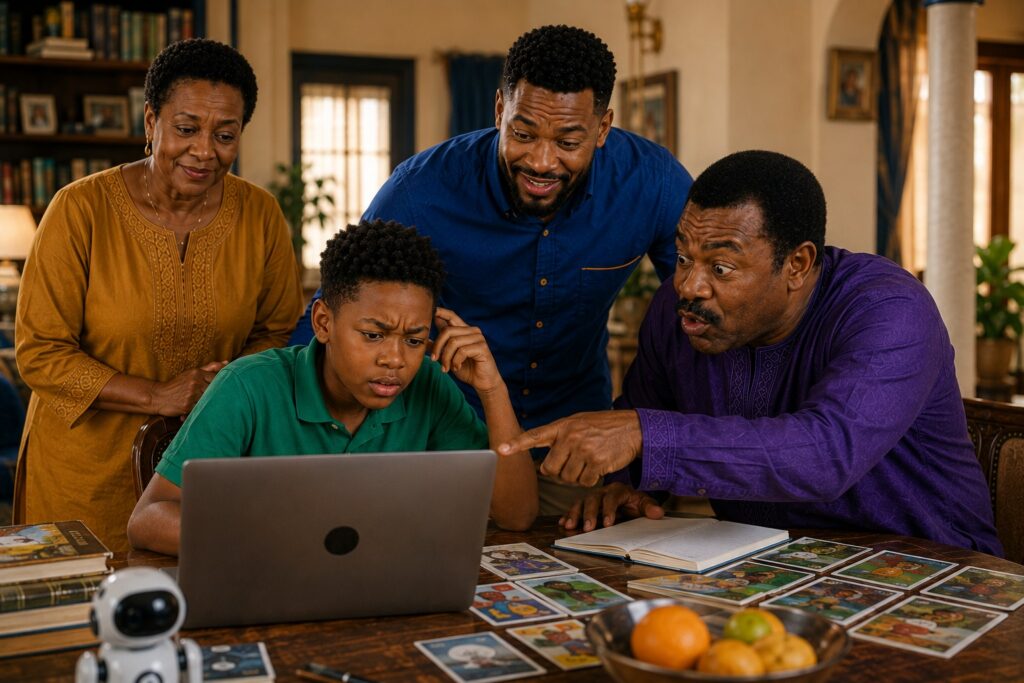
This was Hector’s favourite.
Chrys called it:
“Catch the Machine.”
The rules were simple.
The AI would make five statements.
Hector had to determine which were correct, which were questionable and which required further research.
“For every mistake you catch,” Chrys explained, “you get a point.”
“And if I miss one?”
“The machine gets the point.”
Hector sat upright.
“Let’s play.”
The first statement appeared.
Correct.
Second.
Correct.
Third.
Hector stopped.
“That’s suspicious.”
“Why?”
“It gives a number but doesn’t tell me where the number came from.”
Chrys smiled.
“Point.”
The game continued.
Soon Hector wasn’t merely asking whether an answer looked correct.
He was asking:
Who says this?
When was this information published?
What is the source?
Can another reliable source confirm it?
This is one of the most useful ways to design an AI game for kids.
Don’t make the objective:
“Can you get the right answer?”
Make the objective:
“Can you prove that the answer is right?”
That is a much more powerful skill.
Game 4: Build-a-Prompt Challenge
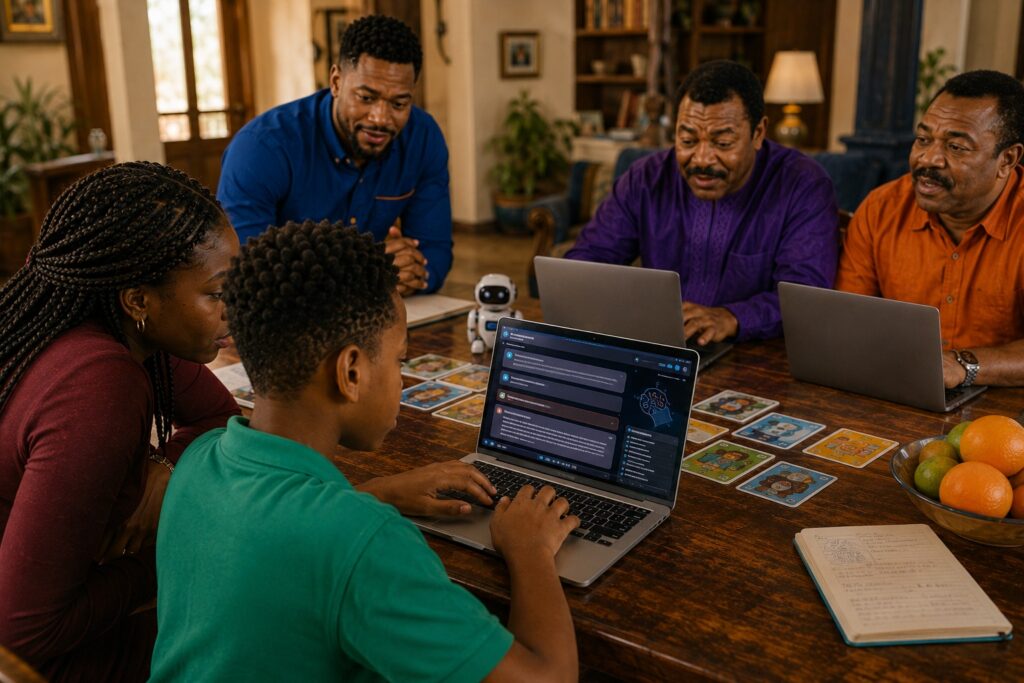
After lunch, Chrys divided the family into teams.
Hector and Ada were Team One.
Uncle Emeka and Mr. Okoro were Team Two.
Mummy Chrys refused to participate.
“I know how this ends.”
Chrys gave each team the same task:
Ask an AI system to create an exciting story about a Nigerian child who discovers something strange at school.
Team One began.
Hector typed a detailed prompt.
Uncle Emeka typed:
“Tell a good story.”
Ada looked at him.
“That is your entire prompt?”
“Yes.”
“That’s terrible.”
“It is concise.”
“It is vague.”
“It is elegant.”
“It is useless.”
Mr. Okoro nodded thoughtfully.
“I think the boy has a point.”
Uncle Emeka looked betrayed.
The results came back.
Team One’s story was much closer to what they wanted.
Hector had specified:
- The age of the main character
- The setting
- The genre
- The tone
- The central problem
- The audience
- The desired ending
Chrys pointed at the two results.
“This is the lesson.”
A good prompt doesn’t guarantee a perfect answer.
But clear instructions give an AI system better information about what you’re trying to accomplish.
And turning prompting into a game makes the concept much easier for children to remember.
Game 5: Create a Story With AI—But Keep the Best Idea
Chrys gave Hector another challenge.
“Create a story with AI.”
Hector immediately opened the laptop.
“What kind?”
“Your choice.”
Hector thought.
Then he said:
“A Nigerian boy discovers that the old radio in his grandmother’s house can predict tomorrow’s weather.”
Uncle Emeka looked impressed.
“That is actually good.”
“Thank you.”
“I didn’t say it was that good.”
Hector used AI to brainstorm characters and possible twists.
The AI produced several suggestions.
Some were interesting.
Some were boring.
One was ridiculous.
Hector rejected most of them.
Then he found an idea he liked.
He changed it.
Made it stranger.
Made it funnier.
Then he wrote his own ending.
Chrys watched quietly.
This was exactly what he wanted.
The AI had not replaced Hector’s imagination.
It had become a creative sparring partner.
That’s an important distinction.
A good AI game for kids should leave room for the child to disagree with the machine.
If every game rewards children for accepting the AI’s answer, children can accidentally learn the wrong lesson.
The machine should not always win.
Sometimes the child should say:
“No. I have a better idea.”
Game 6: The AI Detective
Mummy Chrys entered the room carrying a small box.
“What’s that?”
“Your next game.”
Inside were cards containing strange claims.
One said an imaginary animal could breathe underwater.
Another claimed a particular food could make somebody invisible.
Another claimed a famous invention was created hundreds of years before it actually existed.
Hector laughed.
“These are obviously fake.”
Mummy Chrys raised an eyebrow.
“Are you sure?”
Hector stopped.
“Okay.”
She smiled.
“That’s the game.”
The AI Detective challenge works differently from ordinary trivia.
The child isn’t rewarded for knowing everything.
The child is rewarded for knowing when they don’t know.
For each claim, the child must choose:
TRUE
FALSE
or
INVESTIGATE
That third option is the important one.
Children are often taught that intelligence means knowing the answer.
But in research, science and technology, recognising uncertainty is a strength.
Sometimes the smartest answer is:
“I don’t know yet.”
Then the child investigates.
They search reliable sources.
They compare evidence.
They explain their conclusion.
The game therefore teaches something much bigger than AI.
It teaches intellectual humility.
Game 7: Design Your Own AI Game
By evening, Hector had stopped playing.
He had started designing.
Chrys noticed.
“What are you doing?”
“Making my own game.”
“What kind?”
Hector turned the notebook around.
He had drawn a small robot.
Beside it were three boxes:
QUESTION
AI ANSWER
CHECK
Hector explained the rules.
The player asks an AI system a question.
The AI produces an answer.
Then the player has to decide whether to:
- Accept it
- Challenge it
- Investigate it
- Improve the question
Chrys stared at the drawing.
“You’ve basically turned everything we learned today into one game.”
Hector smiled.
“Can I call it Beat the Bot?”
Uncle Emeka immediately objected.
“No.”
“Why?”
“Because I intend to beat the bot.”
“So?”
“The bot should know who defeated it.”
Mummy Chrys laughed.
Hector went back to his drawing.
7 AI Games for Kids You Can Try at Home
You don’t need to recreate the entire House of Chrys dining room.
Here are seven simple ideas parents, teachers and educators can adapt.
1. Pattern Detective
Give children pictures, objects, numbers or shapes and ask them to identify patterns and predict what comes next.
AI concept: Pattern recognition.
2. Human or AI?
Give children different pieces of writing, images or answers and challenge them to investigate whether they were created or assisted by AI.
AI concept: AI-generated content and critical thinking.
3. Catch the Mistake
Let an AI produce several answers and challenge children to identify errors.
AI concept: AI limitations and hallucinations.
4. Prompt Battle
Give two teams the same task and let them compete to create the most useful prompt.
AI concept: Prompting and precise communication.
5. AI Story Lab
Let children use AI for brainstorming while requiring them to make the final creative decisions.
AI concept: Human-AI collaboration.
6. AI Detective
Give children claims and allow them to choose between true, false or investigate.
AI concept: Verification and information literacy.
7. Build the Game
Ask children to invent their own AI-related game.
AI concept: AI system design and creative problem-solving.
How to Make an AI Game for Kids Actually Educational
There is a trap here.
It is easy to make something entertaining and call it educational.
But an effective AI game for kids should have a learning objective underneath the fun.
Before creating a game, ask:
What should the child understand afterward?
For example:
Game: Catch the Mistake
Learning objective: AI can produce incorrect information.
Game: Prompt Battle
Learning objective: Specific instructions can improve an AI response.
Game: AI Detective
Learning objective: Important information should be investigated.
Game: Pattern Detective
Learning objective: Patterns can be used to make predictions.
The game is the vehicle.
The thinking is the destination.
What Parents Should Avoid
An AI game should not encourage children to treat AI as an unquestionable authority.
Avoid games where:
- The AI is always portrayed as correct.
- Children are rewarded simply for copying AI answers.
- Personal information is used casually.
- Children are encouraged to interact with AI without age-appropriate supervision.
- Creativity becomes nothing more than generating content.
- The technology becomes more important than the child.
The strongest games make children more capable without the AI, not less capable without it.
That is the real test.
The Final Challenge
The sun had disappeared behind the windows of the House of Chrys.
The laptops were closed.
The cards were stacked.
The oranges were almost finished.
Hector looked at Chrys.
“Who won?”
Chrys thought about it.
“The AI?”
Hector frowned.
“No.”
“Uncle Emeka?”
“Definitely not.”
“Then who?”
Chrys pointed at Hector’s notebook.
“You.”
Hector smiled.
“But I didn’t win every game.”
“You didn’t have to.”
Chrys picked up one of the cards.
“Today you learned something more important than how to win.”
“What?”
“How to question the game.”
Hector looked at the laptop.
Then at his notebook.
Then at the little robot he had drawn.
“So the best AI game for kids isn’t the one where the computer wins?”
Chrys smiled.
“No.”
“Then what is it?”
“The one that makes the child think harder.”
Hector nodded.
Uncle Emeka stood up.
“Excellent. Tomorrow, we play football.”
Hector laughed.
“Can AI play football?”
Uncle Emeka froze.
Everyone looked at him.
He slowly sat back down.
“That’s a conversation for tomorrow.”
And somewhere inside the House of Chrys, Hector’s little notebook remained open.
The robot on the page was still waiting for its first game.
Frequently Asked Questions About AI Games for Kids
What is an AI game for kids?
An AI game for kids is an age-appropriate activity that uses games, puzzles, challenges or creative tasks to help children understand artificial intelligence and related skills such as pattern recognition, prompting, critical thinking, creativity and fact-checking.
What is a good AI game for kids?
Good options include pattern-recognition games, AI fact-checking challenges, prompt competitions, human-versus-AI guessing games, AI detective games and creative projects where children use AI as a tool rather than allowing it to make every decision.
Can kids learn AI through games?
Yes. Games can make abstract concepts easier to understand because children can experiment with ideas rather than simply memorising definitions. A pattern game, for example, can introduce the basic idea of finding patterns without requiring a child to understand the mathematics behind machine learning.
Are AI games suitable for young children?
They can be, provided the activity is age-appropriate and designed with safety and privacy in mind. Younger children can focus on patterns, instructions, creativity and simple verification, while older children can explore concepts such as bias, data, algorithms and AI ethics.
Do children need to use an AI chatbot to play AI games?
No. Some of the best AI learning games require no AI tool at all. Pattern games, classification games, prediction challenges and detective activities can teach foundational ideas before children ever interact with an AI system.
The House of Chrys Lesson
The children of the future will grow up surrounded by intelligent machines.
They will ask machines questions.
They will build things with machines.
They will learn from machines.
And sometimes, inevitably, they will believe machines.
That is why the goal of an AI game for kids should not simply be to make artificial intelligence entertaining.
The deeper goal is to make thinking entertaining.
Because if a child learns to recognise patterns, question answers, investigate claims, protect their privacy, communicate clearly, create original ideas and admit uncertainty, they have learned something far more valuable than how to use one particular AI tool.
They have learned how to remain intellectually independent.
And that may be the most important game of all.